


Faiz Ahmad Faiz: When romanticism weaved into revolution

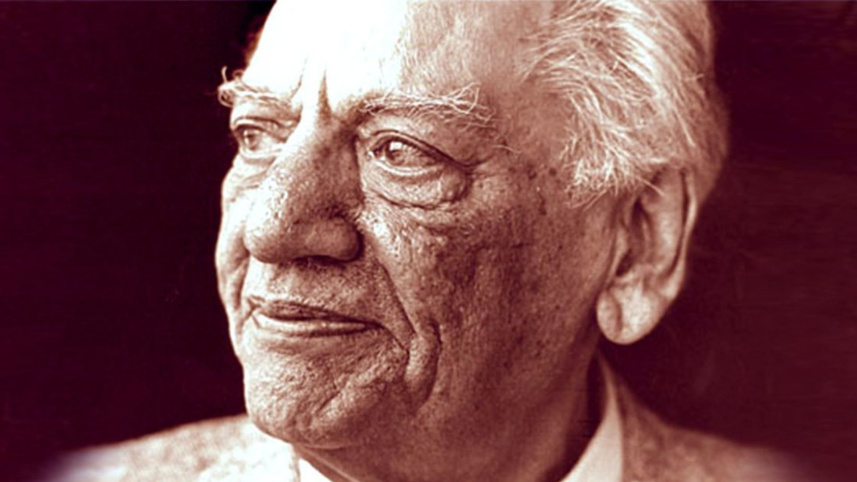
Faiz Ahmad Faiz was a poet by passion, a journalist and army officer by profession, and a Marxist communist by ideology, whose poetry masterfully blends personal longing with political defiance.
There are poets who describe the world as it is, and others who dream it as it ought to be. Faiz, with disarming composure, accomplished both.

Classical cadences of Urdu lyricism found in him a modern conscience. His verse did not simply rhyme. It resonated, ricocheted and, when required, rebelled.
Born on February 13, 1911 in Sialkot, then part of undivided Punjab under the British Raj, Faiz grew up in an atmosphere steeped in Persian refinement, Arabic scholarship and Urdu eloquence.
He later entered Government College Lahore, where English Romanticism conversed with Eastern metaphysics across his reading desk. Shelley and Keats shared shelf space with Ghalib.
But Faiz would inherit the metaphors of roses and nightingales, yet press them into the service of a bruised century.
Making of a revolutionary aesthete
Faiz did not hover above politics like a perfumed abstraction.
He joined the Progressive Writers’ Movement, which sought to yoke art to social transformation. He edited newspapers, served in the British Indian Army during the WWII, and soon became a prominent intellectual voice in the nascent state of Pakistan.
Faiz’s devotion to words was not merely aesthetic; it was existential.
In his poem Aaj Ek Harf Ko Phir Dhoondta Phirta Hain Kheyal, he captures the restless pursuit of expression itself.
The poem celebrates the elusive nature of expression, where every word is precious, every pause pregnant with meaning.
Faiz transformed the act of writing into a journey, a wandering through shadow and illumination, a constant negotiation between what is felt and what can be uttered.
In 1951, he was arrested in connection with the Rawalpindi Conspiracy Case, accused of involvement in a purported coup against the government of Liaquat Ali Khan. Four years in prison followed.
For many, incarceration erodes language into silence. For Faiz, it distilled it. From his cell emerged poems later gathered in Dast-e-Saba and Zindan-Nama.
The bars could circumscribe his body; they could not incarcerate his idiom.
Sorrow in these poems acquires tensile strength. Separation becomes solidarity.
Personal longing is sublimated into collective yearning.
Love reimagined, romance repurposed
No poem illustrates his alchemy more luminously than Mujh Se Pehli Si Mohabbat Mere Mehboob Na Maang:
 For all latest news, follow The Daily Star's Google News channel.
 “Aur Bhi Dukh Hain Zamane Mein Mohabbat Ke Siwa
Raahatein Aur Bhi Hain Vasl Ki Raahat Ke Siwa”
[There are other sorrows in this world than those of love,
There are other comforts than the solace of union.]
Here, the beloved is neither discarded nor dethroned but gently repositioned. The gaze that once lingered upon a single luminous face widens to encompass hunger, labour, humiliation. Romance is not abandoned; it is democratised.
In Faiz’s lexicon, eros evolves into ethos.
Partition’s trauma left a wound that poetry alone could probe.
In Subh-e-Azadi, he wrote the lines that have since become shorthand for betrayed promises across South Asia:
“Yeh Daagh Daagh Ujaala, Yeh Shab-Gazida Sahar
Woh Intezaar Tha Jis Ka, Yeh Woh Sahar To Nahin”
[This stained light, this night-bitten dawn,
This is not the dawn we had awaited.]
Independence had arrived, but freighted with blood and displacement. The dawn was real, yet blemished. What gives the poem its enduring authority is tonal restraint. It does not howl; it registers. It does not renounce hope; it refuses complacency. Disillusionment is articulated without surrendering to despair.
An exiled voice of global conscience
Faiz Ahmad Faiz’s conscience was not confined to borders, yet history occasionally placed him at painful moral crossroads.
In 1974, following his return from the newly independent Bangladesh, he composed Hum Ke Thehre Ajnabi -- a work suffused with regret and quiet heartbreak. The opening lines resonate with the ache of estrangement:
“Hum Keh Thehre Ajnabi Itni Madaaraton Ke Baad,
Phir Banenge Aashnaa Kitni Mulaaqaaton Ke Baad?”
[We remained strangers after so many intimacies,
How many meetings must pass before we become familiar again?]
He had visited Bangladesh for the first and only time alongside then Pakistani Prime Minister Zulfikar Ali Bhutto, arriving as part of a Pakistani mission with cultural advisory duties. He expected warmth, or at least recognition, from his literary peers.
Instead, he encountered a resolute cold shoulder. Friends and fellow writers refused to meet him, mourning his silence during the 1971 atrocities -- the massacre of students, intellectuals, and revolutionaries, including admirers of Faiz such as Munier Choudhury and Shahidullah Kaiser.
The visit left Faiz heartbroken.
Hum Ke Thehre Ajnabi stands as a testament to his enduring honesty: even amidst his own disillusionment, he found the language to mourn, to question, and to humanise the separation of a people from the poet they once knew.
During periods of repression under General Zia-ul-Haq, Faiz spent years abroad in Beirut and London. Exile enlarged rather than diminished him.
In Beirut, as editor of the journal Lotus, he aligned Urdu lyricism with anti-colonial solidarities.
In 1962, he received the Lenin Peace Prize, affirming his stature beyond the subcontinent.
Yet the laurels never hardened into self-importance. His poetry remained intimate even when it addressed the globe.
The anthem that would not be silenced
If one poem secured his immortality in public memory, it is Hum Dekhenge, written in 1979.
“Lazim Hai Ke Hum Bhi Dekhenge
Woh Din Ke Jis Ka Waada Hain”
[Surely we too shall witness
That day which has been promised.]
With Quranic cadence and insurgent imagery of thrones toppled and crowns cast aside, the poem moved from page to public square.
Sung defiantly by Iqbal Bano, it became an anthem of moral inevitability.
Justice in Faiz is not a partisan slogan; it is a cosmic assurance. Tyranny appears not merely unjust but transient.
Craft, code and quiet subversion
Technically, Faiz remained loyal to the architecture of the classical ghazal.
He preserved radif and qafia, retained the imagery of gul, saqi, sharaab and maikada.
Yet beneath this ornamental continuity lay semantic insurgency. The rose often signified the fragile citizen. The cupbearer heralded awakening. The tavern became a republic of equals.
This coded elasticity allowed his verse to circulate between mushaira and manifesto. It could be admired for aesthetic finesse or invoked for political courage.
Few poets have sustained such dual legibility with comparable grace.
The afterlife of a voice
When Faiz died on November 20, 1984 in Lahore, the world mourned more than a poet.
Yet death has proved an inadequate custodian of his relevance. In moments of turbulence, his lines surface like embers stirred by wind. Students chant them. Protesters inscribe them. Singers resurrect them.
“Bol Ke Lab Azaad Hain Tere”
[Speak, for your lips are free]
The imperative endures because it is dignified rather than shrill.
Faiz demonstrated that beauty and resistance are not antagonists but allies.
That lyricism need not be anaemic. That a couplet may carry both the fragrance of roses and the fumes of revolt.
His bequest is neither dogma nor nostalgia. It is a register of poised defiance. In an age fatigued by noise, his voice remains measured yet unyielding, intimate yet insurgent.
The dawn he imagined may still be contested, still deferred.
But through his verse it continues to glimmer on the horizon, stubborn and serene, awaiting its unblemished arrival.
Comments