


The menstruating body and the making of ‘womanhood’ in literature
There is an age when “shorir kharap” stops meaning what it once meant. Before that, the phrase belongs to fever, stomachache, the heavy-eyed tiredness of a school day spent under a slow fan. Then one afternoon, it turns into a red stain where no wound can be found, a bathroom door shut more carefully than before, a piece of cloth or pad folded and carried into secrecy. The body has done something that it is meant to—something ordinary—but the words around it begin to behave as though ordinariness itself must be managed.
This is a contradiction that literature understands better than reassurance often does. To say menstruation is natural is true, but it is also an incomplete sentiment. Natural things can be made humiliating, they can be romanticised, or turned into proof of something larger than the natural phenomena itself. A stain appears on a cloth, but its meaning reverberates across rooms.

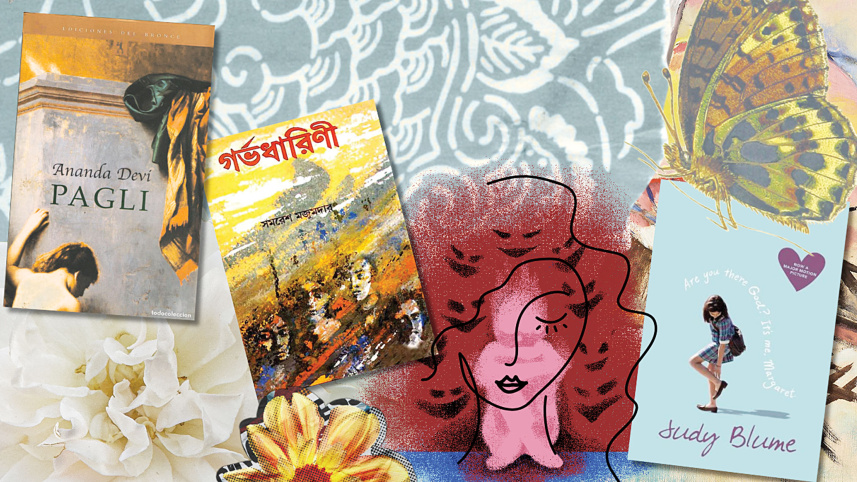
In Judy Blume’s Are You There God? It’s Me, Margaret. (Bradbury Press, 1970), Margaret learns to treat her body as evidence before it has even changed. Having newly moved to a New Jersey suburb, she falls in with girls whose secret club revolves around bras, boys, and periods. Nancy’s casual “Oh, you’re still flat” sounds like childish teasing, but puberty soon becomes something almost examinable. The girls exchange information adults have not yet given them and, in doing so, begin measuring one another with the same anxiety they are trying to escape. Laura Danker, who develops early, is sexualised and ridiculed. Nancy later lies about having started her period. There seems to be no safe speed for becoming a girl.
The novel does not leave Joyita passively trapped inside that fear. When she finally tells Anondo, he refuses to make the disclosure as enormous as she has feared. He treats menstruation as an ordinary bodily problem and has already arranged what she might need. “Chhele bolei bhebe eshechhish atodin, bondhu bole nite parishni” (“You kept thinking of me as a boy. You could not trust me simply as a friend”). The reversal is easy to miss.
Margaret wants the relief of no longer being behind. Her body has become a deadline without anyone needing to announce one. That anxiety runs beside another uncertainty in the novel. Raised between Judaism and Christianity, Margaret spends much of the story trying to work out where she belongs. Religion refuses to give her a clear answer. Puberty seems to promise one. She may not know what kind of believer she is, but perhaps blood can at least certify that she belongs among the girls.
When her period finally comes, Margaret tells her mother that she has been “practising in my room for two months.” The line is comic only until we ask what she has been practising. Menstruation itself cannot be rehearsed. What Margaret has rehearsed is its management. After putting on the pad, she studies herself in the mirror and wonders whether anyone will know her “secret”. She has spent months waiting for proof that she belongs, only to discover that belonging requires her to hide the proof.
Shashi Deshpande’s The Dark Holds No Terrors (first published in 1980) turns this longing inside out. Saru remembers the days of menstruation when she cannot enter the kitchen, sleeps separately and eats from her own cup and plate because her touch is treated as “pollution.” Yet she says these restrictions are not even the worst part. Worse is the “kind of shame” that engulfs her and places her “in the same class as my mother.” When her mother tells her, “You’re a woman now,” Saru’s inward answer is brutal. “If you’re a woman, I don’t want to be one.”
Margaret waits for her period because she fears remaining outside the circle of girlhood. Saru reaches the same threshold only to find that womanhood has been arranged as exile. Their experiences seem opposite, yet both reveal the same unsettling fact. Menstruation does not arrive first and acquire meaning later; the meaning is already waiting. And often it comes through women themselves, through Nancy’s gossip or Saru’s mother enforcing household rules. This is not evidence that women created the systems that hurt them. A system is hardest to recognise when it no longer looks like one.
Gorbhodharini (1987) by Samaresh Majumdar takes that problem beyond childhood. Joyita is travelling with Anondo, Sudip, and Kalyan after the four have grown deeply dissatisfied with the society around them. They question corruption and political passivity, take serious risks and eventually disappear into a remote village. By the time Joyita gets her period, she has already shared danger, hunger, exhaustion, and uncertainty with the men. She is not trying to prove she belongs among them. She already does. Then blood suddenly places an impossible distance between them.
Joyita remembers her mother explaining her first period as something that must remain outside boys’ eyes and ears. More powerful than the instruction itself is its atmosphere. Her mother’s manner made menstruation feel like an “orpito oporadh”, an offence somehow assigned to girls. Although Joyita believes she has discarded many old prejudices, she realises that something planted at that age remains almost impossible to remove. Joyita knows better. The problem is that knowing better and feeling differently are not the same achievement.
The novel does not leave Joyita passively trapped inside that fear. When she finally tells Anondo, he refuses to make the disclosure as enormous as she has feared. He treats menstruation as an ordinary bodily problem and has already arranged what she might need. “Chhele bolei bhebe eshechhish atodin, bondhu bole nite parishni” (“You kept thinking of me as a boy. You could not trust me simply as a friend”). The reversal is easy to miss. Joyita fears that once Anondo knows she is menstruating, he will reduce her from friend to girl. Yet in anticipating that reaction, she has already reduced him from friend to boy. The secrecy she inherited has shaped not only what she thinks about her own body but what she assumes about the male mind.
Anondo offers something more difficult than pretending gender difference has disappeared. He acknowledges difference without converting it into inferiority. These characters have travelled far because they believe society can be remade, yet Joyita discovers that one of society’s oldest lessons has travelled with her. It is easy to reject an institution in theory. It is harder to notice the institution that has become a reflex. The revolution has reached the mountain. It has not fully reached the most intimate room of the mind.
Ananda Devi’s Pagli (2001) pushes the question further. Daya has been sexually violated by the cousin who later becomes her husband, entering a marriage the novel itself frames through vengeance, before finding a “forbidden” love with Zil, a Creole fisherman. When her husband later confronts her, Daya does not hide the body he has tried to possess. From behind the bars, she turns it back on him, asking whether he is afraid of the darkness in her womb, in her mind, and finally, “Et le noir de mon sang menstruel?” Menstrual blood becomes the last and most intimate part of a darkness he cannot control. What is usually concealed as shame is made confrontational, almost threatening. Daya cannot undo the violence done to her, but she can refuse the meanings her husband and the mofines (women who police the household’s ideas of purity), attach to her body.
Pagli also prevents this argument from ending with the easy instruction that periods should now be celebrated. Daya’s blood does not need to become beautiful. Turning it into a clean symbol of empowerment would flatten her almost as badly as calling it impure. Perhaps the deeper problem was never that menstruation had been given the wrong meaning and needed a better one. It was the insistence that the body must prove something at all.
That is why I keep returning to “shorir kharap”. Most people use the phrase without thinking about what it literally says. That is precisely what makes it interesting. Language can carry an old discomfort long after the discomfort has become too ordinary to notice. So can a household arrangement, a joke between girls, a medical word, a mother lowering her voice.
Maybe the most difficult freedom is not being able to say the word ‘period’ loudly. That would be a rather small victory. It is being able to encounter the body before deciding what it proves. How many of the things we feel about our bodies began with us, and how many were taught so early that we can no longer remember learning them?
Agnila Roy is a contributor.
 For all latest news, follow The Daily Star's Google News channel.
Comments