


Aruna Chakravarti’s ghosts don’t just scare, they remember
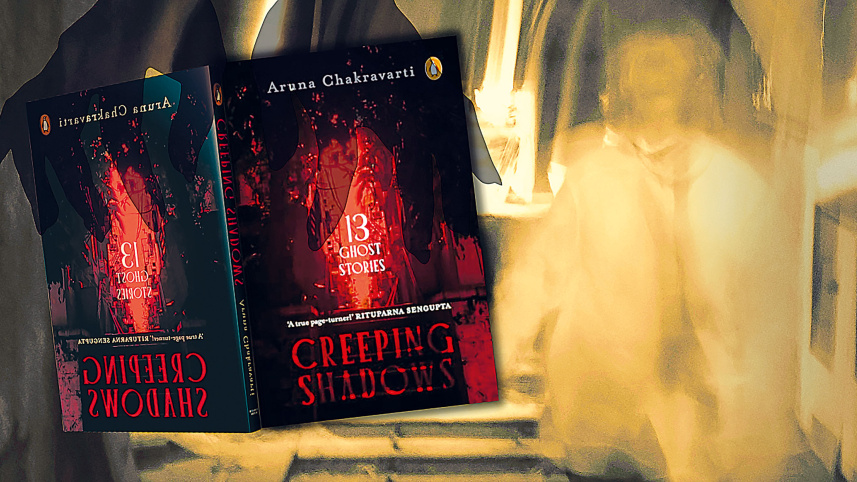
Aruna Chakravarti is a doyen of historical fiction, spinning out narratives on the Bengal Renaissance with her Jorasanko (HarperCollins, 2013) novels, reviving the story of the Bhawal Prince with The Mendicant Prince (Pan Macmillan, 2022) and doing series of fictitious short stories based on chronicles from the past. Then why would she turn suddenly to ghost stories?
She has tried her hand at what she referred to as “a completely new genre” with Creeping Shadows: 13 Ghost Stories. Chakravarti elaborated in a recent interview with Borderless: “For a change, I decided to try my hand at short stories which emerge straight from the imagination. And while at it, I decided to break out of the mould of ‘historical fiction’ writer in which I had trapped myself and try a completely new genre.”
 For all latest news, follow The Daily Star's Google News channel.
 And in the process, she expands on the genre of traditional ghouls. While one of the narratives, “Grandmother’s Bundle”, has the traditional petni stories told with a wry sense of humour, most of the ghouls are tormented souls born out of historical events or accidents. The other narratives have supernatural shadows creeping into normal lives to create a horrific outcome.

The first story in the book, “The Caregivers of Gazipur”, throws up ghouls from the colonial past who died in torment in a non-syncretic world—torn by religious observances that draw alienation and hatred even from loved ones. The protagonist meets these ghouls in the historic year, 1971, when Bangladesh came into being. A story that takes us into modern Bangladesh, “The Road to Karimganj”, has a mother and son duo travel to satisfy their curiosity about their family’s past until, haunted and spooked by a ghost, their trip goes awry.
Some of the rural landscapes in Bengal are imagined by Chakravarti based on her past experiences, where she travelled to source for her historical fictions. But the pièce de résistance she creates out of her imagination is a brothel in the early 19th century China in “The House of Flowers”, influenced by, she admits, her reading of Pearl S Buck and Amy Tan. The descriptions of the countryside in this story could have been impacted by her travels within China. She has shown a world where political borders didn’t exist, and a young man could walk from China to Kolkata without papers. Needless to say, her “spook” here could well be a cross between a zombie or a vampire—a truly original horrific creation and, perhaps, a bit like what you see in spooky Asian films about the undead.

More ghouls from the slaughtering incidents of history—the horrors of the Partition of 1947—crawl out in “They Come Out After the Dark”. Drawing partly from the folklore of nishir dak, the most frightening experiences are not just the spooks but the fact that they could seduce a living person to opt for them.
“One Winter Night”, set in a zamindari of yore, has terrifying ghouls too that grow out of the horrors of poverty and deprivation. That they avenge society by harming a person who tried to help them only emphasises the arbitrariness of their choices, leaving the readers with a sense of meaningless horror. Chakravarti’s ghosts often function as husband-wife as in this story, or father-daughter, son-father in larger family structures.
The isolated ghouls she creates are sometimes born of black magic or possession.
Chakravarti tells us about her spooks in her interview: “These stories do not belong to the gothic/horror genre. They are not about vampires, blood sucking bats, severed heads or violence heaped on violence. They are essentially human-interest stories with a supernatural twist at the end.”
More contemporary sagas creep into her narratives as she recreates ghosts from the Sikh massacre following the murder of Indira Gandhi in “There are More Things in Heaven and Earth”. The narrative weaves in present times and a discussion around the famous quote from Shakespeare’s Hamlet: “There are more things in heaven and earth, Horatio, than are dreamt of in your philosophy.” Thus reinforcing her academic persona, for, she served as a principal of a college in Delhi University for many years.
She has also explored the eco-fiction genre in “Vendetta”, with tree spirits seeking revenge from an abuser of nature. Her storytelling skills mesmerise. She writes, “He stopped. Rather, he was made to stop by an enormous tree looming in front of him. Monkeys of all sizes were hanging from the branches, clinging to the trunk and peering from between the leaves. In his frenzied state he thought he saw hundreds and thousands. Every type of Simian. Rhesus, marmoset, baboon, mandrill, macaque, colobus and others. Whole families of them. From huge hoary red-bottomed patriarchs to wee babies with beady eyes suckling at their mothers’ breasts.”
Aruna Chakravarti has proven once again she can master any genre—be it translations, historical fiction, narratives based on reality, or fantastic ghost stories with imaginative spooks that can make shivers run down your spine. Creeping Shadows is a gripping read that haunts and lingers beyond its pages.
Mitali Chakravarty wafts on a cloud where rests Borderless Journal. She has three books of poems, two anthologies, and a book of humorous essays on China.


Comments