


Whose literary production?: Anthropic’s Project Panama
Publishers in Bangladesh expressed that the recent surge in AI activity has not yet had a significant impact on their publishing practices or the Bangladeshi book market. The concern, however, may lie further ahead. As AI companies expand their appetite for literary material, Bangla literature, too, could become part of the vast pool of texts used to train future models. For a language with a rich literary tradition but a comparatively smaller publishing market, the question is not whether this possibility exists, but how prepared the industry will be when it arrives.
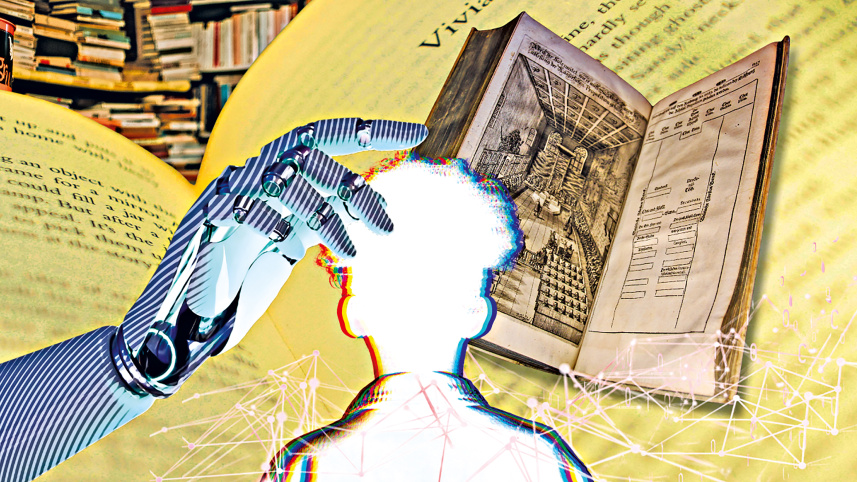
What happened with Anthropic’s Project Panama offers a glimpse into where that possibility could lead. Known for creating the AI-based chatbot Claude, Anthropic initiated the Project Panama in 2024 which they called as their “effort to destructively scan all the books in the world” as revealed by internal documents in legal filings. The goal was to feed the knowledge of these books into its AI products including Claude, to build a world-class model that would not rely on mimicking patterns or ‘internet speak’ but churn out curated facts. After initially considering digitally pirated books, Anthropic shifted to bulk buying millions of physical books through distributors and used-book retailers. Within a year, Anthropic spent tens of millions of dollars procuring and scanning millions of books, including many rare and last surviving book copies.

All the specifics regarding Project Panama which were previously unreported, surfaced after a number of book authors brought a class-action copyright lawsuit against Anthropic. A district judge’s ruling to unseal documents spanning over 4,000 pages in January 2026 opened a can of worms. These legal filings laid out the lengths to which tech firms like Anthropic, Google, Meta and OpenAI have gone to acquire enormous amounts of data to train their AI models. The Anthropic case concluded in June 2026 with a federal judge approving of the landmark USD 1.5 billion settlement, covering nearly 500,000 eligible works. The judge found that Anthropic was well within its rights to scan data from books to train its AI models. They deemed this practice as transformative fair use because eliminating the original means only one copy remains. However, the court also ruled that the central library Anthropic created from digital piracy needed to be permanently destroyed.
This ruling drew the line at how the books were acquired and not whether the books were being used to train AI models or being destroyed. The court reduced it to a matter of legal property which if legally bought can be destroyed if needed. It focused on the transactional question of whether the capital changed hands, and not the ethical intent or impact of how the intellectual property or cultural heritage would be used. The court did not even address Anthropic’s choice to opt for destructive scanning method even though non-destructive scanning exists which does not require cutting the spines. The case used the law for individual resale to legitimize the law of mass extraction at capital scale.
What makes the court ruling all the more uncomfortable is that destructive scanning of rare or last surviving copies of books from earlier centuries is now turning previously accessible public knowledge into private capital whose access and form is decided by the capitalist. Accessing and preserving knowledge will now be a privilege that will be decided by the AI corporate giant.
The question, however, goes beyond whether Anthropic had the legal right to destroy books it had purchased. A book is more than the information contained within its pages. For centuries, books have served as repositories of knowledge and records of human history. Their editions, bindings, illustrations, annotations and dedications can reveal how a text was produced, circulated and received. When a book is cut apart and reduced to machine-readable text, much of that material history disappears with it. What remains may be useful to a machine, but it is not necessarily the same cultural object that existed before.
Digitisation itself is not new to libraries or archives. Fragile manuscripts, rare books and out-of-print works have long been scanned to protect their contents from deterioration and make them available to readers. The difference lies in the purpose and ownership of the process. A library generally digitises a book to preserve it and expand access to it. Project Panama treated books as raw material for a commercial AI system. Anthropic’s mass acquisition of physical books therefore raises a question that goes beyond copyright: what happens when preservation becomes extraction?
A book is more than the words contained within it. Its edition, annotations, publisher’s stamp and even binding can reveal how it was produced, circulated and received. When the physical copy is destroyed, this material history disappears with it, taking away information that was never intended to be part of the text but may become valuable to future scholarship.
This also complicates the idea that AI “reads” books. Human reading involves interpretation, memory, emotion and context. A reader can disagree with a writer, connect a novel to personal experience or return to the same passage years later with a different understanding. A machine-learning model approaches a book differently. It processes enormous quantities of text and identifies patterns and relationships that can be used to generate new outputs. The distinction matters because the books are not entering this system through an act of reading in the human sense. They are entering it as data.
The process also places the labour of writers within a larger system of extraction. A writer spends years producing a novel, essay or collection of poems. A company can then acquire that work, convert it into training material and use it as part of a commercial technology. The book becomes an input into a system whose value is generated elsewhere. This is why the question of capital cannot be separated from the question of literary culture. The issue is not simply that a corporation owns a physical copy. It is that corporate power can determine how large quantities of human cultural production are acquired, transformed and used.
The consequences of this process are already beginning to appear within literary culture. As AI systems absorb vast amounts of human writing, they are also producing stories, essays and books that enter the same literary spaces as human work. Human writers can now find their work questioned as AI-generated simply because it resembles machine-produced language. The controversy surrounding the 2026 Commonwealth Short Story Prize showed how difficult this distinction can become, where winner Jamir Nazir was accused of using AI before an investigation dismissed the allegations, offering an early glimpse of this problem.The allegations grew around perceived stylistic similarities to AI-generated writing.
This could become a defining tension in literature in the years ahead. Authors may increasingly find themselves competing with AI-generated writing while also having to distinguish their own work from it. Publishers, editors, and readers may become more concerned with establishing the human origin of a text. The technology will therefore change more than the way literature is produced. It may also change how literary work is judged, trusted and valued. After feeding centuries of human writing into machines, we may be entering a future where authors are forced to defend the very human labour that made those machines capable of writing in the first place.
Books have traditionally moved through a decentralised network of writers, publishers, booksellers, libraries, and readers. Their meanings have been shaped through that movement. AI introduces another possibility, where enormous collections of cultural works can be concentrated within privately controlled technological systems. For readers, the loss is not only physical. A book that sits on a shelf can be opened by another person, studied by a historian or preserved by an archive. Once its contents have been extracted into a proprietary system, the relationship between the work and its future readers becomes more complicated. That leaves literature facing a question it has rarely confronted before: when machines learn to produce from a cultural archive accumulated by generations of human writers, and that archive is controlled by the companies that can afford to acquire it, who ultimately gets to shape the future of literature and knowledge?
Towrin Zaman is a climate researcher and an eclectic reader.
Mahmuda Emdad is a sub-editor at Star Books and Literature.
 For all latest news, follow The Daily Star's Google News channel.
Comments