


Furniture carpentry their lifeblood
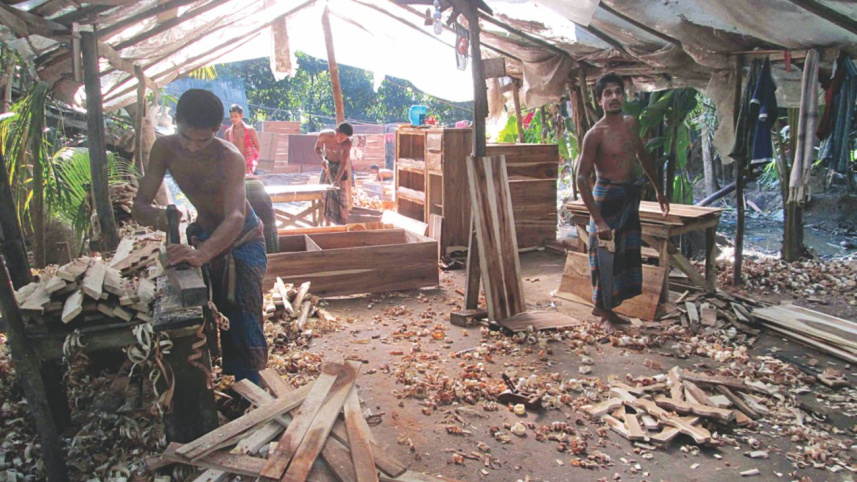
Chami village in Balodiya union of Pirojpur's Nesarabad upazila has always danced to the tune of wood planes smoothing and scraping, chisels carving and paintbrushes sloshing back and forth. Electric machines too have found their home there. But where once the economic lifeblood of the village was boat construction, in more recent years furniture carpentry has found its niche. Over 6,000 villagers are nowadays involved in furniture making.
"It used to be that people in our area as well as nearby Banaripara of Barisal used boats for transportation. There was water everywhere; we only made boats back then," says Md Karul Islam, who owns one of the village's furniture factories.

"With the development of better road links demand for boats decreased and from about 2003 we began to work with furniture, especially beds and food safes," he explains. "Within four years the furniture business spread to every corner of the village."
"At first we encouraged sales by arranging a fair where people could buy furniture cheaply," says neighbour Jaharul, who also has a furniture factory. Promotional activities have become less important as the village reputation for furniture has grown. Wholesale buyers now arrive by trawler in search of furniture pieces to sell nationwide.
"We have every quality," says another local Ruhul Amin, "and reasonable rates. At a minimum the furniture we make will last for five years." He notes that beds are available for as little as Tk 3,000.
According to factory owners, the plentiful supply and low cost of timber have also encouraged the industry to flourish. "The largest timber market around is in our upazila," says Sirajul Islam, who works at one of the furniture concerns.
The industry has offered jobs to many. "Several thousand people work at around 700 furniture factories in our village," says Md Shahin, adding that labourers earn around Tk 300 per day.
With furniture making a seasonal industry, locals do find themselves with lots of free time during the monsoon months; but from the beginning of the dry season it's difficult to pass a single moment idle.
Yet even with the furniture business flourishing it's not always easy for factory owners to turn a healthy profit. Many factories rely on loans to facilitate cash flow. "Often we can't pay for the timber outright," says one entrepreneur, Kabir Hossain. "So we pay more later on once the piece of furniture is sold." As it isn't easy to obtain a bank loan, financial crises are common.
"Even to transfer money we have to go to upazila headquarters," says Md Alauddin who owns two factories and is a member of the Balodiya union council. "There is no commercial bank nearby though our industry deals in crores of taka."
Locals also noted that the dirt road in the village also hinders the industry's further expansion. They believe development of the road could increase business manifold. "Our village is to be found in the last corner of the district," says furniture maker Mahabub. "Few think about us."
 For all latest news, follow The Daily Star's Google News channel.
Comments