


C’nawabganj growers see bumper mustard yield
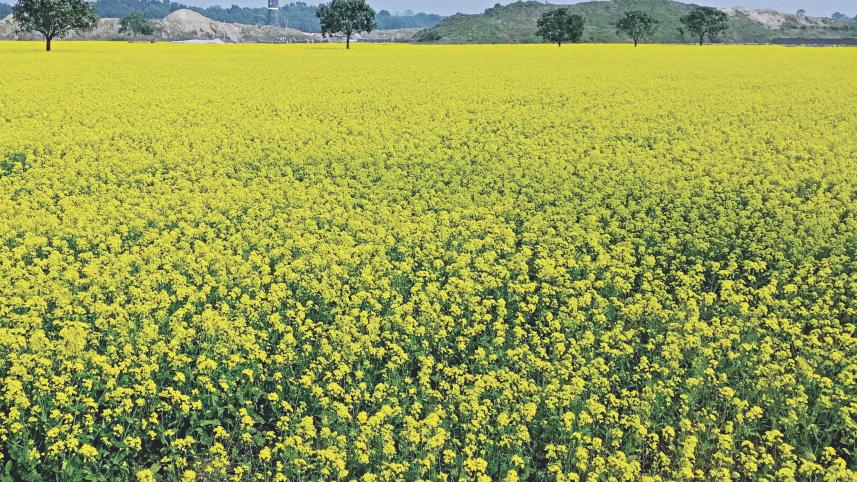
Framers in the district are expecting a bumper mustard yield this season due to favourable weather.
Easy cultivation process and lower production cost compared to other Robi crops is also a reason behind popularity of mustard cultivation among the farmers in the district.
 For all latest news, follow The Daily Star's Google News channel.
 October to mid-November is the suitable time for mustard cultivation and it takes 80 to 85 days to get the yield, said Muhammad Nazrul Islam, district training officer of Chapainawabganj Department of Agricultural Extension (DAE).
The farmers in the district have cultivated mustard on 15,535 hectares of land against the DAE’s target of 13,958 hectares of land.
Of the mustard fields, 4,485 hectares are in Sadar upazila, 3,120 hectares in Shibganj, 2,160 hectares in Gomostapur, 7,70 hectares in Bholahat and 5,000 hectares in Nachole upazila.
Most of the lands are covered with varieties developed by Bangladesh Agriculture Research Institute (BARI), including BARI Sharisha-14, BARI Sharisha-15 and BARI Sharisha-17.
A few local varieties have also been cultivated, said Nazrul.
Depending on soil condition, the cultivation of mustard requires only one or two times irrigation while about Tk 1,800 to Tk 2,000 is needed to cultivate the crop on a bigha.
On an average six maunds of mustard is produced from each bigha of land, the official said.
The DAE authorities are trying to persuade the farmers to cultivate high yielding varieties of mustard invented by BARI between the gaps of Aman and Boro to earn good profit.
Farmers of Sadar upazila said they are hopeful to get bumper production of mustard and harvest will begin this month.
Selim Hasan of Mara Pagla village in Sadar upazila said “I cultivated mustard on two bighas of land in the current season, spending Tk 2,500 and I’m expect to get at least 12 maunds. I will sell each maund for Tk 1,800 to Tk 2,000.”
I cultivated mustard on my two bighas of land this season and I am expecting to get six maunds of produce from each bigha,” said Mizanur Rahman, a farmer of Shibirerhat village in the same upazila.
Masud Rana, another farmer of the same village, said earlier, he cultivated tomato on his three bighas of land, but flood damaged those.
Later, he cultivated mustard on his land due to lower production cost, said Masud.
Comments