


Brisk trade in jhora on puja
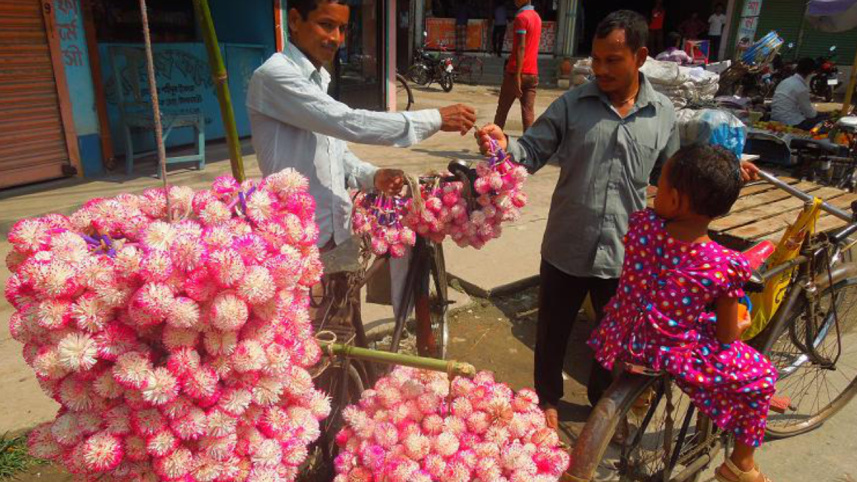
About 2,000 Paul families in the district are doing brisk business making jhora on the occasion of Durga Puja, the biggest festival of the Hindu community in the country.
Jhora, an important element for celebrating the puja, is made of spong wood (shola), jute sticks, thread and red dye. It looks like a kadam flower.

Dilip Kumar Chakroborty, chief priest of Nilphamari Kalibari, said jhora is regarded as a blessing of Goddess Durga, without it the festival cannot be held.
It is mandatory for Hindu families to hang jhora in puja mandaps, temples and residential houses, on agricultural tools, and even around the necks of cattle.
Jhora maker-cum-trader Sukumar Paul of Kundopukur village in Sadar upazila, said the families usually start making jhora two months ahead of Durga Puja.
It is easy to collect jute sticks locally as it is jute harvesting season now, but spong wood is scarce as it grows in marshy land, most of which are filled up by grabbers. For collecting the material, they have to go to Kala Peerer Beel, a vast marshy land in Thakurgaon, he added.
Around six-foot-long spong wood is dried in the sun and painted red. Then it is cut into small pieces measuring two inches by two inches.
Minoti Rani, a housewife of Sonarai village, said they use a small knife, locally called katari, to make 350 to 400 fine white petals on each spong wood piece, using a particular technique. They are then attached with thread to three-inch-long piece of jute stick to make them look like kadam flowers.
"It takes only three minutes for an expert to make the petals of a jhora. A family of five members can make at least 250 to 300 pieces daily," Minoti added.
On a visit to different puja mandaps, it was seen that the makers were carrying huge stock of jhora, which cost Tk 2.50 to Tk 3.00 per piece.
Traders said though jhora price is cheap, the huge sale enables them to earn handsome profit.
Hundreds of families buy 50 jhoras each on an average, and each of the hundreds of mandaps requires at least 100 to 150 pieces.
Jhora maker Animesh Paul said, "My family made 12,000 jhoras this season and I expect to earn around Tk 35,000 profit after spending only Tk 1,000 for buying jute stick, thread and red dye."
Akkhoy Kumar Roy, president of the District Puja Udjapan Committee, said there are nearly 850 puja mandaps in the district, which need huge quantities of jhora. The poor people get a chance to earn additional money by making jhora, he added.
 For all latest news, follow The Daily Star's Google News channel.
Comments