


The pitfalls of armchair psychology
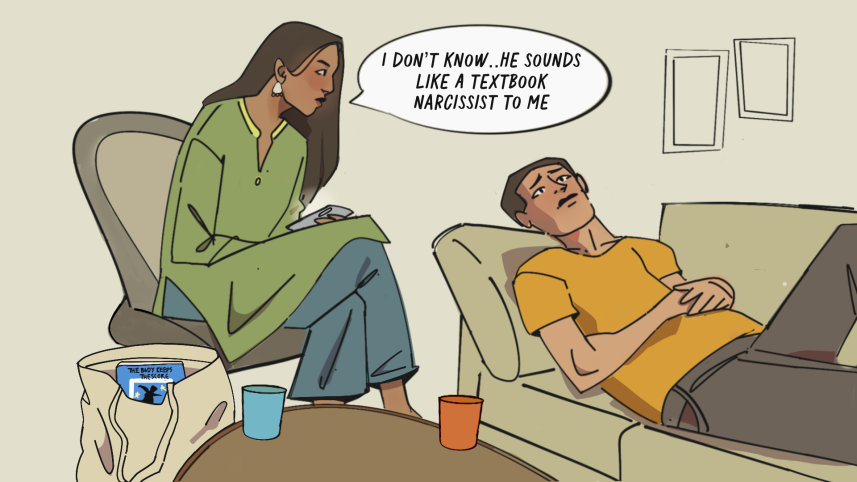
Open any social media app right now, and you’ll likely run into it within seconds—commenters online confidently diagnosing celebrities as “narcissists”, strangers explaining how someone’s ex-partner is clearly "bipolar", and friends in group chats declaring that your classmates’ behaviour is obviously “gaslighting”. The standard adjectives are no longer fancy enough—we have upgraded every single emotion to a clinical diagnosis.
We’ve gone from “I’m having a really sad, stressful week” to “I’m experiencing a clinical depressive episode”. We don’t say “she likes her space clean and organised” anymore—we say “she’s so OCD”. We’ve turned the Diagnostic and Statistical Manual of Mental Disorders (DSM) into everyday slang.

This is armchair psychology—when someone with zero professional qualifications—no degree, no licence, no internship, nothing—makes speculations and psychological judgements about people’s behaviours, mental states, personalities, motivations, or relationships using pop-psychology buzzwords they picked up from the internet. It shows up in casual conversation, online arguments, dating advice, and workplace dynamics.
This usually involves a few recognisable patterns—diagnosing someone based on very little observation (tone of a text or secondhand gossip); applying clinical terms incorrectly; and treating viral concepts as scientific fact.
A 2022 study published in The Canadian Journal of Psychiatry examined the 100 most popular ADHD videos on TikTok and found that 52 percent were misleading, 27 percent were based on personal experiences, and only 21 percent were actually useful.
These vocabularies were built to help clinicians and patients talk honestly about pain. But when every minor disagreement is labelled as "abuse" and every daily inconvenience becomes "traumatic", it makes it harder for the people who are dealing with the real thing to be taken seriously.
When we use heavy medical labels for normal human emotions, the people who are genuinely struggling with mental health conditions get lost among all the noise. Psychologist Naomi Torres-Mackie, head of research at the Mental Health Coalition, told TIME that overusing these words can dilute their meaning, and words have power.
Once you’ve got the vocabulary, every casual observation becomes diagnostic evidence.
Your friend has been in an unusually good mood for a week because she got a promotion, and now she’s “manic”. Your co-worker flinches when someone slams a door, and now she “clearly has PTSD”. Someone is a little quiet and withdrawn after a rough breakup, and they’ve “dissociative disorder”. Someone takes a day to text back, and suddenly he has an “avoidant attachment style”.
Sometimes, people are just tired, hangry, insecure, distracted, or having an off day—none of which requires a diagnosis. As a result, we begin treating ourselves and the people around us based on diagnoses none of us are remotely qualified to make.
Armchair psychology has also become the ultimate get-out-of-jail-free card. When you pathologise bad behaviour, you eliminate personal accountability. Honestly, you’ve got to admire the cheek of it. You do something inconsiderate, like ghosting someone, or forgetting your friend’s birthday—and instead of just saying, "Sorry, that was badly done of me," you go, "I was just protecting my peace.” “I’m setting a boundary” now frequently means “I am about to do something unkind, and you aren’t allowed to get mad about it."
What ends up happening is, this acts as a roadblock to actual medical treatment. Someone with real symptoms of anxiety, depression, or a personality disorder might read a few TikTok captions, recognise a couple of overlapping traits, and mistakenly conclude they’ve cracked the case.
Worse still, some people avoid getting evaluated altogether because the internet already gave them an answer, and a free one at that. Why pay to see a licensed clinician when WebMD and a 90-second video already told you what’s going on? This self-diagnosis creates a false sense of closure, leading people to self-medicate and opt out of real medical support they might desperately need.
Just for the record, I’m not saying don’t learn about psychology or talk about mental health—please, do. For generations, society perceived mental health struggles as shameful; breaking that stigma is a massive victory. Understanding healthy boundaries, emotional triggers, and communication patterns can be genuinely useful when they’re not being used just to win an argument. The issue isn’t the knowledge itself. It’s the overconfidence with which it is misused.
 For all latest news, follow The Daily Star's Google News channel.
 So, the next time you’re tempted to diagnose your annoying co-worker, take a long, deep breath instead. Let’s leave the heavy lifting to the professionals who actually have the degrees and the certificates.
References:
- BetterHelp (May 13, 2026). What Is Armchair Psychology, And Why Should I Avoid It?
- TIME (March 15, 2023). Gaslighting, Narcissist, and More Psychology Terms You’re Misusing.
- The Canadian Journal of Psychiatry (2022). TikTok and Attention-Deficit/Hyperactivity Disorder: A Cross-Sectional Study of Social Media Content Quality.
- IDONTMIND (June 21, 2022). Not everyone you dislike has a mental illness: The problem with armchair psychology, and what to do instead.
- The New Yorker (March 26, 2021). The Rise of Therapy-Speak.
Comments