


IUB seminar highlights measles risks and need for vigilance
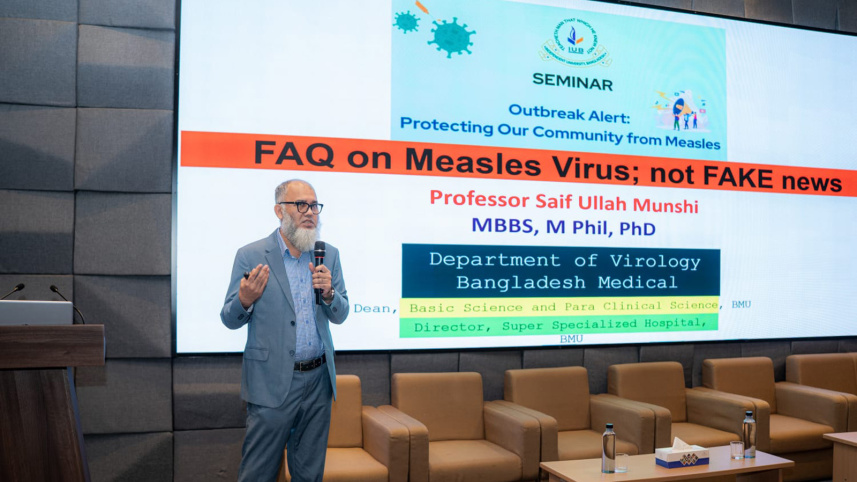
Independent University, Bangladesh (IUB) held a seminar on measles awareness amid an ongoing outbreak.
The seminar, titled “Outbreak Alert: Protecting Our Community from Measles,” was organised by the Department of Public Health at the university’s DMK Lecture Gallery, says a press release.

Health experts, academics and students attended the programme to discuss prevention, early detection and response.
Prof. Dr. Saif Ullah Munshi, dean of the Faculty of Basic Science and Para Clinical Science and director of Super Specialized Hospital at Bangladesh Medical University, spoke at the event.
Prof. Dr. Tahmina Shirin, director of the Institute of Epidemiology, Disease Control & Research (IEDCR) and National Influenza Center, and Prof. Dr. Muhammad Tawfique, consultant of paediatrics at Bangladesh Specialized Hospital, also addressed the seminar.
Saif Ullah Munshi said individuals born after 1990 are generally protected due to vaccination, while those who previously had measles develop natural immunity.
He said measles spreads through coughing and sneezing, especially in enclosed spaces.
He added that the likelihood of the outbreak becoming a pandemic is low and urged ensuring two doses of the measles vaccine for children.
Tahmina Shirin said a suspected outbreak is defined as three or more cases in a specific area within one month, while two laboratory-confirmed cases indicate a confirmed outbreak.
She said most recent cases involve unvaccinated children.
Muhammad Tawfique said measles symptoms include fever, runny nose and rash.
He said the rash typically appears around the third day of illness and begins near the hairline before spreading.
He also said Koplik’s spots inside the mouth are a key sign of measles infection.
He advised people to consult registered doctors for diagnosis and avoid misinformation.
The seminar was chaired by Prof. M. Tamim, vice chancellor of IUB.
Dr. Kamran ul Baset, dean of the School of Pharmacy and Public Health, and K Ayaz Rabbani, dean of the School of Environment and Life Sciences, also spoke at the programme.
 For all latest news, follow The Daily Star's Google News channel.
Comments