


Unprepared LDC graduation to bring more problems
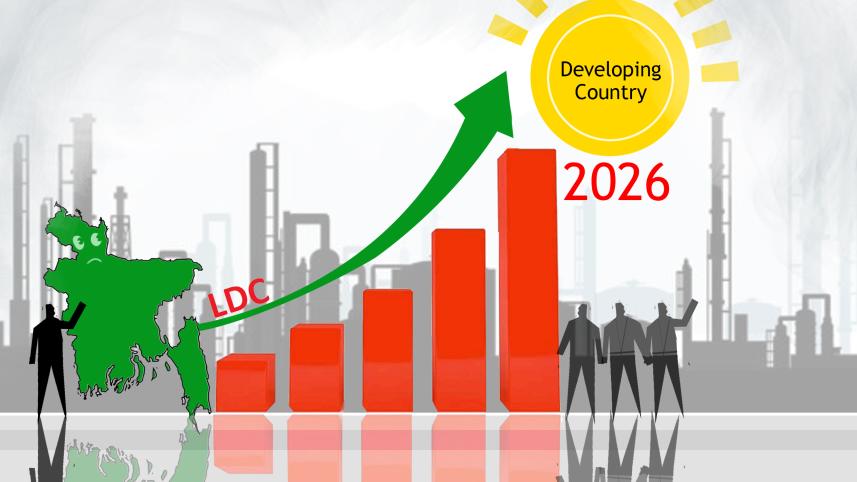
Bangladesh may face economic challenges and a rise in poverty if it proceeds with a premature and unprepared graduation from its least developed country (LDC) status, warned economists, politicians and researchers yesterday.
They argued that without evidence-based action, the recent political unrest, economic challenges, and data inadequacies could severely harm national interests and long-term development if LDC graduation proceeds prematurely.
 For all latest news, follow The Daily Star's Google News channel.
 "Graduating without preparedness is like jumping off a cliff and hoping to land safely on the other side," said Mushtaq Khan, a professor of economics at SOAS University of London in the UK.
Despite this formal progress, concerns are mounting over the absence of a preparedness roadmap, he said.
Khan made the remarks at a roundtable titled "LDC graduation of Bangladesh: Between readiness and realities," organised by think tank Change Initiative at Sheraton Dhaka in the capital.
Apparently, Bangladesh has met all the criteria set by the UN for the graduation. This is why the government is saying that nothing can be done and the country is set to graduate in November 2026.
Arguing with the process, Prof Khan said, "We want to challenge this argument that nothing can be done. Bangladesh should not just say 'we're not ready' instead of placing evidence-based assessments."
"So, if we want to make that argument, we have to be prepared with a lot of homework," he said.
"We must present solid evidence to the United Nations Economic and Social Council (Ecosoc) that premature graduation will increase poverty—and that's the case we must make," he added.
"Ecosoc is concerned with poverty, and there are good reasons they might consider an evidence-based appeal sympathetically," he added.
He suggested that Bangladesh argue by mentioning the current global system, which is in huge turmoil as a result of US President Donald Trump hiking tariffs on imports from different nations.
Besides, Bangladesh can also present its 15 years of undemocratic governance, institutional decay, rampant kleptocracy, and a banking system on the verge of collapse as key reasons to delay graduation, he added.
Khan also warned that the country's apparel, electronics, pharma and food industries may face more challenges after the LDC graduation.
At the event, Amir Khasru Mahmud Chowdhury, a standing committee member of Bangladesh Nationalist Party, said this whole graduation process came out of a politically manufactured development narrative—not from real economic fundamentals.
"The financial sector has been hollowed out. The capital market has been looted. Without a functioning financial system, no graduation or economic leap is meaningful," he said.
Chowdhury said the GDP and export figures were all manipulated. The Bangladesh Bureau of Statistics (BBS) lost credibility, and that undermines the very basis of economic planning, he said.
"There's been no democracy for the last 15 years. No representation. No debate. Going forward, we need a democratic transition—where parliament and people's voices shape critical decisions like this," he said.
In his keynote presentation, Change Initiative Head of Research Eshtiaque Bari warned that the upcoming graduation could negatively impact 71.5 percent of Bangladesh's total exports.
He further pointed out that Bangladesh would lose access to concessional climate financing and adaptation support under the Least Developed Countries Fund.
"Without robust structural reforms, diversified market strategies, and revenue protection mechanisms, the transition could bring more losses than benefits," said Bari.
Change Initiative CEO M Zakir Hossain Khan said the LDC graduation was a profound structural shift, not just a formality.
Citing examples like Angola and Nepal, he warned that without transparent data, banking reforms, and better tax performance, Bangladesh risks confusing eligibility with true readiness.
Zonayed Saki, chief coordinator of Gonoshonghoti Andolon, said, "Graduation is inevitable, but timing matters. Without reliable data, reforms, and national dialogue, rushing it could endanger Bangladesh's economic future amid rising global standards and risks."
AKM Sohel, additional secretary to the Economic Relations Division, said, "We are not saying we won't graduate—we are saying we need more time."
"We can't unilaterally delay, but we can present a strong case for additional time based on costs, competitiveness, and institutional gaps," he said.


Comments