


A tiny gene could make all the difference
Rice is more than a crop -- it’s the heartbeat of Bangladesh. It feeds nearly 176 million people, supports millions of farming families, and stands at the centre of our nation’s food security.
Every year, farmers grow rice on more than 11 million hectares, harvesting nearly 38 million tonnes of rice over three growing seasons. But there’s a new challenge threatening our rice -- heat.

As climate change intensifies, higher temperatures, long droughts, and ever-more frequent heat waves threaten to upend centuries of experience and break the back of rice production, especially during its most delicate phase: flowering.
HEAT: THE SILENT THREAT TO FUTURE RICE PRODUCTION
The 2023-2024 El Niño brought record-breaking temperatures and prolonged drought across Asia, wreaking havoc on agriculture, disrupting lives, and costing $100 billion or more worldwide. Bangladesh got its share of the pain. During the 2024 Boro season, we saw temperatures above 38°C in many of our rice fields, and in some places above 40°C.
For rice, timing is everything. Most varieties bloom between 9:30 am and 12:30 pm, right about the time temperatures start rising fastest. As soon as temperatures reach around 35°C or so, pollen viability drops off, fertilisation becomes spotty, and spikelet sterility rises. If things get bad enough, more than half of what could have been grains will stay empty. And it doesn’t stop there. Heat shortens grain filling, lightens grains, and causes plants to breathe more deeply through the night, leaving less energy for grain growth. And because much of our Boro crop blooms in the warmer months of March and April, the stakes are highest when we need them most. For us, the math is simple: fewer grains, smaller yields, thinner wallets. For Bangladesh, where rice accounts for over 70 percent of daily calories, adapting to climbing temperatures has become no longer a distant worry -- it’s a near-term imperative.
WHY HYBRID RICE SEED PRODUCTION FAILS FIRST
It gets harder still when it comes to the production of hybrid rice seeds, where success is more about timing than yield alone. Today, almost 1.9 million hectares of Bangladesh’s rice area are grown with hybrids, accounting for close to nine million tonnes of annual output. To meet that demand, we need around 22,283 tonnes of hybrid seed every year. Thankfully, local public and private organizations now provide nearly 86 percent of that requirement, an encouraging sign for Bangladesh’s seed sector. Much of this seed is grown in special zones such as Muktagacha, Mymensingh, Sherpur, Bogura, and Dashuria, Pabna- places increasingly under stress from rising temperatures during the flowering period. Unlike grain production, hybrid seed production relies on precision, not volume. The female parent makes no functional pollen, so successful seed-setting hinges on getting just enough pollen from the male parent, in just the right place at just the right time. Even small glitches in flowering, pollen viability, or anther opening can slash seed yields. And if temperatures climb above 35°C and humidity falls below 60 percent, seed setting rates plummet, and hybrid seed yields can plunge. Protecting seed production is thus almost as critical as protecting grain.
A DISCOVERY THAT CHANGES THE WAY WE THINK ABOUT HEAT STRESS
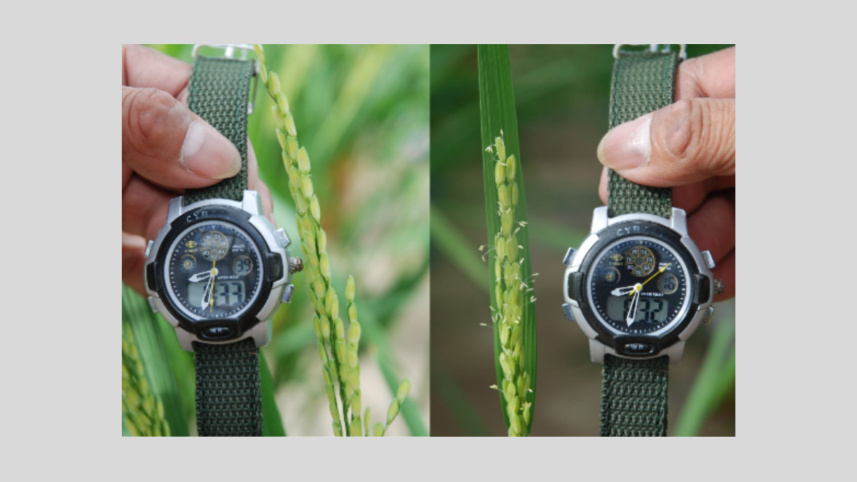
A team of JIRCAS, NARO, IRRI, and other researchers discovered a gene they call Early Morning Flowering 3 (EMF3), which offers a completely different way to cope with heat. Instead of trying to make rice tolerant of heat, EMF3 helps rice avoid heat in the first place. They found a rare, extraordinarily useful form of the gene, called emf3-1D, which pushes flowering by about 1.5 hours. That little difference means that pollen shedding and fertilisation can happen in the cooler hours of the morning, while damaging temperatures lie far in the future.
HELPING RICE ESCAPE THE HOTTEST HOURS OF THE DAY
Most rice varieties flower during the late morning, when temperatures rise rapidly. Rice carrying the favourable EMF3 allele flowers earlier and completes pollination before the hottest part of the day. In effect, the plant escapes heat stress rather than fighting against it. Field studies showed that rice lines carrying the emf3-1D allele maintained significantly higher seed-setting rates under temperatures approaching 38°C, without affecting plant growth, maturity, or yield under normal conditions. That’s what makes EMF3 so remarkable. Farmers don’t need new management practices or additional inputs. The plant simply changes its schedule-and those few hours can make the difference between sterility and a successful harvest.
A NEW TOOL FOR CLIMATE-SMART RICE BREEDING
The significance of EMF3 extends far beyond flowering time. The gene has already been introduced into both indica and japonica rice backgrounds, including internationally important varieties such as IR64, Swarna, Pusa Basmati, TDK1, Sahel 329, Caiapo, and Toyomeki. Its real strength lies in combination breeding. Rather than improving one trait at a time, future rice varieties could integrate early-morning flowering with high yield potential, drought tolerance, disease resistance, zinc enrichment, superior grain quality, and premium aroma. This represents an important shift from single-trait improvement to integrated climate-smart breeding.
WHAT COULD EMF3 MEAN FOR BANGLADESH?
For Bangladesh, EMF3 offers a timely opportunity. Public institutions such as BRRI, BINA, and agricultural universities, together with private-sector innovators including ACI, BRAC, Lal Teer, and Supreme Seed, could integrate EMF3 into future breeding pipelines. Combined with drought-tolerance genes such as qDTY2.2 and qDTY4.1, resistance genes for blast and bacterial leaf blight, and traits for nutrition and grain quality, EMF3 could help deliver rice varieties designed not only for today’s climate but also for tomorrow's. The potential may be even greater for hybrid seed production. By shifting flowering into the cooler hours of the morning, EMF3 could improve parental synchronization, enhance pollen transfer, increase seed-setting rates, and stabilize seed yields under rising temperatures.
A SMALL GENE WITH A BIG MISSION
The beauty of EMF3 lies in its simplicity. It doesn’t alter plant architecture, require new crop management practices, or reduce yield under normal conditions. It simply shifts flowering by about 1.5 hours. Yet those few hours can determine whether pollination succeeds or fails during a heatwave.
As plant physiologist Dr Tsutomu Ishimaru aptly observed, “With EMF3, rice plants wake up early to avoid heat stress, proving that being an early riser isn’t just good for birds -- it may also be the key to securing future food production.”
His observation captures an important lesson for modern agriculture: not every breakthrough makes crops bigger or stronger. Sometimes, the smartest solutions simply help plants do the right thing at the right time. For Bangladesh, where rice remains central to food security and locally produced hybrid seed now supplies nearly 86 percent of national demand, helping rice flower a little earlier may become one of the most practical and effective adaptations to a warmer future.
 For all latest news, follow The Daily Star's Google News channel.
 The author is the Director of R&D & Operations at ACI Seed, a strategic business unit of ACI PLC
Comments