


Commodity supply under pressure amid non-stop rain


Incessant rain across the country over the past week, coupled with flooding in the southeast, is threatening to push up prices of food and other essential goods.
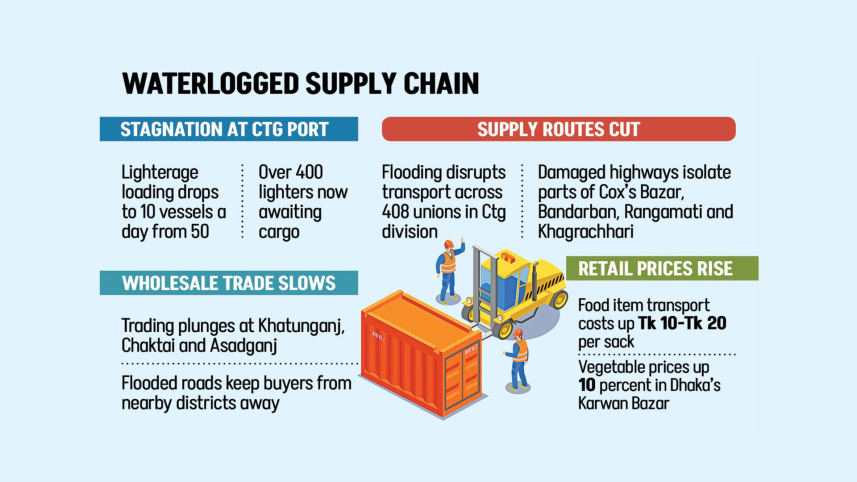
Businesses say the downpour has disrupted the entire supply chain, from loading and unloading vessels at Chattogram port to trading at major wholesale markets and transporting goods across the country.

The monsoon rains have also submerged large areas of farmland, damaging vegetables and other crops. Getting farm produce to major urban markets has become more difficult, with vegetable prices already rising in Dhaka.
Some dry food items, including flattened rice, puffed rice, vermicelli, biscuits, noodles and dates, have become more expensive as demand has surged because of flood relief campaigns.
Businesspeople say prices of most other food items are stable for now, but prolonged disruptions could trigger wider market volatility.
Bangladesh relies heavily on imports for essential commodities such as sugar, edible oil and wheat. These bulk goods are transferred from mother vessels to lighter ships, which then carry them across the country through inland waterways.
Over the past week, rough seas and heavy rain severely disrupted the transfer of cargo from larger ships to lighter vessels.
Only five to 10 lighter vessels loaded cargo from larger ships each day over the past week, compared with the usual daily average of 40 to 50, said Gazi Belayet Hossain, president of the Bangladesh Cargo Vessel Owners’ Association.
Loading and unloading resumed yesterday morning as sea conditions improved. However, Belayet said more than 400 lighter vessels were still waiting to load cargo as of yesterday, and it would take a few days for operations to return to normal.
Meanwhile, traders at major wholesale markets in Chattogram’s Khatunganj, Chaktai and Asadganj markets said daily trading had fallen sharply because buyers from nearby districts were unable to reach the markets.
“Business has slowed because wholesale buyers from different districts are unable to come to the market,” said Aminul Haque, a wholesaler at Khatunganj.
Demand for dry food, however, has risen. Prices of chira, muri and vermicelli have increased by Tk 3 to Tk 5 per kilogramme.
The wholesale price of a 25-kilogramme sack of standard-grade flattened rice has risen to Tk 1,300 from Tk 1,200 a week ago. Puffed rice now sells for Tk 65 to Tk 68 per kilogramme, up by Tk 2 to Tk 3, while a 30-kilogramme basket of loose vermicelli has increased to Tk 1,050 from
Tk 900. Prices of dates have also risen by Tk 20 to Tk 30 per kilogramme.
“We think this is a temporary increase driven by the floods,” Aminul told The Daily Star.
Heavy rain also disrupted the loading of essential goods onto trucks, while transport shortages made the situation worse.
As many as 408 unions across Chattogram division have been affected by flooding, waterlogging and landslides. Khagrachhari has been the worst-hit district, with around 73 percent of its area affected, followed by Chattogram at 50 percent and Cox’s Bazar at 49 percent.
Road links with Cox’s Bazar, Bandarban, Rangamati and Khagrachhari have been disrupted by waterlogging and landslides in hilly areas, making it difficult to transport goods to those districts, traders said.
Despite these disruptions, businesses in Chattogram said wholesale supplies of rice, lentils, sugar and edible oil are adequate. However, the market could become volatile if the rain and flooding continue.
Like Chattogram, wholesalers in Dhaka also reported supply disruptions.
 For all latest news, follow The Daily Star's Google News channel.
 Mostafa Kamal, a vegetable wholesaler at Karwan Bazar, said supplies have fallen because of heavy rain and flooding, pushing wholesale prices up by about 10 percent compared with normal levels.
He said persistent rain has disrupted harvesting and transport, making it difficult for farmers to send produce to market.
Abu Bakar Siddique, a grocery trader at Karwan Bazar, said flooding and waterlogging have disrupted supplies of edible oil, sugar and flour.
“For the last four to five days, companies have been unable to meet even half of the existing demand,” he said.
Although wholesale prices have risen only slightly, retail prices of some essential goods, especially dry food items, have increased because of higher transport costs and supply shortages, he added.
Meanwhile, some industrial groups said flooding and waterlogging have disrupted their supply chains, making it difficult to deliver products.
SM Mujibur Rahman, head of accounts of Meghna Group of Industries, said the company usually delivers 280 to 300 tonnes of goods a day but managed only around 50 to 60 tonnes daily over the past week.
Mujibur said the situation has worsened after rainwater partially submerged the company’s depot premises in Chattogram. The company was unable to move vehicles from the depot for four days.
Md Shafiul Ather Taslim, director for finance and operation of TK Group, said the company had been struggling to secure enough transport over the past two to three days.
“When available, vehicles were unable to reach many areas due to a cut off supply network.”
He added that deliveries had been disrupted in several areas, including Rangamati, Khagrachhari, Bandarban, Cox’s Bazar, Satkania, Lohagara and parts of Sylhet city.
Taslim said the impact has not yet become significant because dealers still have enough stock available.
Comments