


From sea breeze to power blades: Cox’s Bazar leads wind energy push



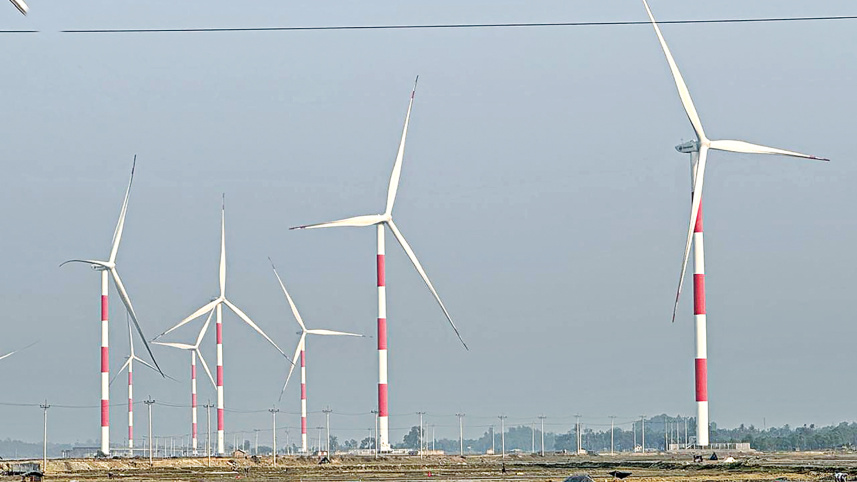
Passengers on board planes about to land in Cox’s Bazar, the country’s most popular beach destination, often spot rows of wind turbines standing across crop fields beside the shoreline.
Wind power is rare in Bangladesh, so the tall structures with 90-metre rotating blades come as a surprise to many.
 For all latest news, follow The Daily Star's Google News channel.
 In the presence of sufficient wind speed, the 60-megawatt (MW) wind power plant in Khurushkul and Chowfaldandi unions of Cox’s Bazar Sadar upazila -- the largest such plant in the country -- supplies electricity directly to the national grid.
The Cox’s Bazar 60 MW Wind Power Plant Project was implemented by US-DK Green Energy BD Ltd with an investment of about $120 million and support from the Chinese company SPIC Wuling Power Corporation. It was inaugurated in March 2024 and soon began full-scale power generation.
Each of the plant’s 22 wind turbines has a capacity of 3MW. It has generated an average power output of about 10MW over the past two years and supplied around 184 million kilowatt-hours (kWh) to the national grid during its first two years, according to Imtiaz Ahmed Faridi, a deputy director at the Bangladesh Power Development Board (BPDB).
The government buys electricity at $0.12 per kWh and has paid about $22 million over the past two years.
RISING DEMAND, IMPORT DEPENDENCE AND WIND POTENTIAL
Bangladesh has an installed power generation capacity of about 28,500MW but remains energy-deficient, relying heavily on imported fuel to run its over $450 billion economy.
More than 95 percent of capacity is based on fossil fuels, mostly imported, while the rest comes from solar, hydropower and wind.
Wind contributes less than 1 percent.
Imported fossil fuels -- largely sourced from Saudi Arabia, the United Arab Emirates and Qatar -- account for about 90 percent of electricity generation.
The US-Israel war on Iran caused Tehran to close the Strait of Hormuz, a key global route for oil, liquefied natural gas and fertiliser trade. The consequent supply disruption and rising fuel prices have raised concerns and strengthened calls to diversify energy imports and power generation sources.
Experts have recommended accelerating solar development, including rooftop systems for commercial and industrial use. Wind power is also seen as an alternative.
Under national targets, Bangladesh aims to generate 20 percent of its electricity from renewable sources by 2030 and 30 percent by 2040, including solar, wind, biomass and biogas.
A 2018 study by the US Department of Energy’s National Renewable Energy Laboratory, conducted for Bangladesh’s Power Division, found strong wind potential in coastal areas.
It reported that Khulna, Barishal and Chattogram divisions have wind speeds above 6 metres per second at 120 metres height.
The study estimated that over 20,000 square kilometres of land have wind speeds between 5.75 and 7.75 metres per second, with a total gross wind power potential of more than 30,000MW.
Project officials said the average wind speed in Cox’s Bazar is about 5.5 metres per second, with the strongest winds between May and August, when electricity generation also peaks.
Md Billal Hossain, assistant manager and engineer at US-DK Green Energy, said, “The turbines start generating electricity at wind speeds of about 3 metres per second, while around 9 metres per second is needed to reach the full 3MW capacity.”
“Our experience shows that wind conditions are generally better from afternoon to night, when electricity demand is higher, which helps increase production,” he added.
He also said each 3MW turbine uses only about 20 decimals of land. “In a densely populated country like Bangladesh, this is a major advantage,” he added.
However, the plant’s capacity factor -- the share of actual output compared to its maximum capacity -- is about 17 percent, lower than in India.
Mukit Alam Khan, an engineer involved from the start and now chief business officer at Akij Engineering Ltd, said initial expectations were around 23 percent.
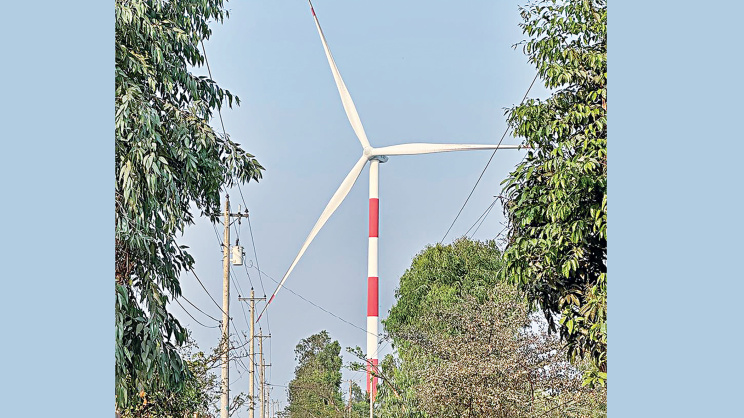
“The wind pattern in Cox’s Bazar has been somewhat weaker in recent years. This can happen for several years at a time,” he said.
However, he assured that once conditions improve, the plant will be able to produce more electricity.
“In coastal regions with stronger winds, there is strong potential to establish more wind power plants. If the government undertakes more projects like this, it could make a significant contribution to the country’s electricity generation.”
Zahurul Islam Khan, managing director of US-DK Green Energy Ltd, said, “We are satisfied with the current level of electricity generation and see good prospects ahead.”
“We secured investors for another similar project, but previous governments did not approve it. As a result, we have not been able to move forward with new renewable energy initiatives,” he added.
Officials said the project may take around 10 years to recover its investment. Turbines can operate for about 20 years with relatively low operation and maintenance costs.
Md Muzibur Rahman, director of renewable energy at Sustainable And Renewable Energy Development Authority (SREDA), said, “Investors in the wind power project in Khurushkul, Cox’s Bazar, now want to expand, which clearly shows there is potential.”
He added that a Danish firm is preparing a feasibility study for a 500MW offshore wind project.
A 2022 European Union (EU)-funded feasibility study identified six high-potential sites: Patuakhali, Moheshkhali, Inani Beach, Cox’s Bazar, Teknaf and Parki Beach.
It proposed six projects that could add 260MW to the national grid if implemented. It also said this could help Bangladesh meet 40 percent of its unconditional Nationally Determined Contributions (NDC) and 33.5 percent of conditional targets by 2030, while cutting carbon dioxide emissions by about 609,737 tCO2e (tonne of carbon dioxide equivalent) per year.
It may be noted that NDCs are national climate action plans by each country under the Paris Agreement.
The study added that falling technology costs are improving prospects, with equipment prices dropping between 2010 and 2018 by 33 percent for offshore wind and 20 percent for onshore wind projects.
FROM PILOT PROJECTS TO EXPANSION PLANS AND CLIMATE RISKS
Wind energy exploration in Bangladesh began in 1982, when a study using data from 30 meteorological stations found that Chattogram and Cox’s Bazar were suitable for wind power, according to SREDA.
The first wind power plant was established 23 years later in 2005, as a pilot project near the Muhuri River in Feni, close to coastal char areas of Sonagazi upazila. It was connected to a rural electrical feeder to meet local demand.
An electrical feeder transmits power from substations to distribution points.
From 2007, the project remained shut for several years due to technical faults, mismanagement, and low wind speed. It was restarted in February 2014 and later stopped again.
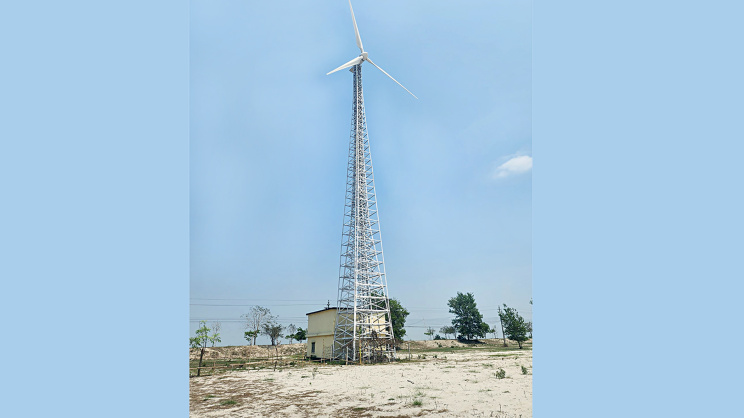
Another plant in Kutubdia, Cox’s Bazar, with 50 turbines of 20KW each (1MW total), is currently not operating due to mechanical faults.
The BPDB later launched a 2MW wind power plant project in Sirajganj in 2018, the first in northern Bangladesh. Located in the Malshapara area, it has eight units of 250KW each.
The project was delayed by seven years and, even after completion in April 2025, has not reached the expected output. Md Masud Rana, manager of the Sirajganj wind plant, said turbines do not receive enough wind to rotate properly.
SREDA officials said all projects except the Cox’s Bazar 60 MW plant were pilot schemes that did not achieve expected results.
Md Muzibur Rahman said proper wind mapping and turbine design based on wind flow are essential, and poor data matching and unsuitable design affected performance.
Officials also said weak maintenance and cyclone damage contributed to failures.
The EU-sponsored study also highlighted cyclone risk in Bangladesh, which remains a key concern for policymakers and the private sector.
It referred to Cyclone Sidr, one of the worst disasters in the country, with wind speeds of 120 miles per hour, and said that only a few turbines can currently withstand cyclones.
The study suggested a stronger turbine design using water-resistant components and better drainage systems.
It also recommended alternative risk transfer solutions, such as parametric insurance, to protect wind power plants from tropical cyclone damage. “Such insurance can cover not only physical damage to components but also the economic impact of downtime and repair of affected components.”
SREDA’s Rahman said initial investment for wind turbines, especially towers, is higher in Bangladesh than in countries like Germany.
Despite high costs, the wind power plants have become a popular attraction for visitors, as Sharmin Sultana, a housewife from Chowfaldandi village, said, “People come from far away to see it.”
Comments