


Import rules open up to spur trade
Easing restrictions on opening letters of credit (LCs), simplifying imports and placing greater emphasis on free trade, the government has issued a new import policy order that has received a mixed reaction from business communities.
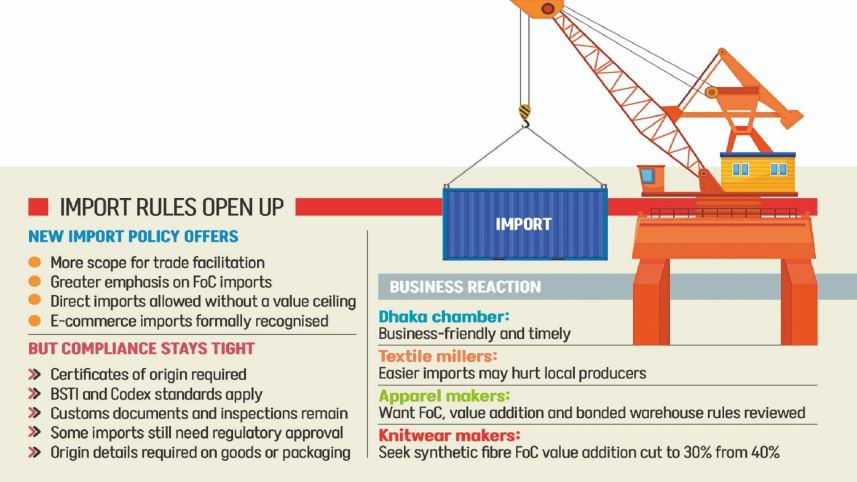
The Import Policy Order 2026-29 aims to facilitate trade, attract domestic and foreign investment and bring Bangladesh closer to global trading practices as the country prepares for the challenges of graduating from the least developed country (LDC) category.

To diversify the country’s exports, the new policy has expanded “free of cost (FoC)” import facilities. Export-oriented manufacturers can now import certain raw materials, and production inputs free of charge, making it easier for them to source materials needed for export production.
Issued by the commerce ministry on Monday, the order took effect immediately, replacing the previous Import Policy Order 2021-24.
The policy also introduces Bangladesh’s first regulatory guidelines for free trade zones (FTZs) and central bonded warehouses, while setting out measures to encourage expatriates to invest in local industries.
Trade chambers have welcomed the new policy, but local textile millers said easier imports could hurt domestic producers. Local apparel manufacturers have also called for a review of some provisions, including rules on value addition and bonded warehouse facilities.
EXPANDED FOC IMPORTS FOR EXPORTERS
The new policy has significantly expanded FoC import facilities for export-oriented industries, with the aim of supporting export diversification and helping manufacturers move into higher-value products by sourcing essential materials without upfront overseas payments.
For the garment sector, the policy raises the limit on free-of-cost samples. Apparel exporters can now import up to 15 samples, including shirts, trousers and jackets, per design.
The previous policy allowed 10.
The government has also doubled the allowance for key manufacturing trims and raw materials.
Manufacturers can now import up to 10 pieces of labels, tags, hangers and fabrics per design on a free-of-cost basis, compared with five under the previous policy.
The move is intended to reduce costs and paperwork and speed up production for global buyers. The FoC facility now also covers essential safety and compliance equipment beyond traditional apparel inputs.
Export-oriented factories can import life-saving and firefighting equipment, as well as specialised machinery parts, without making overseas payments.
The change is expected to help factories meet the environmental and safety standards required by international buyers and global brands.
UNLIMITED IMPORTS WITHOUT LCS
The new policy has abolished the annual limit on commercial imports made without an LC, a move aimed at cutting transaction costs and easing banking bottlenecks for domestic traders.
Under the previous policy, commercial importers using sales or purchase contracts instead of bank-guaranteed credit faced an annual ceiling of $500,000, with tighter limits for some specialised items.
 For all latest news, follow The Daily Star's Google News channel.
 The new policy removes the monetary ceiling, allowing businesses to import goods on the basis of sales or purchase contracts without an annual limit.
The change is expected to reduce the administrative burden on businesses that have faced delays and difficulties in processing import transactions through banks.
Instead of applying for bank credit for each transaction, traders can settle payments directly with overseas suppliers under agreed contractual terms.
RECOGNISING INTERNATIONAL PREFERENTIAL TRADE DEALS
The new policy sets out a framework for trade arrangements, including Preferential Trade Agreements (PTAs), Free Trade Agreements (FTAs), Comprehensive Economic Partnership Agreements (CEPAs), Economic Partnership Agreements (EPAs) and Regional Trade Agreements (RTAs).
To claim tariff concessions or duty-free access under these agreements, importers must present a valid certificate of origin.
The certificate, issued by a designated authority in the exporting country, confirms that the goods meet the rules of origin set out in the relevant agreement.
The verification process is intended to prevent goods from third countries being routed through partner countries to avoid normal customs tariffs.
REGULATORY FRAMEWORK FOR FTZS, EXPATRIATES DEFINED
In the new policy, the government has established its first regulatory framework for Free Trade Zones (FTZs) and central bonded warehouses. By providing clearer rules for these specialised trade areas, the government hopes to attract multinational companies and increase foreign direct investment.
The approach is in line with customs and tax reforms introduced by the National Board of Revenue (NBR) in the national budget for FY 2026-27.
Under the new rules, companies operating in the zones can import raw materials, capital machinery and production inputs through simplified procedures.
The policy also allows warehoused goods to enter more easily and facilitates contract-based shipping without the usual credit restrictions.
The policy formally defines “Non-resident Bangladeshis” to encourage expatriates to invest in local industries. Expatriates will be able to set up businesses more easily, with investment channels aligned with central bank regulations.
The policy also complies with the World Trade Organisation Trade Facilitation Agreement. By adopting international standards and clarifying rules of origin, Bangladesh will be better placed to negotiate bilateral free trade and preferential trade agreements with major economic partners, including the European Union.
‘TIMELY, BUSINESS-FRIENDLY’: SAYS DCCI
The Dhaka Chamber of Commerce and Industry (DCCI) has welcomed the new policy, describing it as business-friendly and timely.
The chamber said allowing direct imports through sales or purchase agreements without a value ceiling, along with plans to establish free trade zones and central bonded warehouses, would strengthen the country’s competitiveness in global trade.
DCCI thanked the government and the commerce ministry for retaining its recommendations on the motorcycle sector, saying the policy would support high-tech motorcycle manufacturing and strengthen local backward linkages.
It also welcomed measures to simplify imports for foreign investors and expand raw material and tariff facilities for export-oriented industries as the country prepares for the challenges of the post-LDC period.
DCCI urged the government to ensure the policy is implemented quickly and effectively to improve trade facilitation and support sustainable economic growth.
APPAREL MAKERS SCRUTINIZING POLICY, TEXTILE CONCERNED
The local textile sector has raised concerns that easier imports could put domestic producers, particularly primary textile manufacturers, under greater pressure.
Showkat Aziz Russell, president of the Bangladesh Textile Mills Association (BTMA), said many provisions of the new import policy order conflict with the interests of domestic industries, especially the local primary textile sector.
He said the policy has eased and encouraged imports when the country needs greater value addition and more domestic production of raw materials to retain more export earnings and create more jobs.
“But in the new import policy order such options have been kept limited,” he added. “The local industries will face more competition from the international competitors,” the BTMA chief also said.
Bangladesh should not rely more on imports, but the government should facilitate the expansion of local production capacity to serve domestic and international markets, Russell said.
Mahmud Hasan Khan, president of the Bangladesh Garment Manufacturers and Exporters Association (BGMEA), said the trade body’s main concerns are free-of-cost (FoC) imports, value addition requirements and bonded warehouse facilities.
All these issues have been incorporated into the new import policy order, but the BGMEA is still scrutinising it. If it finds anything that needs to be reviewed, the trade body will share its concerns with the commerce ministry.
On value addition, Mahmud Hasan Khan said the BGMEA, Bangladesh Knitwear Manufacturers and Exporters Association (BKMEA) and BTMA have reached a consensus before the order was finalised.
BKMEA President Mohammad Hatem said the new import policy order is “so far good”. However, he said the value addition requirement for synthetic fibre imported under the FoC facility should be 30 percent, like other raw materials, instead of 40 percent.
“It should be corrected,” he said.
He also welcomed the government’s decision to allow duty-free imports of raw materials under bonded warehouse facilities for non-RMG export-oriented sectors, saying these industries are expected to perform well in the coming years.
Hatem said he is scrutinising the order and would seek further changes if necessary.
Mohammad Abdur Razzaque, chairman of the Research and Policy Integration for Development (RAPID), said the government’s evolving import policy is increasingly linked to its broader trade strategy, particularly as Bangladesh signed trade agreements with Japan and South Korea.
He said the government is now using trade more strategically than before to protect domestic industries, manage imports and strengthen revenue collection.
According to Razzaque, changes in import duties might not have an immediate impact on revenue collection. Their effect could become more visible over time, particularly because the government’s income tax collection remains relatively low.
A well-designed import policy could therefore support revenue mobilisation while promoting trade competitiveness and protecting domestic economic interests, he said.
Comments