


House rent climbs for three consecutive quarters

Accommodation costs in Bangladesh have risen for three consecutive quarters this year, adding to the financial strain on middle- and lower-income households already under pressure from high inflation.
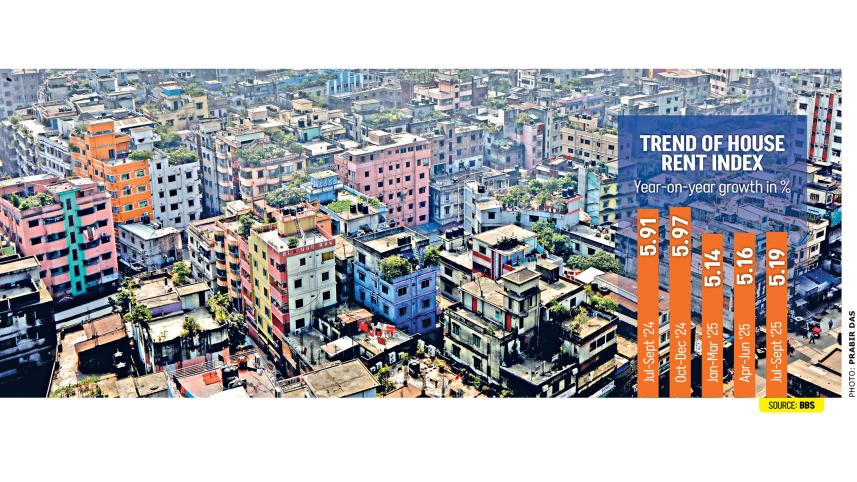
The House Rent Index (HRI), which tracks quarterly changes in rental costs, climbed to 5.19 percent in the July-September quarter of fiscal 2025-26, up slightly from 5.16 percent in April–June and 5.14 percent in January-March, according to data compiled by the Bangladesh Bureau of Statistics (BBS).

On a year-on-year basis, however, rent growth has eased. In the July-September quarter of 2024, the HRI stood at 5.91 percent.
The index reflects rental costs across three types of housing -- pucca, semi-pucca and mud houses. Data are collected nationwide, covering both urban and rural areas.
"Typically, house rents tend to rise either at the beginning or the middle of the year. But that seasonal pattern is no longer holding," said a BBS official familiar with the survey.
"When a tenant moves out, landlords often raise the rent immediately, which puts automatic pressure on the next tenant," the official added.
House rent is part of the non-food component of the consumer price index. With prices of essential commodities also rising, higher rents are compounding the burden on low- and fixed-income households already struggling with prolonged inflation.
Inflation rose to 8.29 percent in November, driven by non-food inflation of 9.08 percent, according to BBS monthly data.
Bangladesh has been grappling with elevated inflation for nearly three years. Consumer price inflation remained above 9 percent until May 2025 and has stayed above 8 percent since then.
SM Nazar Hossain, vice-president of the Consumers Association of Bangladesh, said landlords are increasing rents arbitrarily, even amid high inflation, exploiting the wide gap between housing demand and supply in Dhaka.
"Although the Premises Rent Control Act was enacted many years ago, there is no implementation," he said. "If the law were enforced, rent levels could be controlled to some extent, but the government is not playing an effective role."
"There is no system at all, no structured mechanism," Hossain said. "As soon as demand rises, rents are increased immediately."
He said the practice is more prevalent in labour-intensive and high-demand neighbourhoods. "When one tenant leaves, the rent goes up right away. And because demand is strong, another tenant is always willing to move in, even at a higher rate."
"We keep talking about it and the media keeps writing about it, but nothing is changing," he said. "The real problem is that there is a law, but no enforcement."
Hossain, however, welcomed a recent initiative by the Dhaka North City Corporation (DNCC), saying it could provide some relief if implemented effectively.
"DNCC has said it will mediate disputes between tenants and landlords and prepare area-wise rent charts," he said.
"If ward councillors are empowered to intervene and if there are clear rent ranges for different areas -- such as Gulshan or Mohammadpur -- it would help tenants make informed decisions and reduce their vulnerability," he added.
 For all latest news, follow The Daily Star's Google News channel.
Comments