


Dollar nears Tk 123 as war keeps markets on edge

The taka edged lower against the US dollar today, with the weighted average interbank rate marginally rising to Tk 122.85 from Tk 122.75, where the greenback had held steady since late March, Bangladesh Bank data showed.
The dollar rate stood at Tk 122.55 on March 9.

Trading in the interbank foreign exchange market was also thin at the start of the week, suggesting importers are not rushing to buy dollars in large quantities. Just three transactions were recorded on Sunday, totalling $4.03 million, down from $62.50 million on April 2.
The depreciation of taka comes against a volatile global backdrop. The US-Israeli war on Iran has kept oil prices elevated above $108 a barrel, stoking inflation concerns across import-dependent economies, according to a Reuters report.
The dollar softened slightly today, down 0.2 percent on the DXY index, as investors watched for any signs of progress toward a ceasefire. Even so, the dollar remains broadly strong, underpinned by expectations that the US Federal Reserve will hold rates high through the year, according to the CME FedWatch tool cited by Reuters.
Bankers say the main concern is panic-driven behavior.
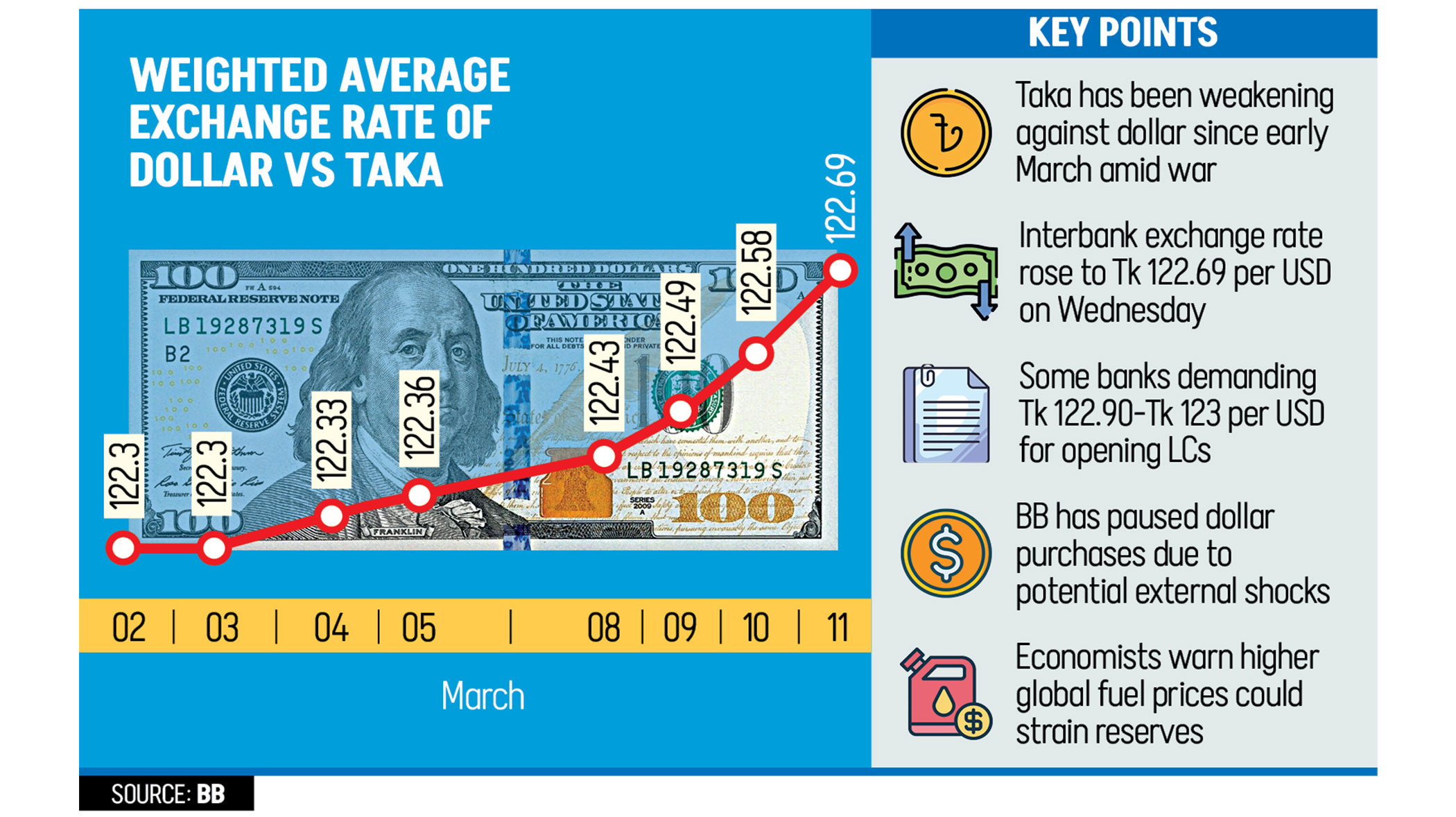
Mirza Elias Uddin Ahmed, managing director of Jamuna Bank, said the immediate risk is panic-driven demand amid the uncertainty caused by the US-Israeli war on Iran rather than any fundamental deterioration in Bangladesh's external position. Remittance inflows for fiscal year 2024-25 (FY25) reached $30.32 billion, up 26.81 percent year-on-year, and exports grew 8.58 percent to $48.28 billion
"Fuel prices and food prices are increasing," he noted, pointing to the potential for cost-push inflation to ripple through the economy. “A rise in fuel prices will eventually lead to an increase in food prices.”
But he cautioned that Bangladesh's underlying trade fundamentals remain sound. While the country has recorded a dip in exports to the United States recently, the broader trajectory of remittances and export growth over the last fiscal year offered a degree of cushion.
Ahmed flagged a particular concern around import behaviour during periods of uncertainty. Past episodes have shown that importers tend to accelerate letter of credit (LC) payments, booking early to lock in rates, which amplifies pressure on the dollar at precisely the wrong moment.
On the structural dynamics of the exchange rate, Ahmed also said the forex reserves are under slight pressure driven in large part by the need to import oil at elevated prices. “The volatility is mainly stemming from the war. We have to be patient to avoid panicking. This will not last long,” he added.
Bangladesh Bank has so far maintained a buffer. Gross foreign exchange reserves stood at $34.43 billion in the latest available figures, while usable reserves under the IMF's BPM6 methodology were $29.81 billion. Since the start of FY26, the central bank has purchased over $5 billion from the interbank market to rebuild reserves, reversing a years-long trend of dollar sales.
 For all latest news, follow The Daily Star's Google News channel.
Comments