


'Disease outbreaks a major concern for aquaculture sector'
Disease outbreaks remain a major concern for Bangladesh's aquaculture sector due to inconsistent biosecurity practices across the country, said Abu Tahir Muhammad Zaber, secretary to the Ministry of Fisheries and Livestock.
He made the remarks at a programme organised by the Aquaculture Network of Bangladesh at Sheraton Dhaka in the capital's Banani today.

The event was supported by the Centre for Environment, Fisheries and Aquaculture Science, Evolved Research Consulting, and MacAlister Elliot and Partners of the United Kingdom.
Zaber said unregulated expansion of aquaculture is putting pressure on the environment through nutrient loading and poor waste management. Seed and feed quality also vary widely due to inconsistent hatchery management and certification.
Climate change is posing new threats such as salinity intrusion, flooding, sea-level rise, and heatwaves, particularly in coastal and floodplain areas.
"We also face issues of fragmented governance, limited access to finance for smallholders, women, and youth, and increasingly stringent market requirements for traceability and sustainability," he said.
To address these challenges, the government has taken several proactive steps, including establishing major carp brood banks, importing improved brood stock, enforcing hatchery regulations, and building the capacity of both public and private operators, he added.
"Fish is not just food for Bangladesh; it is a foundation of nutrition, livelihoods, and national identity. But as the sector continues to grow, we must ensure that this growth remains both sustainable and inclusive," Zaber said.
He stressed that the time has come for a comprehensive National Aquaculture Policy to safeguard current achievements and guide future growth.
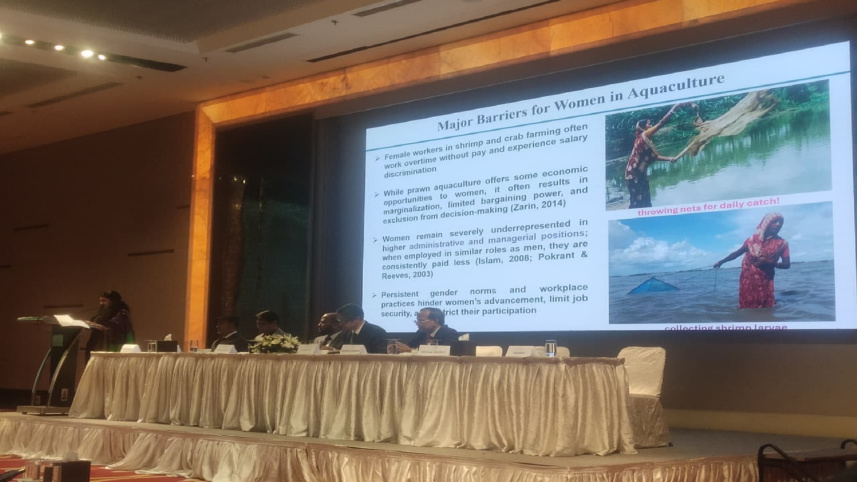
Speaking at the event, Maria Zaman, assistant professor and head of the Department of Marine Fisheries and Aquaculture at Bangladesh Maritime University, called for expanding women's access to affordable finance and capital for aquaculture enterprises.
She emphasised the need for targeted training and capacity-building in areas such as aquaculture skills, processing, and entrepreneurship, along with the adoption of women-friendly and safe technologies across the value chain.
Motaleb Hossain, director of inland fisheries at the Department of Fisheries, said Bangladesh's fish production has grown steadily over the last five years from 45.03 lakh tonnes in fiscal year 2019-20 to 50.18 lakh tonnes in 2023-24 driven mainly by aquaculture, while marine catches plateaued.
Md Monirul Islam, professor of fisheries at the University of Dhaka, said aquaculture now accounts for more than 58 percent of the country's total fish production and has evolved into a technology-driven, high-productivity industry supporting rural livelihoods and economic growth.
However, rapid expansion has brought challenges such as environmental degradation, disease outbreaks, food safety concerns, and weak biosecurity. Limited seed quality, high feed costs, and poor management continue to hinder sustainability, he said.
"Bangladesh needs a "National Aquaculture Policy", and I hope the government will prioritise this," he added.
 For all latest news, follow The Daily Star's Google News channel.
Comments