


Chinese economic zone still stalled after a decade
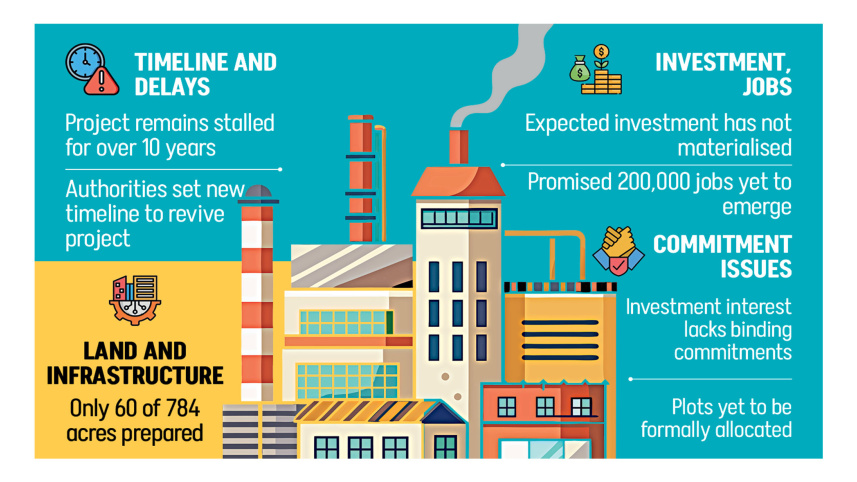
More than a decade after Bangladesh and China announced a Chinese Economic and Industrial Zone in Anwara upazila of Chattogram, the project remains largely on paper with no visible construction.
The Bangladesh Economic Zones Authority (Beza), which is overseeing the project, says the zone could attract $1.5 billion in investment and create more than 200,000 jobs. However, there are still no firm commitments, signed land-lease agreements, or confirmed factory setups.
 For all latest news, follow The Daily Star's Google News channel.
 Of the nearly 784 acres allocated in Anwara, only about 60 acres have been prepared, and not a single factory has been established.
Basic infrastructure on the ground is still incomplete, with utility services only partly in place. The Chattogram Water Supply and Sewerage Authority has installed a limited water supply pipeline, while the Karnaphuli Gas Distribution Company has set up a nearby gas station.
Beza has also built an administrative building and two access roads.
This reflects a broader pattern in Bangladesh’s investment landscape, where large pledges do not always translate into actual inflows. Chinese foreign direct investment also remains modest, with only a small share of announced amounts materialising.
HOW THE PROJECT BEGAN
The project dates back to June 2014, when, during a visit to China, former prime minister Sheikh Hasina proposed an exclusive economic zone for Chinese investors. Beza pursued the plan and signed an agreement with China’s commerce ministry during the visit.
The Executive Committee of the National Economic Council approved the project in September 2015 and allocated Tk 420.37 crore for the first phase, with China expected to provide a loan to fund it.
Beza later acquired land in Anwara, about 270 kilometres south of Dhaka, for the zone.
In October 2016, Beza signed a contract with China Harbour Engineering Company Limited, but the development and land-lease agreements could not be finalised, and the deal collapsed in April 2022.
Later, on July 16, 2022, China nominated the China Road and Bridge Corporation (CRBC) as the new developer. Beza signed cooperation and investment terms with CRBC later that year and finalised the shareholder agreement in October 2023.
Progress remained slow under the Awami League government. After the political change in August 2024, the interim government renewed efforts to move the project forward, but there has still been no progress on the ground.
This is happening despite stronger Dhaka-Beijing ties and rising US tariffs that are encouraging Chinese manufacturers to consider relocating factories.
Beza sources said some Chinese manufacturers visited the site last year, and around 200 investors are expected to participate in the zone, suggesting the project still has strong potential if long-standing delays are resolved.
BEZA EXPLAINS DELAYS IN NEGOTIATIONS
“Progress on the proposed Chinese economic zone has been slow due to unresolved contractual and commercial issues,” said Mohammad Zakaria Mithu, director (MIS and research) at Beza.
He said that although land acquisition is complete, no formal agreement has been signed with the Chinese side, and negotiations on the engineering, procurement and construction (EPC) contract are still ongoing.
“The development agreement, which is needed to start physical work, depends on finalising the EPC contract,” he added.
Mithu also said disagreements over cost valuation under the Chinese loan framework remain a key obstacle, with both sides yet to align their expectations.
He attributed the delays mainly to prolonged negotiations and pending approvals, while a multi-ministry committee is working to resolve the issues.
Mithu added that once the EPC contract is finalised, further steps such as the development agreement, company registration and formal approval can proceed, enabling implementation.
He also said Chinese investment is expected in sectors including textile manufacturing, electronics assembly, renewable energy (solar), light engineering and agribusiness.
Meanwhile, Ashik Chowdhury, executive chairman of Beza, has outlined a 180-day roadmap to complete negotiations for the long-stalled project.
He said that although part of the land is ready, progress has been delayed due to unresolved commercial issues between the government and Chinese private partners.
“These disputes have delayed the signing of key land-lease and development agreements,” he added.
Chowdhury said the immediate focus is to resolve technical cost issues and complete administrative procedures so that groundwork can begin within six months.
He added that the goal is to shift the project from prolonged negotiations to actual industrial development.


Comments