


ADP spending hits multi-year low amid political transition

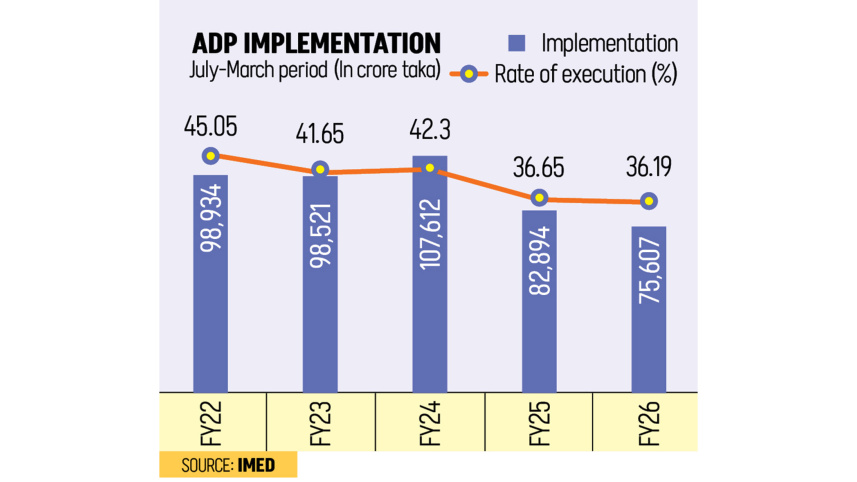
The government’s development expenditure has fallen to its lowest level in at least five years in the first nine months of the current fiscal year 2025-26 (FY26).
Ministries and divisions spent only Tk 75,607 crore in the first nine months, just 36.19 percent of the total allocation under the Annual Development Programme (ADP), according to data released by the Implementation Monitoring and Evaluation Division (IMED) yesterday.
 For all latest news, follow The Daily Star's Google News channel.
 While broadly similar to the same period last year, the figure is significantly below the five-year average. In FY22, nine-month implementation stood at 45 percent, the highest in recent years.
The drop, both in terms of amount and execution rate, comes amid economic uncertainty and political transition midway through the fiscal year.
The situation is particularly acute in the health sector, which implemented only 21.6 percent of the July-March target, despite growing concerns about healthcare accessibility.
With only three months remaining, analysts say Bangladesh is likely to record another year of very low development budget implementation. This will likely impact revenue collection by the National Board of Revenue (NBR), which collects advance income tax and VAT from implementing authorities.
It may, however, help contain the budget deficit and limit government borrowing from the banking sector.
Development spending hit a historic low in FY25, with only 68 percent of the revised ADP implemented, the weakest performance since FY1976-77.
Execution this year may fall to around 60 percent, said Mohammad Lutfor Rahman, a professor of economics at Jahangirnagar University. Implementation rates typically rise in the fourth quarter, but the gains may not be enough to close the gap.
“The current pace of ADP implementation reflects both administrative hesitation and structural weaknesses in fiscal management,” he said.
Rahman attributed the slowdown to the country’s unusual administrative transition. Two governments were in office during the current fiscal year. Project officials under the interim government hesitated to spend allocated funds, fearing possible complications if a new government came in.
“Since it was not an elected government, there was less accountability. As a result, towards the end, the focus shifted mainly to elections, and development spending did not get due attention,” Rahman observed.
Officials at the planning ministry earlier said last year’s disruption followed the fall of the Awami League government in a mass uprising, which prompted many project directors to abandon their posts. The revised ADP for the current fiscal year totals Tk 208,935 crore.
Rahman cautioned that the shortfall would have wider economic implications.
“Most ADP projects are infrastructure-based, so delays affect people directly. Employment, especially for daily wage workers at the grassroots level, is also hit due to reduced project activity, creating a multiplier effect on the economy,” he said.
Ashikur Rahman, principal economist at the Policy Research Institute of Bangladesh (PRI), said overall ADP implementation is likely to remain subdued in the current fiscal year.
“Like last year, there were many disruptions in the current fiscal year, including the national election, political transition, as well as global turmoil,” he said, adding that these factors collectively slowed down development spending.
In line with Rahman, he also estimated that total implementation may ultimately stand at around 60-65 percent.
He cautioned about the broader fiscal implications of lower public expenditure. “Due to this lower government expenditure, revenue collection will also be affected.”
Comments