


Unsolicited investors may get an edge in state asset bids
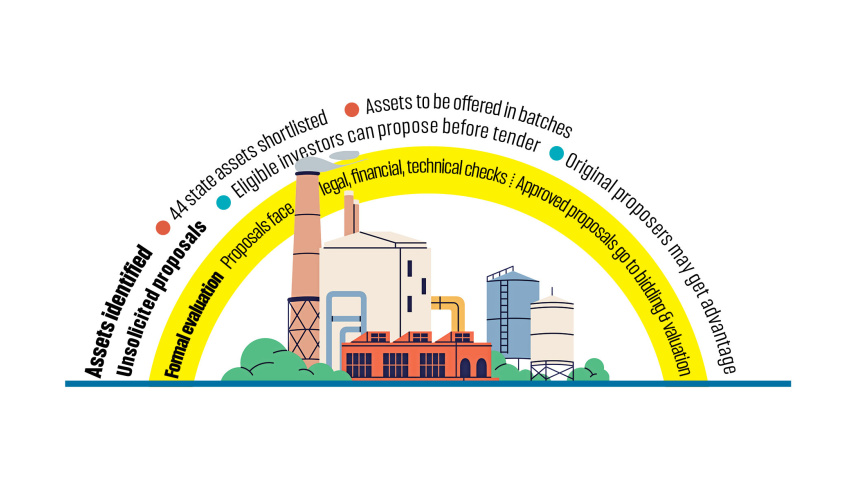
An investor who submits an unsolicited proposal to revive or develop a state-owned enterprise may receive a 7 percent advantage in the subsequent competitive bidding process under a proposed government policy.
The provision is part of a draft policy on transferring, leasing or selling state-owned industrial and commercial enterprises, unused land and facilities, shares and ownership rights.

The Invest Bangladesh Act, 2026 provides the legal basis for such transfers. The draft policy was discussed with government and private-sector representatives at a stakeholder consultation on July 27. A revised version has since been circulated for final comments.
The government has identified 44 state-owned assets for the initiative and plans to offer them in batches rather than all at once.
Of the 44 assets, 13 are under the Bangladesh Sugar and Food Industries Corporation, 12 under the Bangladesh Textile Mills Corporation, 10 under the Bangladesh Chemical Industries Corporation, five under the Bangladesh Jute Mills Corporation and four under the Bangladesh Steel and Engineering Corporation.
Under the draft policy, domestic or foreign companies, joint ventures, consortia and other eligible entities can submit proposals before a formal tender is invited.
If the authorities decide to proceed, the original proposer must compete with other eligible bidders. Its evaluated score may be increased by 7 percent if the advantage is disclosed in the tender or proposal documents in advance.
The benefit, however, would not give the original proposer an automatic right to the asset, a first right to negotiate or a guarantee of winning the contract. Another bidder could therefore win if its proposal scores sufficiently higher even after the 7 percent advantage is applied.
PROPOSALS TO FACE FORMAL EVALUATION
The policy would cover full or partial transfers of enterprises, leases, strategic sales, joint ventures, revenue-sharing arrangements, and management or operational partnerships.
An investor seeking to submit an unsolicited proposal would first have to provide a concept paper outlining the proposed transaction, expected investment, potential economic and social benefits, and their experience and capacity.
The relevant authority would assess the proposal based on the legal status of the enterprise or asset, land-use plans, public interest, potential investment, and economic and social benefits.
If the proposal is considered suitable, the investor could be asked to submit a detailed proposal covering the technical, financial and commercial structure, feasibility studies, financing plans, implementation schedule, environmental and social issues, and required regulatory approvals.
The government would not be required to proceed simply because a proposal had been submitted. The investor would also have to bear the cost of preparing the proposal.
If the government decides to proceed, the asset would be formally put up for transaction. The usual processes of due diligence, valuation, investor selection, approval and contracting would then apply.
The draft also proposes an Investment Transaction Coordination and Oversight Committee to oversee the process. The committee would review transaction plans, valuations, tender documents, investor-selection strategies and draft agreements before recommending the highest-ranked or best-valued bidder to the final approving authority.
The committee would not have final approval powers unless these are specifically given to it by law. It also could not introduce new eligibility or evaluation criteria after the process had started.
The policy also calls for independent professional valuation of state assets and businesses. Depending on the type of asset, valuation could use market value, income, asset value, comparable transactions or fair value.
The government says the policy aims to put state assets to more productive use while protecting its financial interests, workers’ legitimate dues and the wider public interest.
 For all latest news, follow The Daily Star's Google News channel.
Comments