


Energy roadmap key to attracting more US investment

Major takeaways
- $5b more US investment targeted
- Predictable energy roadmap needed
- Energy supply certainty crucial
- ICT, AI seen promising
- Cybersecurity remains a challenge
- IP violations deter investment
- AmCham plans global roadshows
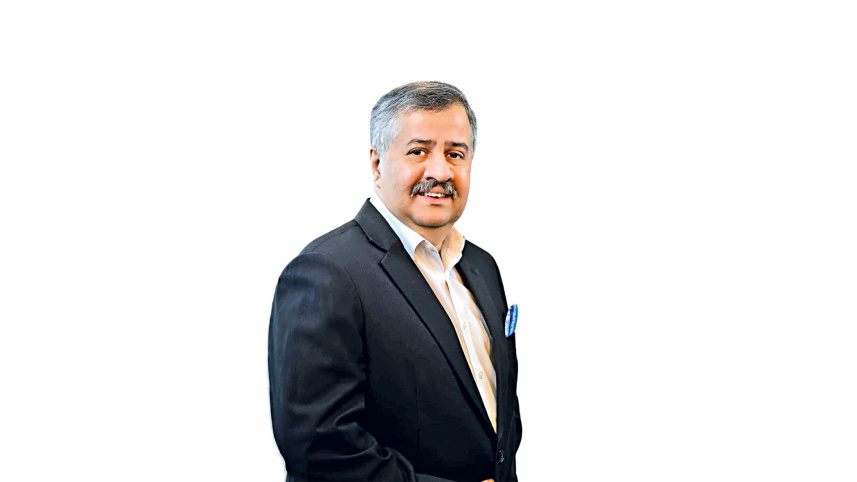
An energy security roadmap, an enabling investment climate and timely policies are among the major tasks for the government to attract more American investment in Bangladesh, said Syed Mohammad Kamal, president of the American Chamber of Commerce in Bangladesh (AmCham).
Over its 30-year journey in Bangladesh, AmCham members have invested more than $5 billion in the country. In the next four to five years, the chamber aims to bring at least another $5 billion in US investment to Bangladesh, as there are opportunities here, Kamal also said.

The AmCham president talked with The Daily Star yesterday in an interview on the occasion of the chamber’s 30th anniversary in Bangladesh, which will be celebrated on September 12.
In 1996, AmCham started its journey here as the America-Bangladesh Economic Forum (ABEF), but the name was later changed to AmCham, he said.
When the ABEF started its journey 30 years ago, bilateral trade between Bangladesh and the US was below $1 billion, hovering around $653 million.
But in the last calendar year, bilateral trade in goods and services between the two countries reached $13.7 billion in 2025, up 10.3 percent, or $1.3 billion, from 2024, according to data from the US Trade Representative (USTR).
US goods imports from Bangladesh totalled $9.5 billion in 2025, up 13.4 percent, or $1.1 billion, from 2024. The US goods trade deficit with Bangladesh was $7.1 billion, a 16.3 percent increase, or $993.5 million, over 2024, the USTR data also said.
US services exports to Bangladesh in 2025 were $1.4 billion, up 7.6 percent, or $102.0 million, from 2024. US services imports from Bangladesh were $362.0 million, down 14.6 percent, or $62.0 million, from 2024.
Over the years, the US has also become the market leader in several sectors, such as garments, as the US is the single largest export destination for Bangladesh because of the higher volume of apparel shipments.
In terms of attracting US investment to Bangladesh, if the government provides a good energy roadmap as per its plan, it is possible to bring in higher American investment.
For instance, the government has announced that the energy situation will improve significantly in two years as it has been taking a lot of initiatives, he said.
Providing an energy roadmap will give American investors greater predictability and enable them to make the right investment decisions. The roadmap will also provide predictability regarding energy supply.
The roadmap should clearly state what will be achieved in six months, 12 months, 18 months and 24 months.
For instance, if any project is undertaken to improve the energy situation and, after working for a few months, it is said that it will not be able to continue, then what will happen to local and foreign investors? So, the energy roadmap is very important for foreign investors, Kamal also said.
Over the past 16-17 years, $5 billion has come in from the US as foreign direct investment. During the next four and a half years of their tenure, it is possible to bring another $5 billion in US investment here.
The AmCham has identified several sectors, such as ICT, AI, energy, medical equipment, pharmaceuticals and cybersecurity. Cybersecurity is a major challenge for foreign investment, as data privacy has also become a challenge here.
Another major challenge is the violation of intellectual property rights, as fake goods sometimes emerge as threats to original products because of violations of intellectual property rules.
American investment in Bangladesh has remained underutilised, although there is a great opportunity to demonstrate its capabilities.
The AmCham chief also lauded the government’s promise to deregulate rules and policies, which will ultimately facilitate and expedite the processes for attracting foreign investment if these are implemented as per the commitments.
Regarding the signing of the Agreement on Reciprocal Trade between Bangladesh and the US, he said there has been a lot of criticism around this.
 For all latest news, follow The Daily Star's Google News channel.
 “I think the question of what we got and what we gave is one area to consider. But we also need to remember that if we look at our latest imports -- we know that we import less than $2 billion from the United States, while we export $11-13 billion to them,” he said.
Advocating the ART, he said there are many positive sides of the agreement which also need to be explored for exporting, importing and more investment between the two countries.
The government is looking for a cashless economy, or a cashless Bangladesh. Going fully cashless is probably not that easy, as perhaps Bangladesh will start with less cash and eventually become cashless. Because until now, 28 percent of transactions are cashless and 72 percent are conducted in cash, he added.
Here, all players need to be able to participate properly. We need to ensure that everyone can play in the areas where they have capabilities.
For example, we have seen Bangla QR being promoted over time. But Bangla QR is just one tool.
There are many other options: mobile financial services, cards like ours, and others.
Everyone has different capabilities, and they should all be able to remain players and help accelerate the transition to a cashless economy. The incentive the government has announced is not enough.
Currently, AmCham has 270 members. In Bangladesh, if it is about large American companies with direct investment, there are only around 56 or 57, maybe 60, he added, saying that AmCham will hold roadshows in different countries to attract more investment.
Comments