


Political influence broke the banks
Repeated policy concessions, political patronage and a culture of impunity for wilful defaulters have pushed non-performing loans (NPLs) in Bangladesh to a record Tk 6.06 lakh crore, according to bankers and an industry expert.
Bad debt across the country’s banking sector surged to 32.78 percent of total outstanding loans by the end of June, according to central bank data.

At a discussion at The Daily Star Centre yesterday, the industry experts said that prolonged regulatory forbearance has created a serious moral hazard, discouraging good borrowers from repaying their loans.
The discussion was titled “Tk 6 Trillion in Bad Debt: Who Really Pays?”. It was the second episode of a discussion series organised by The Daily Star under the broad theme “Business & Beyond”.
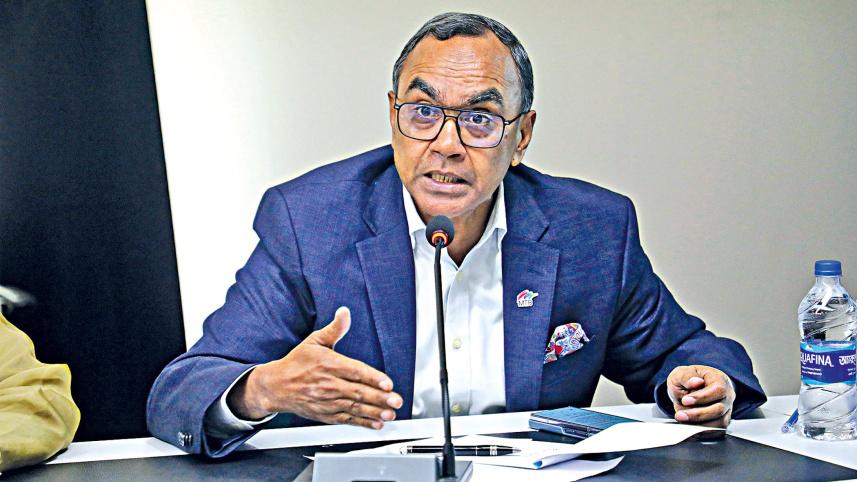
“Relaxed down-payment requirements, generous rescheduling facilities and extended loan-classification windows had masked the true health of the sector,” said Syed Mahbubur Rahman, managing director and CEO of Mutual Trust Bank.
“That was the worst thing that has happened,” Mahbubur said of the accounting leniency, noting that international investors assess domestic lenders against strict global standards.
The crisis extends far beyond poor credit risk management, the panel said, pointing to deep-rooted political influence.
The Mutual Trust Bank MD and CEO identified 2017, marked by controversial developments surrounding Islami Bank, as the “final nail in the coffin” for sector governance.
“There was a perception that if you had a connection with the government, you could take money and did not necessarily have to pay it back,” Mahbubur said, adding that wilful defaulters frequently enjoy social respect and “VIP treatment” rather than facing social or legal stigma.
The problem is compounded by inflated collateral valuations and a slow judicial process. Citing loans associated with S Alam Group, Mahbubur said that underlying assets often fall far short of the value of the loans, making recovery impossible.
“Furthermore, with over 1 lakh loan-recovery cases pending, obtaining and enforcing a court judgment can take nearly a decade,” he commented.
Mahbubur conceded that banks themselves are also complicit. Aggressive lending amid unhealthy competition has allowed corporate borrowers to take on excessive debt, with funds frequently diverted into non-productive assets such as land.
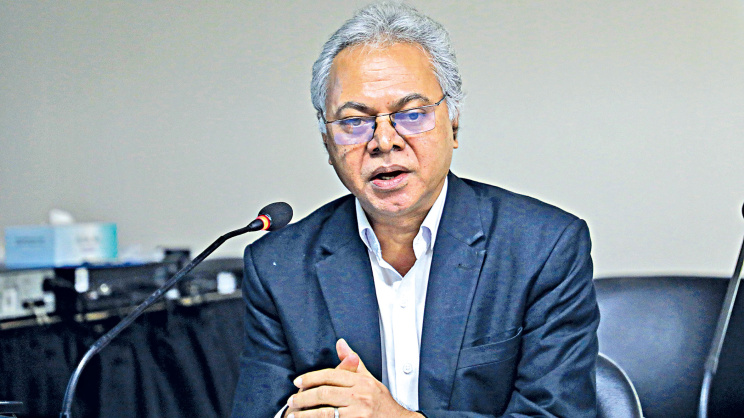
At the discussion, Md Ezazul Islam, director general of the Bangladesh Institute of Bank Management (BIBM), criticised excessive regulatory intervention in interest rates and lending mandates, describing the environment as one of “financial repression”.
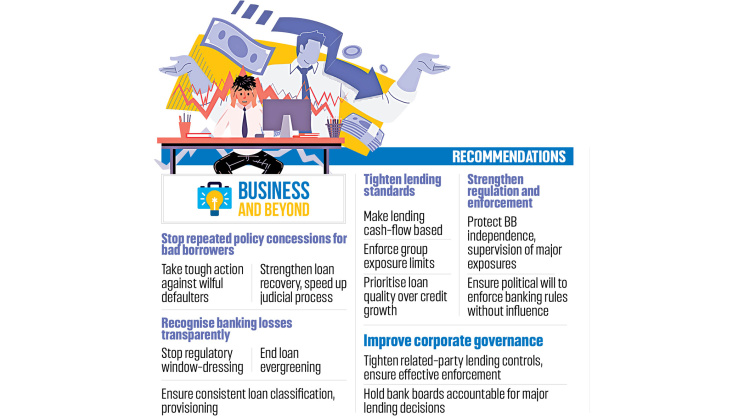
Ezazul urged commercial lenders to end the practice of “evergreening” bad debts and base lending decisions strictly on verifiable cash flows rather than corporate reputation or overvalued collateral.
“We need to recognise the losses honestly,” said the BIBM director general, warning that the full extent of the damage to the banking sector remains uncertain.
He stressed that lending must be based on cash flow rather than simply collateral, corporate guarantees, or the reputation and influence of borrowers.
He cited the difficulties faced by City Group, saying a viable business could face serious trouble if basic operating conditions deteriorate.
“If a factory lacks gas or electricity, providing more loans for machinery does not solve the underlying problem,” he said. “Without sufficient cash flow, the borrower may eventually be unable to service the debt.”
Ezazul also called for tighter enforcement of group exposure limits, saying even a strong corporate group can fail.
He said banks must also strengthen controls over related-party lending, while bank boards should be held accountable for major lending decisions. “Boards cannot simply serve the interests of a particular shareholder or business group.”
 For all latest news, follow The Daily Star's Google News channel.
 He called for disclosure of conflicts of interest, proper recording of board decisions and post-mortem reviews of major lending decisions.
The Bangladesh Bank must have the necessary authority and independence to enforce these requirements, he said.
Ezazul also warned that sample-based regulatory inspections could miss problems involving large borrowers.
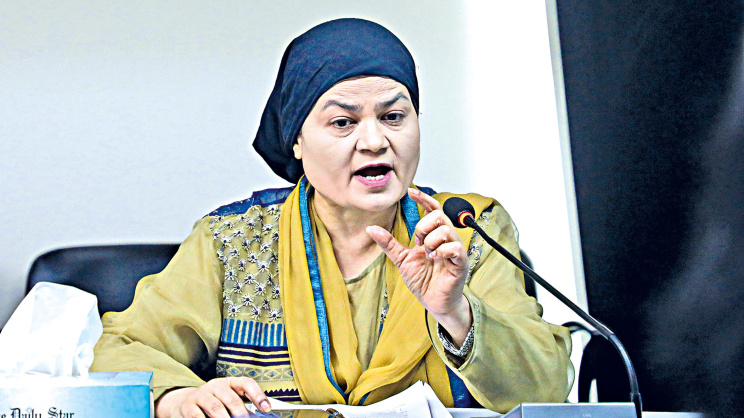
MD and CEO, LankaBangla Finance
“Supervision cannot work that way,” he said.
He said credit growth does not necessarily mean better economic performance. What matters is the quality of lending and whether funds reach productive businesses.
“Loan growth must therefore be assessed alongside asset quality, recovery, professional ethics and accountability.”
Ezazul added that rules alone will not change the banking sector if politically connected borrowers, influential shareholders or bank insiders can override them.
“The country ultimately needs the political will to enforce the rules consistently,” he said.
Humaira Azam, managing director and CEO of LankaBangla Finance, said the banking sector now has a major mess to clean up.
Billions of dollars may have left the country, and recovering the money will require expensive legal expertise and take time, she added.
“The consequences of NPLs are being felt across the economy, with depositors, taxpayers, and good private-sector entrepreneurs paying the price.”
If the banking system functioned properly, interest rates for good borrowers should be much lower, perhaps around 5 or 6 percent, with 7 percent being the upper end, she said.
“We need the capital market and bond market to provide funding for capital expansion and long-term investment,” said Humaira.
She said commercial banks should focus mainly on working capital and trade finance, while long-term financing should increasingly come from the capital and bond markets.
The LankaBangla Finance MD said the entire Tk 6 lakh crore NPL should not automatically be treated as a loss without first determining how much can be recovered. Some loans are backed by assets, while some businesses remain viable.
“Businesses may also have suffered from broader economic conditions, including the sharp devaluation of the taka, which eroded equity in firms with high import exposure.”
Despite the scale of the problem, Humaira said it could be addressed systematically.
One option, she said, would be to create a long-term structure and shift part of the burden into government bonds with maturities of 15 or 20 years, gradually reducing the pressure on banks’ balance sheets.
Mentioning loan defaulters, she said, “We see large loan defaulters roaming around Gulshan and Banani, throwing lavish wedding parties. In any other country, their photos would probably be plastered on billboards.”
The LankaBangla Finance MD said that untangling the crisis would be a “Herculean job” requiring immense political will, the cessation of state interference and a return to rigorous banking fundamentals.
Arun Debnath, deputy editor of The Daily Star, hosted the discussion, while Aasha Mehreen Amin, joint editor of the newspaper, delivered the concluding remarks.
Comments