


THE DAIRY BOOM

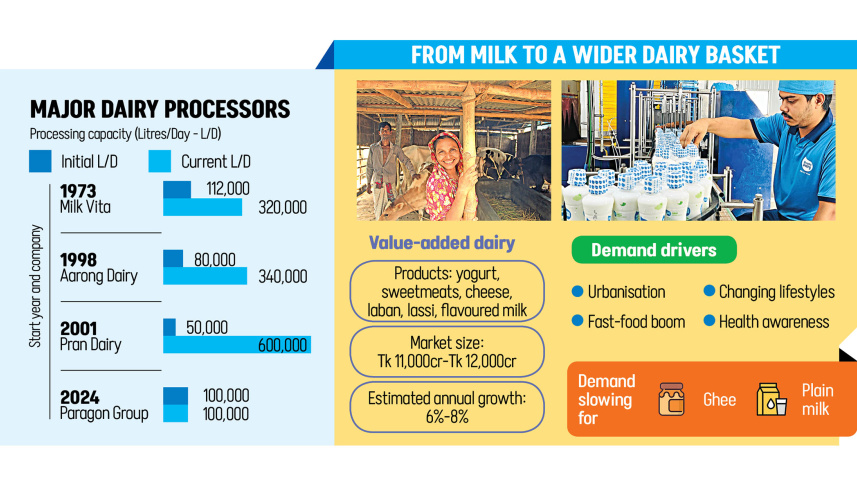
Nearly twenty-five years ago, agro-processing giant Pran introduced its liquid milk to the local market. At the time, the country used to import huge amounts of powdered milk.
Pran had a simple market logic: increasing the production of liquid milk would reduce dependence on imports. It would also boost the rural economy, as cattle rearing is the second-largest source of income after farming.

The milk-processing business proved successful, and Pran later moved into products such as ghee and cheese. But processing and pasteurising milk requires heavy investment, while margins on those basic dairy products were relatively thin.
So, what is the solution? The answer was to sell more dairy products than just plain milk. Pran began expanding its range of milk-based products, eventually offering more than two dozen items, including sweetmeats, yoghurt, laban, matha and lassi.
“Bangladeshis love sweetmeats and praise the good ones. It is kind of our defining characteristics,” said Ahsan Khan Chowdhury, chairman and CEO of Pran-RFL Group. “But around a decade ago, people only in upscale Dhaka like Gulshan could get premium sweetmeats at high prices. We thought, why not we manufacture these products and sell at affordable prices to all.”
That thinking led to the launch of popular sweets and bakery brand Mithai in 2015.
Pran’s story is broadly similar to that of other major dairy companies, including Aarong, Milk Vita, Paragon, Akij and RD Milk. They, too, have moved beyond basic milk into higher-value dairy products. Together, these companies now comprise a market estimated at around Tk 12,000 crore, which is growing by 6 to 8 percent a year. That pace of expansion is comparable with once-supercharged construction and real estate.
This formal dairy-processing sector now employs around 175,000 people.
Manufacturers say urbanisation, changing lifestyles, rising disposable incomes, the fast-food boom and greater health awareness have driven the sector’s growth over the past two decades.
But the boom has also exposed a basic problem. That is, processors need a steady supply of milk, while fewer farmers are willing to produce it.
Besides, the recent reciprocal trade deal between Bangladesh and the US covering agricultural and livestock products poses another challenge for local producers, an agricultural economist said.
FROM MILK TO A WHOLE NEW DAIRY BASKET
Value-added dairy products are not new to Bangladesh. What has changed is their scale and reach.
Mohammad Anisur Rahman, senior director of BRAC Enterprises that markets dairy products under Aarong brand, said traditional products such as sweet yoghurt, chhana and ghee have long been made from surplus milk before gradually becoming commercial products.
Consumer demand has now expanded beyond traditional sweets to sour yoghurt, dairy-based drinks and different types of cheese, he said.
Dairy-based sweetmeats and sweet yoghurt remain popular nationwide, while sour yoghurt, yoghurt drinks and cheese are consumed mainly in urban and semi-urban areas, according to Anisur.
The growth of these products has also prompted processors to build their own cold-storage and distribution networks because the country lacks dedicated infrastructure for a dairy cold chain, he said.
According to Anisur, some categories are now emerging as particularly promising. Dairy drinks such as laban, matha and lassi are expected to grow strongly as consumers look for healthier alternatives to soft drinks. Cheese is also gaining ground, with demand for mozzarella, cottage cheese and cream cheese rising alongside the fast-food industry.
The picture is different for ghee and plain milk. Health concerns and rising prices are pushing some consumers to cut back, with many opting for blended alternatives instead of pure ghee.
“Flavoured milk, including chocolate and mango variants, also has strong growth potential,” he said.
 For all latest news, follow The Daily Star's Google News channel.
 Preetam Kumar Das, manager of the Planning and Development Department of Bangladesh Milk Producer’s Co-operative Union Limited, commonly known as Milk Vita, said the cooperative has expanded from pasteurised milk, butter, ghee and milk powder to 24 dairy products.
Its range now includes sweet and sour yoghurt, sweets, dairy-based drinks and mozzarella cheese.
“Sweet and sour yoghurt are among Milk Vita’s most popular products, while laban sees strong seasonal demand during the summer,” Preetam said.
Kamruzzaman Kamal, marketing director of Pran-RFL Group, said yoghurt, ghee and flavoured milk are their strongest value-added categories. He expects future growth to come from health drinks, yoghurt and milk-based beverages.
In the dairy market, Paragon is a new entrant.
Moshiur Rahman, chairman of Paragon Group, said the company’s main value-added products are pasteurised milk, flavoured milk, butter and ghee, with pasteurised and flavoured milk generating the strongest demand.
He said consumers are increasingly choosing fermented dairy products and healthier options over direct milk consumption.
Paragon plans to expand its ghee production and introduce more product variations. Moshiur identified ice cream as a major growth area, saying demand exceeds current supply.
FARMERS BEHIND THE BOOM ARE LOSING INTEREST
The dairy industry’s biggest problem may lie not in consumer demand but at the other end of the supply chain, as BRAC’s Anisur identified declining interest among dairy farmers as the sector’s biggest challenge.
Farmers are increasingly shifting to beef production because it is simpler and more profitable. They also face the daily demands of caring for cattle, milking cows and finding reliable markets, while often receiving prices that do not cover rising production costs, he said.
Shortages of green fodder, competition for farmland and the high cost of feed are also reducing the number of dairy farmers, he said.
For processors, another problem is that the market is heavily concentrated in cities.
Pran-RFL Group’s Kamruzzaman said value-added dairy products are concentrated in urban and semi-urban markets because of distribution issues and the need for a reliable cold-chain system.
Paragon Group’s Moshiur said the company faces challenges including government regulations, processing issues and management constraints. He identified medicine and vaccination as key challenges for dairy development.
CAN LOCAL DAIRY KEEP UP WITH DEMAND?
The local value-added dairy sector is expanding as more companies invest with support from the government and financial institutions, said Jahangir Alam Khan, former director general of the Bangladesh Livestock Research Institute.
Rising incomes are also boosting demand for value-added dairy products, creating further opportunities for growth, said Jahangir, an agri-economist.
But the next phase of growth will depend on whether local producers can keep their costs under control.
He stressed the need to manage production, marketing and other costs so locally produced dairy products remain affordable and competitive. “If locally produced dairy products are available at competitive prices, consumers will have less dependence on imported products, which will help strengthen the domestic dairy industry.”
That challenge is becoming more important as Bangladesh opens its market further.
Asked about Bangladesh’s trade agreement with the US on agricultural and livestock products, Jahangir said it could pose challenges for the domestic dairy industry.
He said allowing imports at supplier-determined prices without scope for negotiation could put local producers at a disadvantage. “The agreement should be reviewed and discussed in detail in Parliament.”
Comments