


Foreign banks’ lending fell 11% in 2025
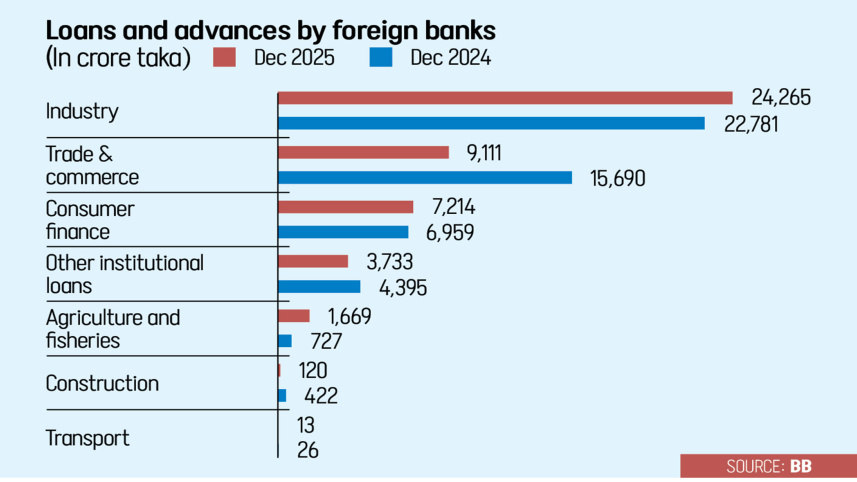
Lending by foreign banks operating in Bangladesh declined 11 percent in 2025, with a Bangladesh Bank (BB) report describing the contraction as a “cautious business strategy”.
Last year, nine foreign banks had Tk 46,122 crore in loans and advances across sectors including agriculture, construction, industry and transport.

The amount was Tk 51,970 crore in 2024, according to the BB report titled “Foreign Banks’ Operation in Bangladesh: Trends and Operational Insights (July-December, 2025),” published yesterday.
The decline was most pronounced in trade and commerce, where loans dropped 42 percent to Tk 9,110 crore by the end of 2025 from Tk 15,690 crore a year earlier.
The BB said this reflected subdued trade financing activities and possible portfolio adjustments amid changing economic conditions. Credit to the construction sector also declined during the period.
Conversely, lending to industry, the main recipient of funds from foreign lenders, grew 6 percent year-on-year to Tk 24,265 crore as banks continued supporting export-oriented manufacturing and global value chains.
A notable increase was recorded in agriculture, fishing and forestry, where lending more than doubled to Tk 1,668 crore, although these sectors still represent a small portion of the total portfolio.
As a result, the share of foreign banks in total banking sector credit declined to 2.6 percent at the end of 2025 from 3 percent a year earlier, indicating reduced participation in domestic lending activities, the BB said.
The decline in lending came as the sector faced pressure on asset quality, reflecting a rise in bad loans across the banking sector in recent years.
While overall non-performing loans (NPLs) as a share of total outstanding loans exceeded 30 percent at the end of last year, the NPL ratio of foreign banks rose to 5.9 percent in December 2025 from 4.9 percent a year earlier.
EXPORTS ANCHOR FOREIGN BANKS
Despite the decline in loans and advances, foreign banks handled higher volumes of exports and imports for local businesses and manufacturers.
The BB said the share of foreign banks in Bangladesh’s export receipts remained stable at around 19 percent at the end of 2025, while their import share stayed at 13 percent.
Their activities were concentrated in textiles and raw materials supporting export-oriented manufacturing, as well as capital machinery and intermediate goods, highlighting their role in industrial upgrading.
“This asymmetric role -- higher export than import shares -- implies a net positive contribution to foreign exchange inflows,” the central bank said.
The report said foreign banks maintained a stable deposit base and relatively sound asset quality during 2025. They held around 4.2-4.6 percent of total banking sector deposits, exceeding their credit share, indicating a net liquidity surplus and a conservative intermediation stance.
“This scenario reflects that foreign banks function as liquidity anchors rather than aggressive credit creators, contributing to system stability during volatile periods,” it said.PROFITABILITY AND OUTWARD REMITTANCES
The BB said foreign banks’ net profit increased to Tk 3,739 crore in July-December 2025 from Tk 3,558 crore a year ago, partly due to lower tax expenses.
The foreign lenders sent Tk 1,315 crore in profits as outward remittances during July-December 2025, more than double the Tk 577 crore remitted during the same period a year ago.
Reinvested earnings by the banks in Bangladesh fell by more than half to Tk 2,096 crore in the second half of 2025 from Tk 4,595 crore a year earlier.
 For all latest news, follow The Daily Star's Google News channel.
 The central bank said foreign banks in Bangladesh demonstrated considerable financial resilience during 2025, supported by strong capital adequacy, abundant liquidity, sound profitability and relatively low levels of non-performing loans.
It said the increase in foreign assets and continued profitability indicate sustained confidence in their business models.
“Nevertheless, the moderation in credit growth and declining provision coverage warrant continued monitoring to ensure that foreign banks remain adequately positioned to support productive economic activities while preserving their traditionally strong financial soundness and risk management standards.”
Comments