


S&P revises Bangladesh outlook to negative
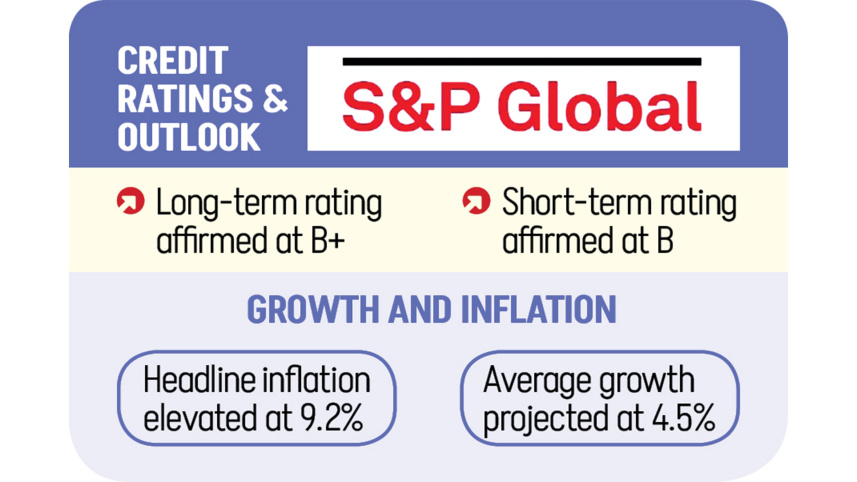
S&P Global has revised its long-term outlook on Bangladesh to negative from stable amid persistent weakness in the banking sector, with additional risks stemming from volatile global energy markets and trade conditions.
“We revised the outlook to negative due to the increasing risks to Bangladesh’s economy posed by a weak domestic banking sector, fiscal constraints, external headwinds, and the growing prospect of a more protracted recovery,” said an S&P outlook published July 27 .

“Our ratings on Bangladesh reflect the economy’s modest per capita income and limited fiscal flexibility owing to a combination of low revenue-generation capacity and the government’s elevated interest burden. Evolving administrative and institutional settings represent additional rating constraints,” added the report.
The US-based ratings agency said continued stability in Bangladesh’s external accounts will depend on remittances remaining strong, a rebound in the readymade garment sector, and continued engagement with multilateral lenders.
Earlier in May, global ratings agency Fitch Ratings revised its outlook on Bangladesh’s long-term rating to negative from stable, citing macroeconomic vulnerabilities arising from the country’s significant exposure to the conflict in the Middle East.
S&P said the negative outlook on Bangladesh reflects its view that the country’s trend rate of economic growth and external balance sheet position could weaken further because of adverse conditions.
“These include the war in the Middle East, financial sector imbalances, and energy market vulnerabilities, which could impede a faster export and economic recovery over the next 12 to 18 months,” the agency said.
Bangladesh’s economy could record average annual growth of around 4.5 percent over the next three years amid weakness in the domestic banking sector, energy market uncertainties, and an uncertain readymade garments market.
Risk of further downgrade in rating
S&P cautioned that it could lower Bangladesh’s ratings if the country’s long-term trend growth rate declines to levels more in line with those of peers with similar average incomes, reflecting its expectation that economic growth is unlikely to rebound significantly from current levels over the next two to three years.
It could also lower the ratings if Bangladesh’s external position deteriorates, such that, for example, narrow net external debt exceeds 100 percent of current account receipts on a sustained basis, the agency said.
The report said lower current account receipts, a wider current account deficit, or a failure to materially increase foreign exchange reserves could also put downward pressure on the ratings.
Weakness in banking sector
The credit rating agency said the banking sector faces significant capital needs owing to poor aggregate asset quality, though these conditions are generally concentrated at state-owned and Islamic banks. “Poor capital adequacy and asset quality are likely to hamper the sector’s ability to provide greater support to Bangladesh’s economic recovery.”
S&P noted that although private sector banks are in better shape, there are notable risks at the state-owned commercial banks, which account for less than 30 percent of total banking sector assets. However, their non-performing loans ratio is much higher than that of their peer commercial banks, standing at about 40 percent in aggregate.
High inflation to affect consumption
Noting that inflation remains elevated amid disruptions in the energy market, S&P said, “This could put the brakes on a stronger recovery in private consumption, as incomes are squeezed by elevated fuel and electricity prices.”
The report said mixed external demand conditions continued to weigh on readymade garment exports in fiscal year 2025-26, which ended on June 30.
The US tariff policy applicable to Bangladesh remains in flux. On July 24, 2026, the United States introduced new tariffs on a number of economies, including Bangladesh, which is subject to a 10 percent tariff on most goods exported to the US.
During the January-March 2026 period, 18 percent of Bangladesh’s exports went to the US, and about 86 percent of these were readymade garments, excluding leather products and other textiles, according to S&P.
 For all latest news, follow The Daily Star's Google News channel.
 Fiscal constraints and debt
S&P mentioned the government’s fiscal constraints and said its interest burden is exceptionally high, consuming approximately 30 percent of its total revenues.
It said the country’s narrow revenue base limits the government’s flexibility to provide fiscal support in times of stress, and the government’s bank funding could “crowd out” private credit creation, further slowing the economic recovery.
The rating agency forecast a rise in the fiscal deficit over the next three years to about 4.7 percent of GDP. This is due to the depreciation of the taka and the government’s material exposure to foreign currency-denominated debt, which stands at more than 40 percent of its outstanding public debt stock, said S&P.
“Despite efforts to boost capital expenditure over recent years, many basic social and infrastructure needs in Bangladesh remain unmet. This could imply a higher potential spending burden in the future, particularly if the government is able to strengthen its revenue generation framework,” it stated.
The report said the national election in February 2026 gave a strong mandate to the Bangladesh Nationalist Party (BNP)-led government. “This could support more stable policymaking conditions going forward, which will be a key determinant of the government’s ability to adopt effective reforms.”
Comments