


THE UNPUBLISHED INQUIRY

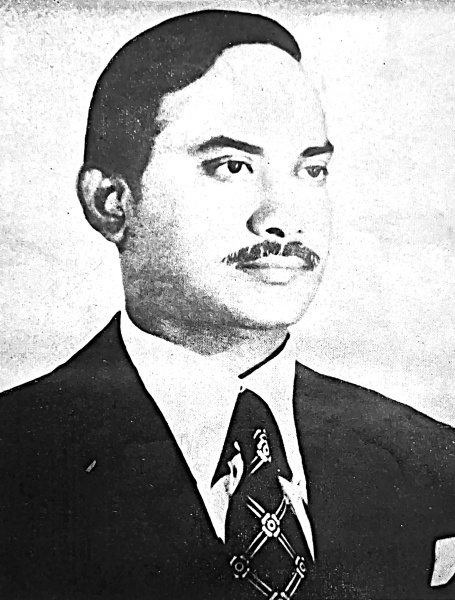
President Ziaur Rahman was assassinated in the early hours of May 30, 1981, in Chattogram’s Circuit House, during an attempted military coup.
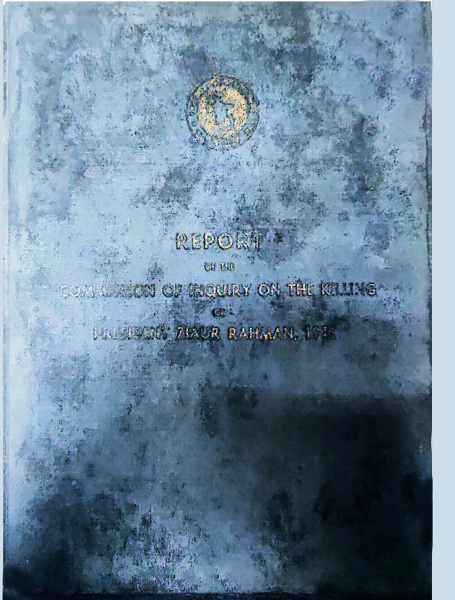
An Inquiry Commission was set up on June 6, 1981, by acting president Justice Abdus Sattar, who later became president. It was led by Justice Ruhul Islam (a former chief justice), and included Justice Abu Taher Mohammad Afzal (who later became chief justice) and Khulna District and Sessions Judge Syed Serajuddin Ahmed.

The Commission started on June 25, 1981, working out of the building that later became the Gono Bhaban.
“This report never saw the light of day. We do not know what happened to this report, and it was never made public,” said Ziauddin M Chowdhury, who was deputy commissioner of Chattogram at the time of Zia murder and was among the first to see the president’s body.
Initially, the Commission’s terms of reference tasked them with investigating whether the assassination was the result of a conspiracy. And if so, it was asked to identify the conspirators, understand their motives, uncover their plan, and examine how the assassination was organised and executed. It was also asked to identify those who supported or abetted in the conspiracy and assess the nature and extent of their complicity.
However, the home ministry later omitted this task from the Commission’s mandate, according to the report.
“The terms of reference of the Commission as set out in the aforesaid notification were subsequently amended by omitting item (i) of paragraph 2 by the Ministry of Home Affairs (Police Section-IV) Notification No. 365-6/106/81-P1(IV), dated June 13, 1981,” said the inquiry report, where item (i) referred to the task mentioned above.
After that, the Commission was left only to evaluate the security measures in place for Ziaur Rahman and assess their adequacy. It examined any failures by individuals, departments, or agencies responsible for the president’s protection.
The Commission also sought to understand why Ziaur Rahman’s body was not secured and why assailants managed to remove it from the spot, identifying any related lapses. Furthermore, it investigated the conduct of civil administration officials, including the police, from the time of the assassination until the surrender of the perpetrators.
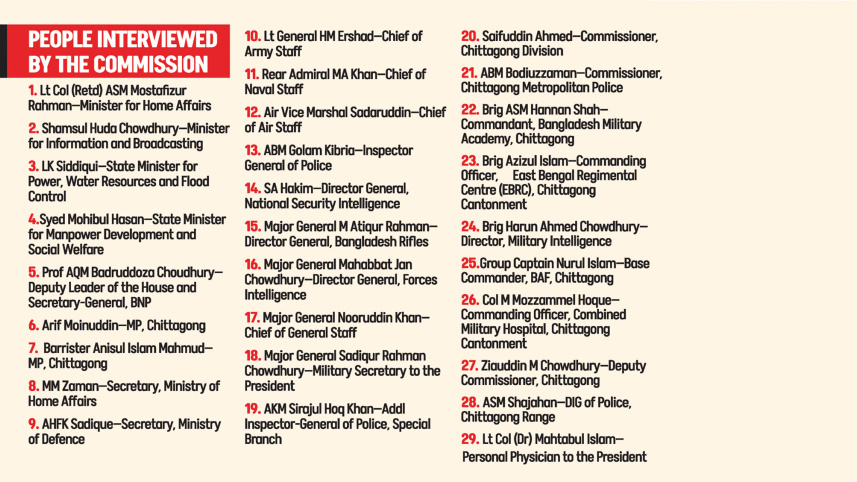
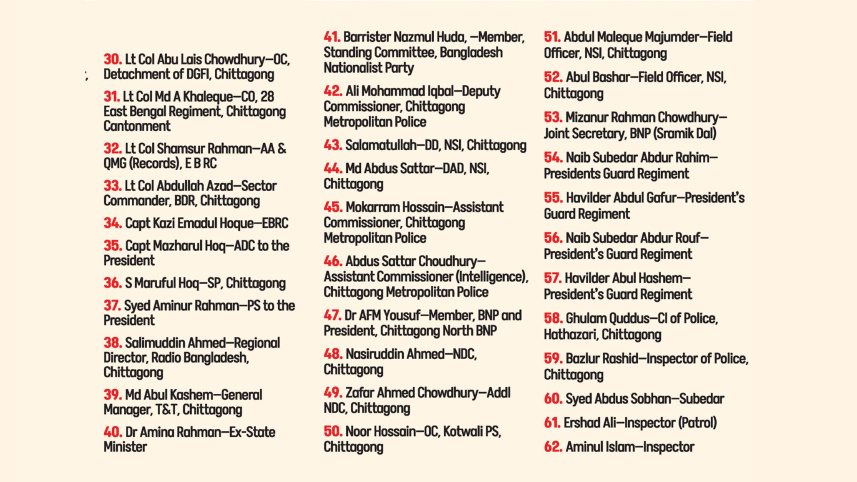
They interviewed a total of 62 witnesses, including Lt Gen Hussain Muhammad Ershad, who was then the chief of army staff.
The major finding by the Commission was that security was so lax that the killers faced almost no resistance, even though the Circuit House was armed to the hilt. “We have not been able to avoid the impression that there was practically no resistance offered to the raiders, and it was just ‘veni vidi vici’ for them,” said the report.
“Veni, vidi, vici” is a famous Latin phrase attributed to Julius Caesar, meaning “I came, I saw, I conquered.”
ROLE OF THE AIDES
The report came down heavily on Lieutenant Colonel Abu Yusuf Md Mahfuzur Rahman, personal secretary to Ziaur Rahman.
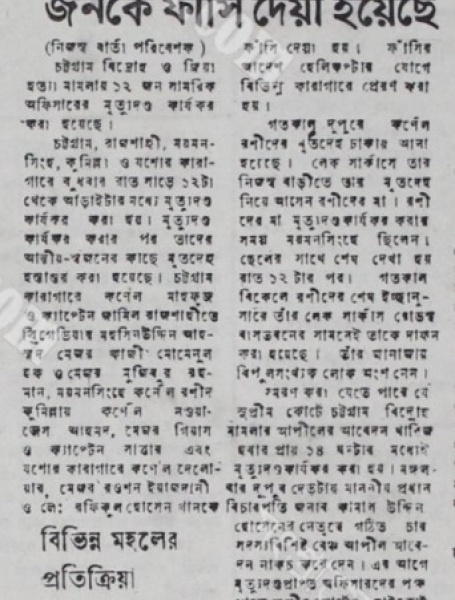
Before the submission of the report, Mahfuzur was found guilty by a military court and subsequently hanged on September 23, 1981. It also cast suspicions upon another executed army officer, Major Mujibur Rahman, as well as the president’s aide-de-camp (ADC), Captain Mazharul Huq. Major Mujibur was also hanged on September 23, 1981.
“We also have reasons to believe that the late President’s security was compromised by one or more of his personal staff during his stay in the Circuit House,” said the report.
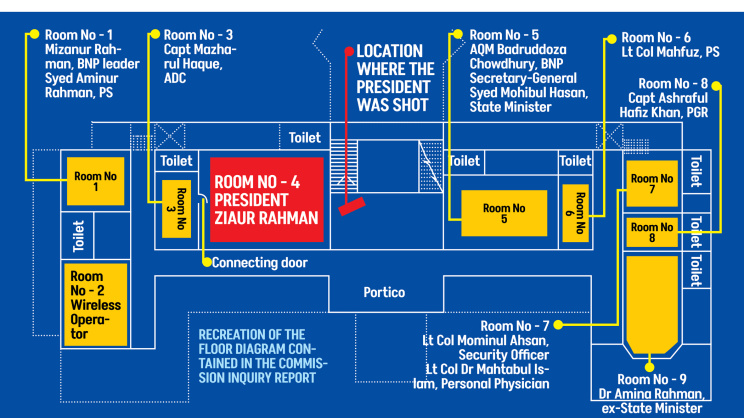
Lt Col Mahfuzur Rahman was staying in the Circuit House, in a room east of that of Ziaur Rahman’s, on the night of the murder, the report said.
According to a statement Captain Huq gave to the Commission, he came out of his room after the firing completely stopped and proceeded by the southern verandah towards Room 4 where the president was staying and saw Lt Col Mahfuzur coming from the other end of the verandah.
“Lt Col Mahfuzur Rahman told Captain Mazharul Huq that everything was lost. They saw the President lying dead in a pool of blood in front of Room No. 4. His body was riddled with bullets and part of his face was mutilated by brush-fire from very close range,” said the report.
Captain Mazharul said that they also found the bodies of Lt Col AFM Moinul Ahsan, chief security officer to the president and of Captain Ashraful Hafiz Khan of the President’s Guard Regiment. Ahsan’s body was lying in the corridor, and Hafiz Khan’s body was on the eastern side of the northern verandah on the first floor of the Circuit House.
 For all latest news, follow The Daily Star's Google News channel.
 The report continued, “It is found that Lt Col Mahfuz also allegedly opened the door of his room at the time of the raid, as did Lt Col Moinul Ahasan and Capt Hafiz. Lt Col Mahfuz was also allegedly fired upon by one of the raiders who was standing in front of the door of his room. It will always remain an enigma as to how Lt Col Mahfuz escaped without a scratch on his person, whereas the two other officers were instantaneously killed.”
The Commission examined the bullet marks on the wall inside the room where Lt Col Mahfuz was staying, which he said were caused by gunfire from outside the door. “We have had the advantage of some expert opinion offered by the Police at the time of examining the said room. It appeared to be very unlikely that the said bullet marks could be caused from outside. The location and the nature of the marks are such that the possibility of a subsequent fabrication cannot be ruled out,” said the Commission.
The report later on concluded that both Lt Col Mahfuz and Capt Mazhar did not come out of their rooms until their doors were knocked on and they were called out by a wireless operator well after the killers had left.
“It is found that these two Army Officers were busy with their telephones inside their rooms and never cared to come out for a long time. This behaviour of the persons concerned, keeping in view their attachment with and responsibility to the late President, was hardly consistent with their bona fides and sincere conduct,” concluded the report.
Regarding Captain Mazhar, the report said that his room had a connecting door to the President’s, but he did not attempt to open it during the firing. Mazhar told them that he tried to telephone the President’s room.
“There is a connecting door between the two rooms. It was the easiest thing for the ADC to reach the President or at least to have made an attempt in that behalf through that door at the time of the occurrence. While the killers were banging on the doors of the President’s room, one of the escape routes available was through the room of the ADC. One would have expected that the ADC would bang on that [connecting] door even if it was bolted from the other side and urge upon the President, who was in imminent danger, to sneak into his room. The President could have avoided the rush of brushfire for some time, may not be finally [sic]. We do not know what would have happened if that door was open. We are surprised to hear from the ADC that he did not even know that there was a connecting door between his room and that of the President,” stated the report.
They also stated a few more reasons as to why they were suspecting Lt Col Mahfuz. “It has been found in evidence that Lt Col Mahfuz, quite unusually on this occasion, asked the NDC Nasiruddin (in charge of the Circuit House) in the morning to supply him with typed copies of charts showing who was occupying which room of the Circuit House. The room distribution is done by the NDC, and a chart is only hung up on the board depicting the room arrangements, and he is not required to supply a copy thereof to anybody. We have been informed that Lt Col Mahfuz never asked for room allocation charts during earlier occasions when the President stayed in the Circuit House.”
The Commission found more. “The House Guards-in-Charge, Inspector Bazlur Rashid deposed that Lt Col Mahfuz asked him at 22-00 hrs (10:00 pm) to withdraw the two House Guards who were to be posted in front of the President’s Room on the plea that they would create disturbance to the President.” And so no guards were posted outside the room.
The Commission also questioned Lt Col Mahfuz’s motives because of what they deemed to be his lack of initiative to safeguard the late president’s body.
Shortly after the murder, Ziaur Rahman’s body was snatched by the rebel army faction and buried in an undisclosed (later uncovered in Rangunia upazila) location. Zia’s body lay at the location of the murder, practically unattended, until it was snatched.
“He sent a message to Army Headquarters in the early morning of May 30, 1981 to send a Helicopter from Dacca [Dhaka] with the Chief of Army Staff, the Military Secretary to the President and the Home Minister in order to take the dead body of the President to Dacca,” narrated the report.
“He knew it quite well that for carrying the dead body of the President to Dacca, nobody’s presence was necessary and there was no difficulty/for him to ask for a Helicopter from the local Base Commander, Bangladesh Air Force,” said the report.
It continued, “Mahfuz carried the President’s Rover set (wireless) to the Divisional Commissioner’s House from the Circuit House and the set and the Wireless operator, Nayek Abul Bashar, were there until Lt Col Mahfuz and others were taken to the Cantonment by Major lazdani after 11:00am on May 30. There is no evidence that Lt Col Mahfuz made any attempt either to pass on any information or to seek any instruction from the Army Headquarters during that time, although he had all the means available to him.”
Major Rawshan Iazdani Bhuiyan was one of the rebelling army officers and brigade major of the 65th Infantry Brigade. He was executed by the military court.
The report continued, saying that Major Mujibur Rahman, the local officer-in-charge of the Field Intelligence Unit (FIU), visited the Circuit House during the day and met the President’s military staff downstairs on the day of his visit.
“He had no ostensible business to be there. We are not prepared to accept that Lt Col Mahfuz and Capt Mazhar were not aware of the background of the relationship between the late President and the local General Officer Commanding (GOC), as also those between the DGFI (Directorate General Forces Intelligence) and the local FIU under the command of Major General Manzur,” it said.
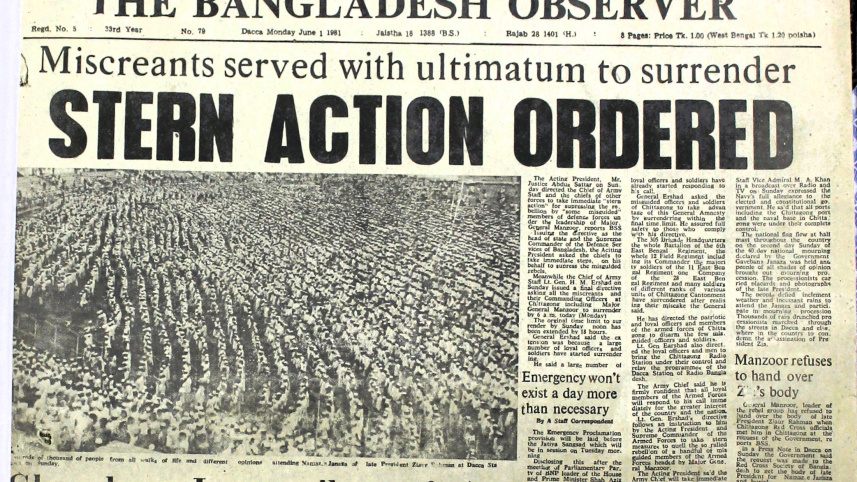
They were referring to the fact that Maj Gen Muhammed Abul Manzur, the GOC 24th Infantry Division, the unit which formed a rebel government after the assassination of Ziaur Rahman, had been openly rebelling against the late President.
“One expected that there should have been a shrewd suspicion under the circumstances that the uncalled-for visit of Major Mujib to the Circuit House was for reconnaissance purposes with an ulterior motive. It is rather strange that none of them seemed to give any importance to the visit of Major Mujib to the Circuit House, not to speak of putting on guard the intelligence and the security agencies,” said the report.
HOW ZIA’S BODY GOT LOST
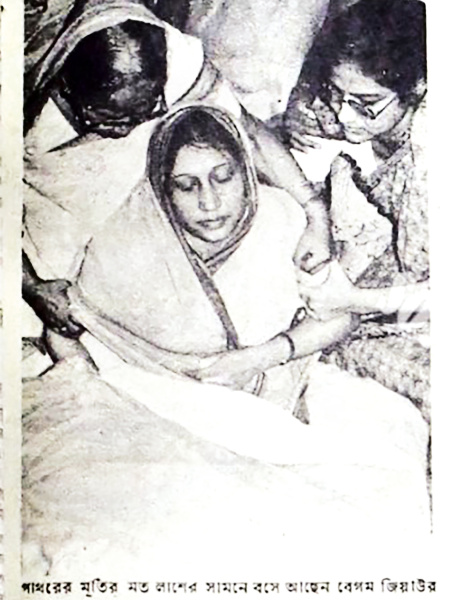
The post-mortem of President Ziaur Rahman’s bullet-ridden body found 20 separate bullet wounds on the body.
The inquiry report includes a copy of the autopsy report, which detailed at length the nature and extent of the wounds. The report stated that the President had suffered several shots to the face, that the lower jawbone was broken into pieces, and all the major structures in the neck were completely cut through -- likely caused by close-range automatic gunfire.
There were about 10 bullet wounds over the chest and abdomen, two bullet wounds on his right arm, one wound below the navel and a few scattered small wounds on both lower limbs, it said.
And in that mutilated state, the body lay in front of Room 4 at the Circuit House in the morning hours of May 30, 1981. All its notable visitors, including the divisional commissioner and the police commissioner, had left the spot, leaving two NSI officers to keep watch, according to the report.
“It is evident that they were nervous and in confusion. They were unable to cope with the situation to decide about the security of the dead body of the President exercising their own authority and judgment being under the apprehension that the occurrence was caused by a section of the local Army and that Army men were on patrol. The Commissioner was called to the Division Headquarters by Manzur,” said the report.
At 8:30am two army jeeps with one army van fixed with automatic weapons rolled up to the Circuit House.
Three Majors and 10-15 sepoys got down and confronted the two NSI officers. They took the two officers, Abdus Sattar and Abul Kalam, upstairs at gunpoint and, after entering the President’s room, asked them about “secret papers” and began searching the room themselves, the Commission found.
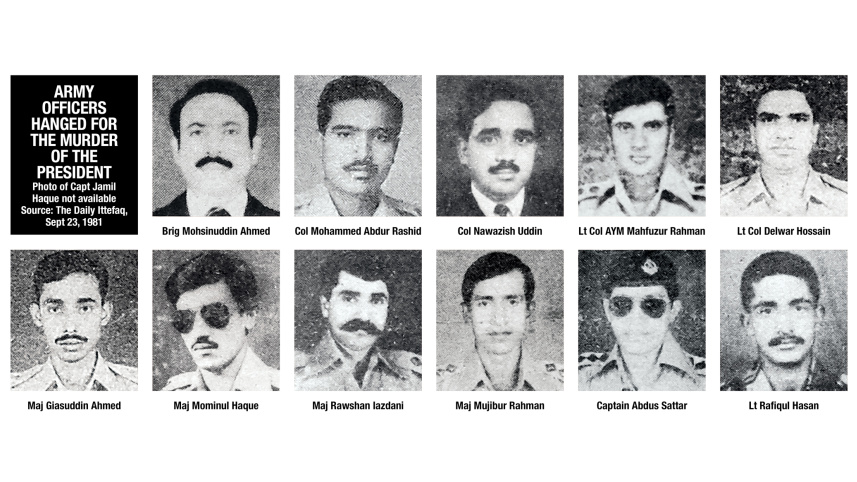
The Commission had interviewed one of the NSI officers, then Deputy Assistant Director Abdus Sattar.
“They collected the personal effects of the President and put them in a suitcase belonging to the late President. The suitcase and some other articles were brought down to the ground floor and the Majors asked Abu Kalam to guard the same and also asked Abdus Sattar to come upstairs with them,” said the report.
“The Majors searched the other rooms and while they were searching Abdus Sattar was guarding the dead body of the President along with one Major,” it continued.
It was in this part of the report that Major (retd) Md Muzaffar Hossain is mentioned.
“One of them addressed another as ‘Major Muzaffar ‘, asking him to bring the bed-sheet of the President. The dead body was covered with a white bed-sheet, and the other one also was used to wrap the dead body,” said the report.
“They then brought down the dead body of the President with the aid of some sepoys,” it continued adding that they also brought down the dead bodies of Lt Col Ahsan and Captain Hafiz, and carried all three bodies into the van. All this took one hour.
Around 12:30pm, one junior commissioned officer and some sepoys arrived at the Circuit House in an army jeep and took Ziaur Rahman’s suitcase.
“Once the dead body was taken away, the local authorities had no knowledge where the body was taken or the location of the place where the dead body was interned,” said the report.
After the fall of the rebel government on June 1, 1981, Brigadier Azizul Islam, commanding officer of the East Bengal Regimental Centre of Chattogram Cantonment, began the search for the President’s body.
The report said that he got a tip-off that the body was buried somewhere on the Kaptai Road.
The President’s aide-de-camp (ADC) Captain Mazharul Huq and personal secretary Lt Colonel AYM Mahfuzur Rahman, along with Lt Col Khaleque, the commanding officer of the 28th East Bengal Regiment, Brigadier Hannan Shah, commandant of the Bangladesh Military Academy in Chattogram, the police and the NSI, left for Rangunia upazila.
Around 9:30am they located the grave on the slope of a hill by the side of Kaptai Road, in the village of Pathargata.
The bodies of Ziaur Rahman, Lt Col Moinul Ahsan and Captain Ashraful Hafiz Khan were dumped in a mass grave. They exhumed the bodies and carried them to the CMH.
The Commission examined why measures were not taken to protect the President’s body and prevent it from getting stolen. “Before removal of the dead body by the rebels, no instruction or direction was given from Dacca for securing the dead body of the late President,” said the report.
“None of the relevant persons, as it appears from the evidence, thought of taking any initiative in the matter of securing the dead body of the President,” it said, adding that right after the assassination, the chief of Naval Staff and two state ministers had visited the site of the murder.
“The Army Chief of Staff stated that the question of securing the dead body of the President did occur to him in the morning, but since he had definite information that Chittagong garrison had rebelled and until the rebellion was crushed, the question of securing the dead body was out of consideration.
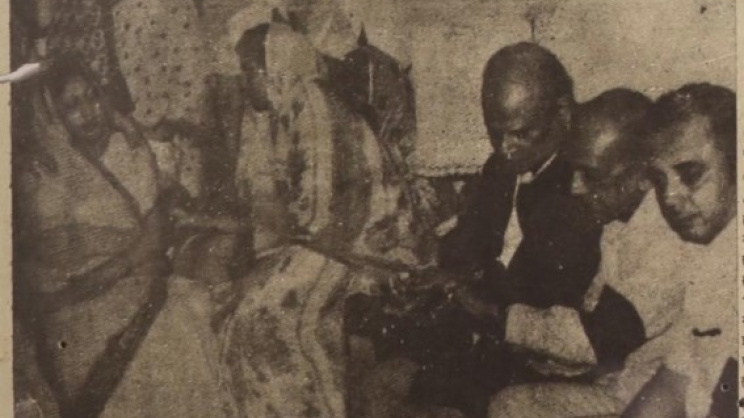
“The Chief of Naval Staff, who came to the Circuit House in the early morning said that the President’s personal secretary Lt Col Mahfuz did not ask for any assistance. He added that disposal of the President’s body required administrative decision, since he was not only a military figure.
“He also stated that at that moment he considered that his immediate task was to alert the ships and make them ready to leave the harbour, as naval ships are sitting targets in the river,” said the report.
“Syed Mohibul Hasan, the State Minister for Manpower and Social Welfare, who was in the Circuit House with Ziaur Rahman that night, stated that he had advised Lt Col Mahfuz to contact Dhaka immediately and had been told that Mahfuz had informed the military secretary over wireless that they were sending a helicopter.
“As there was no response from the local Army, they became apprehensive that the Army itself might have been involved in the occurrence. So he along with Dr Badruddoza Chowdhury left the Circuit House as they considered that it would not be advisable to stay there any longer,” added the report.
It added that LK Siddiqui, State Minister for Power and Water Resources, came to the Circuit House at 7:45am. He told the Commission that Lt Col Mahfuz told him that Dhaka knows, and he was told to leave the Circuit for safety reasons.
Shamsul Huda Chowdhury, Minister for Information and Broadcasting, told the Commission that the Council of Ministers in Dhaka discussed the dead body of the President but no decision was made.
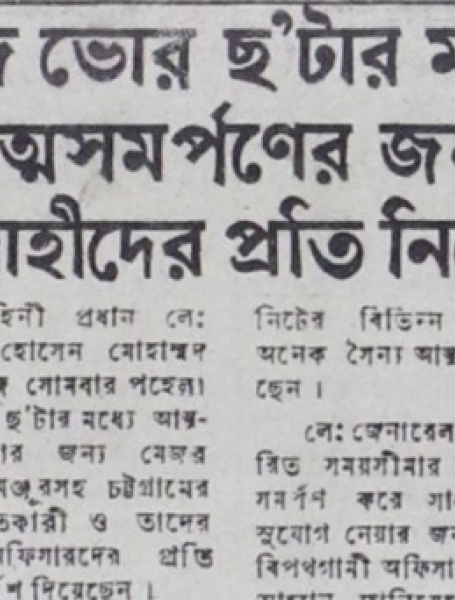
According to the report, the then home minister Lt Col (Retd) ASM Mustafizur Rahman told the Commission that he did not recollect any decision being made by the Council of Ministers in Dhaka about extracting the President’s body. He said that “in an abnormal situation it was expected that the local officials (in Chattogram) would act as per their own initiative and they would take action which could be discussed and approved at a later stage”.
When the Commission asked him what could the local officials have done with the President’s body, he replied saying, “They could have hid the dead body somewhere”. He considered it to be risky to transport the dead body out of Chattogram.
The Commission found the suggestion “ludicrous”.
“We have not been able to visualise as to how the local officials could secure the dead body for hiding it, as suggested by the Minister for Home Affairs. Where could they have hid it? Was it at all natural to expect of them to think of such a step in that morning?”
The Commission also said that none of the more responsible persons who happened to be there at the Circuit House at that time, namely, two State Ministers and the Chief of Naval Staff, did even think of giving any suggestion or instruction to the local officials with regard to the security and protection of the dead body of the late President.
The Commission observed that in that moment of national crisis it did not occur to the Council of Ministers even to issue any direction in this regard.
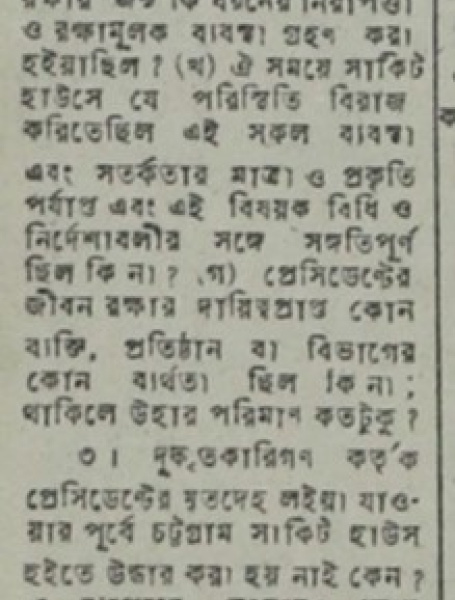
The divisional commissioner of Chattogram during his meeting with Major Gen Manzur on the morning of May 30, 1981, apparently raised the issue of securing the dead body of the late president, but was told that the army was taking care of the dead body.
“The city of Chittagong was in a state of siege from the morning of May 30, 1981, up till small hours of June 1, 1981,” said the report.
“Keeping in view the abnormal and grave situation prevailing in the morning of May 30, we are led to the conclusion that it was not practicable for any of the [local] officers to remove the dead body of the President from the Circuit House, particularly when from morning of May 30 it became clear to everybody that a coup by the Army had taken place, and the local Army was in control of Chittagong and Army units took position at important centres, such as, Radio Station, T&T (phone lines), and Port,” the report pointed out.
“Their [the local officials] helplessness was heightened due to absence of any instruction or response from Dacca. Placed in such a situation, they adopted a ‘wait and see policy’ and for this they cannot be blamed,” said the report. “We do not find any fault with any member of the local administration including the Police for not securing the dead body of the late President from the Circuit House.”
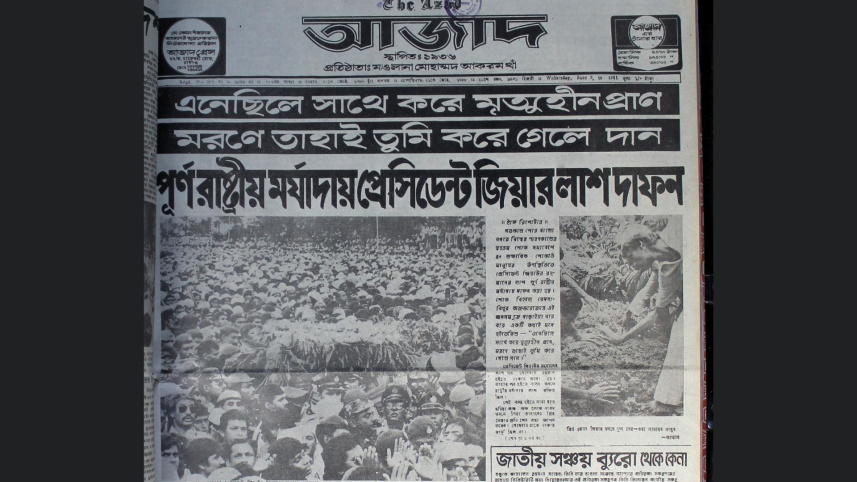
After post mortem, the body of Ziaur Rahman was flown to Dhaka in an Air Force transport plane, and taken first to the “Rashtrapati Bhaban” and to the National Parliament. A big procession on Manik Mia Avenue followed on June 2, 1981, for the janaza, before being taken to its final resting place beside the Crescent Lake.
“As the body was being lowered in the grave around 1:00pm, the three contingents drawn from three Services stood at attention, the Army Buglers sounded the last post, the three Chiefs of Defence Services saluted the leader and the vast concourse of assembled humanity paid their last emotional and tearful homage.”
‘VENI VIDI VICI’
The Inquiry Commission, set up on June 6, 1981, by President (acting president at that moment) Justice Abdus Sattar, concluded that the president’s assassination was a gross security and intelligence failure.
“It becomes apparent and we have no hesitation in holding that the failure of the Intelligence Agencies to forewarn about the conspiracy hatched up by Major General Manzur and particularly the plan of its execution on the date of occurrence was the primary reason which caused grave insecurity to the person of the President and finally cost his life under tragic circumstances,” said the report.
The Commission said that they were “of the view that there was considerable laxity both in degree and nature of vigilance exercised by the security forces.”
Around 3:45am on May 30, 1981, there was a commando-style attack on the Circuit House where President Ziaur Rahman was staying. According to the report, the attackers launched two rockets in quick succession and blasted several grenades. Both the rockets hit the room on the ground floor right beneath the one in which Ziaur Rahman was staying. The rocket-shelling was followed by intense firing.
Some of the attackers quickly got up to the first floor by the main staircase, while the rest used the back-side staircase on the eastern side of the building.
“The late President opened the door on the eastern side of his room and stepped out of the room saying, ‘Tomra ki chao’? Instead of giving reply to the query, the intruders showered his body with brush-fire from sten machine guns, and the President fell on the floor dead. The powerful voice of a valiant fighter, who loved his people and his country most, was silenced forever,” said the report.
Both the major intelligence agencies informed the Commission that they had previously warned Ziaur Rahman about Major General Manzur’s mutinous tendencies.
They were referring to Maj Gen Muhammed Abul Manzur, the general officer commanding of the 24th Infantry Division, the unit which formed a rebel government after the assassination of Ziaur Rahman. Manzur had been openly rebelling against the late president.
Major General Sadiqur Rahman Chowdhury, military secretary to the president, told the Commission that the DGFI was aware of Manzur’s ambition to topple the president and had communicated the information, but the president had apparently ignored it.
SA Hakim, director general of National Security Intelligence (NSI), told the Commission that they had frequently warned him about Manzur.
“Major General Mohabbat Jan Chowdhury, Director General of DGFI, was asked as to whether he was aware, at any time, that Manzur might make a bid to seize state power by staging a military coup. His answer is that there was suspicion that he might attempt a coup for taking power. He added that on analysis of the situation they considered that the time was not ripe. They never expected that such an action would be taken and they could not anticipate such premature action,” said the report.
“To the question of the Commission, the General, however, agreed that his agency in Chittagong failed as they could not have [obtained] early warning about the move of the conspirators,” it added.
The former intelligence head told the Commission that the decision to conduct the assassination operation was limited to a few close associates of Manzur, and the team was formed around 1:30am at night on May 30, 1981.
“He said that there was a lot of Army vehicle movement both inside and outside the Cantonment since there was night training on May 29, 1981. So, the movement of the rebels to Kalurghat and from there to Circuit House could not be detected,” said the report.
Brig Haroon Ahmed Chowdhury, director of Military Intelligence, was responsible for Chattogram. “He stated that he did not have prior information that some Army Officers led by the GOC of Chittagong were hatching up a plan for some time to remove the late President and install Manzur in his place. However, he admitted that it was a part of his duty to collect information about such happenings,” said the report.
Regarding the role of the police’s Special Branch, the Commission’s report stated, “It does not appear from the evidence of the Deputy Police Commissioner (SB) that there was any arrangement for obtaining intelligence reports even about the movements around the Circuit House for checking the evident phenomena which indicated the impending attack on the Circuit House by a section of Army.
“It is also found from the police arrangements that there was no detailment of intelligence officers or security police with necessary walky-talky or Wireless sets for alerting the security guards of imminent danger, if any, to the security of the person of the President. It is felt that there should have been “listening points” around the roads leading to the Circuit House. Had this been done, the security guards could be alerted ahead of the raiders approaching the Circuit House.”
The Commission found that there were a total of 26 constables, 6 habildars, one subedar and two buglers (a person who sounds a bugle) posted in the Circuit House as house guards. In addition, there were three constables at the outer cordon, and three in the cordon in civil clothes and the whole troupe was under the supervision of one inspector.
“Besides the aforesaid police arrangements, a squad of the President’s Guard Regiment consisting of 11 Sepoys, 1 Naik, 1 Havildar and 1 Naib-Subedar under the leadership of late Captain Ashraful Hafiz Khan which arrived at Chittagong on May 28, from Dacca were also stationed at the Circuit House to ensure safety,” it said.
All the constables were armed with 303 rifles, while the head constable had a submachinegun or a revolver. The outer sentries were armed with self-loading rifles, while the President’s Guard Regiment squad was equipped with light machine guns and submachine guns. Captain Hafiz had his own revolver.
However, even with this arsenal of infantry and weapons, the law enforcers fell short, found the report.
“We have been told by the senior police officers that in the face of the superior arms of the raiders, the weapons available to the police force were rather obsolete and were practically of no avail to resist the aggression. We find it difficult to accept this line of reasoning wholly. It is true that the initial attack from outside commenced with the launching of rockets on the Circuit House by hand launchers and the firing of grenades from GF Rifles, but the assault inside the building was carried on with SMGs. We are aware that the Head Constables of police and sentries from the President’s Guard Regiment were also armed with similar weapons, ie, SMGs,” said the report.
The Commission said that they had “been driven to the conclusion that the first floor of the Circuit House could have been reasonably well-secured with great advantage by posting a few sentries on the staircase with some imagination.
“As to the performance of the police force on duty at the main gate and outer and inner cordons, we have not been able to avoid the impression that there was practically no resistance offered to the raiders.”
The Commission said that it was storming that night, and the night shift was nearing its end, and the sentries were seeking refuge in dry places.
“We have also this evidence that the police personnel, including the sentries, huddled together on the ground floor verandah and Conference Hall and lounge of the Circuit House, looking for a place to take shelter from the rains and rest since past midnight,” said the report. “It is significant that there was no casualty at or near the main gate.”
The Commission said that at least one private car entered through the main gate after midnight without being checked by anybody, and that the main gate was wide open all night long.
“We feel that there was a major error in keeping the main Iron Gate of the Circuit House open during the night. We are surprised that it did not occur to anybody that the wide open gate was a great security hazard by itself, and there was no reason not to have closed it.”
“The vehicles rolled on unopposed near the portico and the raiders who kept on firing quickly disembarked, and some of them rushed up to the first floor by the main staircase without any difficulty or obstruction,” the report continued.
The Commission marvelled at the fact that none of the raiders had suffered any injuries at the hands of the sentries.
“It is significant that none of the raiders received any injury in the hands of the forces on duty although it has been claimed that about 200 rounds were fired by the Police during the raid from different weapons,” it said. “We have no manner of doubt, however, that much of it was random firing and that too, in all probability, after the intruders had left.”
The Commission, however, pointed out that one police constable named Dulal Miah, who was on sentry duty, was killed. “He seemed to be the only man who held to his post.”
It also pointed out that there was no security guard, “absolutely none”, around the President’s room, or at his door, or even on the first floor.
“We have noticed that the sentry sepoy Abdur Rouf (President’s Guard Regiment), who was to have been in front of the door of the President’s Room, was found lying dead on the northern verandah downstairs,” noted the Commission, with alarm. The Commission said that while four members of the President’s Guard Regiment were killed and two seriously injured, they were nowhere near the room or in front of the door of the President.
The Commission stated that “a few determined persons with due motivation, if properly posted at a vantage position of the staircase, could have successfully forestalled the raiders from reaching the first floor.”
The Commission called it the worst of tragedies, that “in the presence of all the trained men with their adequate weapons and, last but not least, in spite of having all the tactical advantage of defending the person of the President from inside the Fort-like building, there was none to protect the President.”
The Commission found that only 14-16 officers participated in the operation at the Circuit House.
“Our considered opinion is that the concerned Intelligence Agencies of the Government, the Police and the President’s Guard Regiment, as responsible agencies and departments for the protection of the person of the President, were at fault in varying degrees in the discharge of their duties which resulted in the tragedy at the Chittagong Circuit House in the early hours of May 30, 1981.”
KILLING OF MANZUR
Major General Muhammed Abul Manzur had fought alongside President Ziaur Rahman in Bangladesh’s Liberation War against the Pakistani Army in 1971, when they were both majors.
But apart from being colleagues, they were also close friends, said the Commission’s report.
The Commission was not tasked with investigating the killing of Manzur, which took place inside the Chattogram Cantonment on June 2, 1981. He was shot dead hours into surrender.
However, the Inquiry Commission had interviewed 62 witnesses, including 19 from the military, and the report included several chapters covering Manzur’s role and his murder.
“After President Ziaur Rahman came to power, the relationship gradually became strained, and some sort of rivalry surfaced between them. Late Major General Manzur started nurturing hatred towards the late President and even showed disrespect to him publicly in the presence of other officers,” said the Commission’s report. They called this a violation of the discipline of the defence services.
“Major General Manzur appears to have decided to strike finally to fulfil his ambition of seizing the power of the Government when he was informed about the visit of the President to Chittagong,” said the Commission, citing senior army officials. “As the General Officer Commanding, 24 Infantry Division and Area Commander, Chittagong, General Manzur was consolidating his power by securing like-minded officers transferred and posted there.”
The Commission concluded that Manzur felt that “the only way to undo all the wrongs was to capture the seat of political power, if necessary, by killing the President”.
The President had passed an order on May 25, 1981, transferring Major General Manzur to the post of Commandant, Defence Services Command and Staff College in Dhaka.
“It is not difficult to see how a General having command over roughly one-third of the Armed Forces, and who was aspiring to capture power by military force, would feel like upon receiving such an assignment of teaching. We have no doubt that the arrogant General must have felt that the offensive had come from the opponent and it was time for him to retaliate with full fury,” said the Commission in its report.
Lt Col Abu Lais Chowdhury, the commanding officer of the Chattogram detachment of the Directorate General Forces Intelligence, told the Commission that from the middle of 1980, he marked an attitude of frustration among a younger group of army officers regarding the administration in the country. He said that Major General Manzur transferred like-minded officers into the Chattogram Garrison one by one.
“While giving his reports, he recommended the disintegration of such like-minded officers from Chittagong systematically,” said the report.
The officer told the Commission that by the end of November 1980, there was a meeting in which the jawans expressed their grievances. “General Manzur then rose up and said it was not within his power to fulfil their demands in his present position, indicating his own mind,” said the report.
From February 1981, General Manzur barred the DGFI officer from the Cantonment. “He was to wait at the MP Check-Post and security men would follow him, which made him particularly ineffective,” said the Commission’s report.
As the killers left the Circuit House, following the assassination of President Ziaur Rahman, the scene of activities shifted to the Division Headquarters in the Cantonment.
“Since early morning of May 30, 1981, Major General Manzur was found sitting in his office room, contacting officers, writing laborious notes and giving occasional directions. He left nobody in doubt that he was the major domo,” said the report.
“There was noticeable euphoria amongst the officers who just came back after killing the President, but others who did not know about the incident became increasingly inquisitive,” it continued. “The killers were distributing costly foreign cigarettes among themselves, and someone was asking for a big radio set to be brought to listen to the news of their glorious revolution.”
The morning after the assassination, around 9:40am on May 30, 1981, Radio Bangladesh’s Chattogram station announced that the Army Revolutionary Council had taken over the Government of the People’s Republic of Bangladesh and President Ziaur Rahman was killed. Manzur did not reveal who the members of the Council were.
Around 10:00am, the then divisional commissioner of Chattogram, Saifuddin Ahmed, was called to the cantonment by Manzur. The commissioner and deputy commissioner Ziauddin M Chowdhury were escorted to the cantonment by Major Mujibur Rahman, local officer-in-charge of the Field Intelligence Unit (FIU). They were formally told by Manzur that the Army Revolutionary Council was in control of the country.
“Major General Manzur gave some directions to them and told them to receive instructions only from him, and those must be obeyed. Each of the Officers assembled in the office of the GOC was made to touch the Holy Quran, showing allegiance to the cause of the Revolution,” said the Commission’s report.
They were informed that there would be a meeting of all the heads of the different government departments, senior bank officers, railway, and port officials at 10:30am the next day in the Court building.
On the following day, May 31, Manzur arrived at the Court Building at 11:15am and addressed a meeting held in the conference hall of the Deputy Commissioner’s Office in Chattogram.
“In his address, he told the meeting that none should listen to the Dacca Radio broadcasts. He asserted that he was very much in command and Dacca must bow down to his demands,” said the Commission’s report.
“Amongst others, he directed the Port Authority not to allow any ship movement; and that no petrol should be sent to Dacca. He directed the Regional Director, Radio Bangladesh, Chittagong to comply with the instructions given to him and maintain 24 hours service. He directed the local Bank officials to carry on the functioning of the banks. He left the Court Building at about 13-00 hours (1:00 pm).”
This government would not last long. The rebellion would collapse that very night.
“It is found from the evidence of Brigadier Hannan Shah, commandant, Bangladesh Military Academy, that the dialogue with the Army Headquarters for a negotiated settlement started early in the night of May 31, and continued till 00:30 hours (12:30am of June 1, 1981),” said the report.
“He was the chief negotiator on behalf of the rebels as directed by Major General Manzur himself. But the Army Headquarters was not prepared to accept any terms except unconditional surrender by the rebels. The rebel leader appeared to be completely broken down, and himself talked to the Chief of the General Staff after midnight,” the report said.
The Commission found that the rebel government was poorly planned. “From the facts and circumstances since the occurrence, we have no doubt that the actual planning of the operation at the Circuit House was done in a hurry and the conspirators had no planning and preparation for the follow-up steps to be taken. The whole episode following the killing of the President right up to the apprehension of Major General Manzur with his family appears to be singularly amateurish and an exercise in apprenticeship,” the report stated.
Major Gen Manzur, his family, his other accomplices and the family of Lt Col Delwar Hossain left the cantonment between 2:00am and 3:00am of June 1, 1981, in two jeeps and one pick-up truck and travelled through Hathazari and Fatikchhari.
Major SM Khaled and Major Rawshan Iazdani Bhuiyan picked up their two men who had been injured during the Circuit House operation and had been receiving treatment at the Combined Medical Hospital and fled with them in tow.
The report said that at one point Maj Gen Manzur, Lt Col Delwar, their families, as well as Major AKM Rezaul Islam and Major AZ Giasuddin, ditched their cars and started on foot, going deeper into the hills of Chattogram.
Around 3:30am, Abdus Sattar, a deputy assistant director of NSI, was informed by Brig Azizul Islam, the commanding officer of East Bengal Regimental Centre, that the rebels had fled.
He took two field officers and a constable and set out by car at 7:30am to track down the rebel leader, and reached Fatikchhari police station an hour later. At the station, he found the two injured rebels, Lt Col Fazle Hussain and Captain Jamil Huq -- even though they had been taken along while fleeing, they were later left behind when the group dumped their cars and proceeded by foot.
The injured rebels told Abdus Sattar that Maj Gen Manzur and the others were going towards Manikchhari, and Sattar’s team set off accordingly. On the way, they came across the abandoned army vehicles, said the report.
“The party also came to know from the public that two officers in uniform with some children and ladies proceeded towards Asia Tea Garden on foot,” said the report.
Sattar went back to Fatikchhari police station for backup. He, along with the police, headed out for Asia Tea Garden.
“The party, dividing itself into three groups, started searching in and around Asia Tea Garden. At about 3:30pm, they got information that some Army Officers with ladies and children were seen hiding in the house of tea garden coolie Manu Mia near No. 2 gate of Asia Tea Garden,” said the report.
They went to the spot and surrounded the spot. “On learning about the presence of the police party, Maj Gen Manzur came out with a Chinese automatic rifle in hand,” said the report. The search party threatened him with death and told him to surrender. Manzur put down the weapon and surrendered without any resistance, the report said.
The police arrested Manzur, his wife, his four children, Major Reza, the wife of Lt Col Delwar and his three daughters and loaded them onto two jeeps. They were taken to the main road where Maj Gen Manzur, his wife and their youngest child were shifted to a private car, while the rest stayed in the jeep. The NSI officer Abdus Sattar got into the car with Manzur.
They reached Hathazari police station at 7:30pm, but did not feel safe about going to Chattogram. The report stated that the capture of the rebel leader had drawn massive crowds, and the cops called for additional backup from Chattogram range.
Both the police superintendent of Chattogram and the deputy inspector general of the range reached the spot within an hour -- but so did Captain Emdadul Haque.
“Captain Emdadul Huq requested the DIG to hand over Major General Manzur and others to their custody,” said the report. The top cops contacted the Chattogram police commissioner and the divisional commissioner and requested them to get clearance from Dhaka as to whether Manzur would be handed over to the army.
The report said that the police were instructed to go ahead, and so they handed over Manzur, his wife, children, Major Reza, the wife of Lt Col Delwar and his three daughters to the Captain. They obtained a written receipt from him documenting the transfer.
“When Maj Gen Manzur was being handed over to the Army Officer, he protested saying that as he ceased to be an Army Officer, he should be handed over to the Civil Authority who would arrange his custody. However, in view of clear instructions from the Army Headquarters, the arrested rebel-leader Maj Gen Manzur, Major Reza and other members of his party were handed over to Captain Emdadul Huq,” said the report.
“Maj Gen Manzur was practically dragged from the police truck to the Army vehicle. Captain Emdadul Huq tied the hands and legs of the rebel leader with ropes, and his two eyes were blindfolded with a piece of cloth,” said the report. The rebels and their families headed towards the Cantonment.
Captain Kazi Emdadul Huq was one of those interviewed by the Commission.
He told the Commission that they were heading to VIP House but noticed troops storming the road, so they took a detour.
Near the CSD Canteen, armed soldiers stopped and surrounded the vehicle. They opened the rear door and took control of Manzur. Captain Huq said that he had pleaded with them to let him take Manzur to the Commanding Officer for proper legal action, but the troops ignored him and threatened to kill him (Huq) if he didn’t leave.
Captain Emdadul Huq then left to report the incident to Brigadier Azizul Islam. At the office, he found Brigadiers Azizul Islam and Abdul Latif waiting. After hearing his report, they took some time to decide. Later, Captain Huq was called back to Brig Azizul Islam’s office, where Lt Col Shamsur Rahman and Major Kamal were also present.
Brig Azizul Islam and Lt Col Shamsur Rahman were also interviewed by the Commission for their version of the events.
“They were sent to the spot where the Jeep had been stopped with Major General Manzur therein. Lt Col Shamsur and his party reached the spot and found some persons standing on the west corner of the tri-junction where Captain Emdadul Huq had got down from the jeep,” said the report.
“On seeing them, the people standing there slowly melted away. Lt Col Shamsur Rahman and his party saw something lying on the ground. On coming closer, they found that it was the body of Major Gen Manzur,” said the report. He was dead.
The Commission interviewed the commanding officer of the Combined Military Hospital of Chattogram, who said that Manzur had a gaping wound on the back of his head, towards the right. The wound was 4-inch by 2-inch.
Both the inquest report and external post-mortem report said that it was a bullet wound, noted the Commission’s report.
Manzur was buried in the Army graveyard in Chattogram.
“Thus, the episode of rebellion ended,” said the report.