


Spare businesses from stiff policies
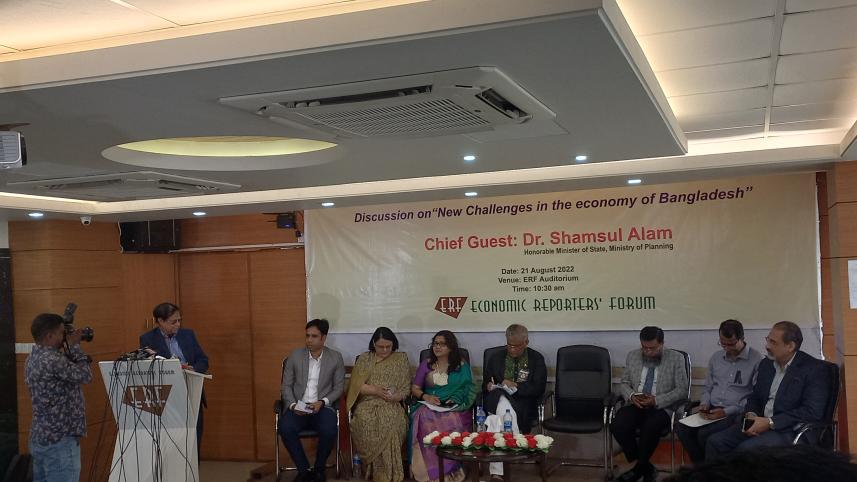
Businesses yesterday urged the government to spare them from stiff policies as they were navigating through difficult times for the ongoing energy and dollar crisis, inflation and increasing order cancellations.
They said they were worried over energy security and that the government should rethink its energy policy.

"Industries and businesses should be deregulated as we have to go through so many unnecessary formalities in doing business," Abul Kasem Khan, former president of the Dhaka Chamber of Commerce and Industry (DCCI).
"For example, there is no need for a trade licence, which is problematic to conduct business. The more we ease the rules in doing business, the more business will expand, revenue will be collected and the country will be benefited," he said.
"To catch one unscrupulous business, we are choking the honest 99 businesspeople," he said at a discussion titled "New Challenges in the Economy of Bangladesh" organised by Economic Reporters' Forum (ERF) at its auditorium in the capital.
"We want to be tax compliant but want to avoid tax complications. Sometimes it is reaching the level of harassment," said Khan.
He also stressed adopting a 10-year masterplan on offshore energy exploration and substituting imported liquefied natural gas with local coal.
Mohammad Hatem, executive president of the Bangladesh Knitwear Manufacturers and Exporters Association, said garment export orders were declining and buyers were abruptly suspending orders apprehending global recessions.
"Many factories were compelled to close production lines due to low demand. On the other hand, repeated hikes in energy prices are leading to a rise in production cost and raw material costs have increased substantially," he said.
"The profit of the profitable company is declining while many are facing losses," he added.
Nihad Kabir, chairperson of Business Initiative Leading Development, said there were some weaknesses in the management of the economy and financial sector.
If these weaknesses are not overcome, the future will not be good, she said, adding that maintaining competitiveness was now the prime challenge.
Various obstacles are being created to business through policies, leading to a rise in the cost of doing business, she said.
She said although the economy was not facing any big challenge, common people were having to pay more for an increase in the price of rice, fish and chicken.
She said the prices of fuels was decreasing in the world market and it had to be adjusted in the local market.
Nihad said even countries like Germany were opening coal-fired power plants. "So, we can also go for coal," she said.
Shamsul Alam, state minister for planning, said although there was a stockpile of high-quality coal in the country, the government had to import coal.
This was to pacify general people as sometimes the government needs to prioritise political actions rather than giving in to economic consideration, he said.
He said there were apprehensions that farmlands would be damaged if coal was extracted from underground.
Alam alleged that the country's economists mostly tend to express concerns while failing to see attainments and possibilities.
 For all latest news, follow The Daily Star's Google News channel.
 "But the foreign research institutions have highlighted the strengths and potentials of the economy of Bangladesh," he added.
Alam said the fuel price hike instigated inflation while there was no denying the fact that people were now suffering.
There was no alternative to raising the price of fuel. But the government has taken various steps and hopefully the inflationary pressure will come down by October. Despite that, some pressure will be there, he said.
But there is no crisis in the country, he added.
Chief Economist at Bangladesh Bank Md Habibur Rahman said the inflationary pressure would persist as it has wholly been caused by imports.
"Despite this, Bangladesh Bank has taken various steps to contain inflation, bring stability in the exchange rate, and ensure discipline in the financial sector. For this, efforts are on to control inflation through improving the supply side without raising the interest rate," he added.
Ahsan H Mansur, executive director of the Policy Research Institute, said the monetary policy was not working well to contain the inflationary pressure while hard times were looming large.
He said the deficit in balance of payments would not go away very soon if export earnings and inward remittance do not increase, imports do not decline, and there was a desirable balance in foreign trade.
He said the government was doing very little to rein in inflation.
Sharmeen Rinvy, president of the ERF, also spoke while and SM Rashidul Islam, general secretary, moderated the event.
Comments