


Private sector credit growth falls to 33-year low

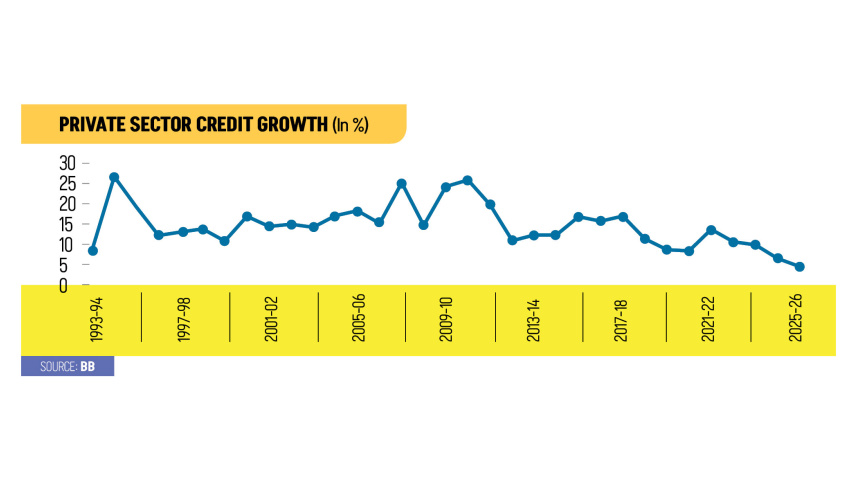
Private sector credit growth fell to its lowest level in the past 33 years as businesses lost their appetite for borrowing, shelved investment plans and banks remained cautious about lending amid mounting economic pressures.
Private sector credit grew by 4.47 percent in June, down from 4.98 percent in May, according to Bangladesh Bank (BB) data.

Central bank officials said the June figure was the weakest since 1993. The previous low was 4.72 percent in March this year.
“You could say we are in a state of economic war,” said Syed Mahbubur Rahman, managing director of Mutual Trust Bank.
He said businesses are holding back investment because of weak export demand, declining household incomes and an uncertain economic outlook.
“Many factories are running below capacity because of gas shortages,” said Mahbubur, who is also the former chairman of the Association of Bankers Bangladesh (ABB).
He said inflation has also remained stubbornly high, further eroding demand for credit.
The point-to-point inflation rate eased to 9.16 percent in June this year from 9.42 percent in May, but remained above 9 percent.
“When there is little investment, why would people borrow? Overall, the situation is quite bleak,” said Mahbubur.
“With export demand remaining weak, the opening of LCs [letters of credit] has also nearly come to a halt.”
The senior banker urged the government to respond quickly. “It should identify a few key priorities and act on them. This challenging period requires a collective effort, with everyone working together to overcome the crisis.”
Md Touhidul Alam Khan, managing director and CEO of NRBC Bank PLC, shared a similar assessment.
He said there are no major investment projects in the pipeline, while LC openings also remain weak. At the same time, many banks have limited capacity to extend fresh loans because of the growing burden of non-performing loans (NPLs).
At the end of March, defaulted loans stood at Tk 588,704 crore, or 32.26 percent of the Tk 1,824,668 crore in outstanding loans, according to BB data.
Touhidul said banks are instead focusing on smaller borrowers. “We are now focusing on the SME sector and trying to expand small-ticket lending.”
The June credit growth also missed the central bank’s own target. The BB initially projected private sector credit growth of 8.5 percent for January to June under its monetary policy for FY26.
It later revised the June target to 5.5 percent in the monetary policy statement for July to December of FY27. Even after the revision, actual growth remained well below the target.
In its latest quarterly report, the BB said private sector credit growth has been slowing for the past two fiscal years because of cautious lending by banks, rising non-performing loans, weakening business confidence, subdued investment and global economic uncertainty.
Md Akhtar Hossain, chief economist at the central bank, said weak credit growth should not be viewed in isolation. He said rapid credit expansion during the previous Awami League government reached as high as 20 percent, but much of that lending went to large borrowers who later siphoned off the funds.
“So, while credit expanded rapidly, it ultimately caused significant damage to the economy,” said the BB chief economist.
 For all latest news, follow The Daily Star's Google News channel.
 Akhtar said banks are now reluctant to lend after a sharp deterioration in asset quality. “More than 30 percent of loans have turned non-performing, leaving banks uncertain about whether new loans will be repaid.”
He said many banks are investing in government treasury bills and bonds instead of extending loans because those investments carry little risk. At the same time, even financially sound businesses are delaying investment and expansion because of economic uncertainty.
The chief economist said conditions should gradually improve as recent policy measures begin to take effect. “The government and the central bank are taking measures to revive credit growth and support business activity.”
The policy interest rate has been reduced to encourage borrowing, while the central bank is urging banks to lend to creditworthy customers, he said.
On July 30, the BB cut its policy, or repo, rate from 10 percent to 9.5 percent, its first reduction in six years.
“Stimulus packages have also been announced. As a result, private sector credit growth is expected to recover in the coming months,” Akhtar added.
Comments