


NBR misses revenue target for 10th straight year

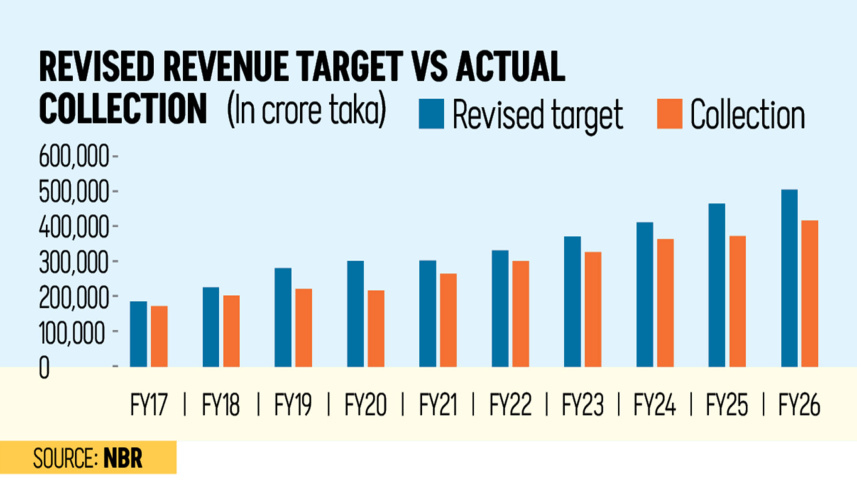
The National Board of Revenue (NBR) has missed its revised annual collection target for the 10th consecutive fiscal year, adding to pressure on government finances and social spending.In fiscal year (FY) 2025-26, the tax authority collected Tk 4.15 lakh crore, falling Tk 88,000 crore short of its revised target, according to provisional NBR data released yesterday.
Economists said the target was unrealistic from the outset, given the NBR’s structural weaknesses, while revenue officials blamed slower economic activity and weak public spending.

“Government expenditure does not stop because revenue falls short. The shortfall has signalled deeper fiscal stress,” said Mohammad Lutfor Rahman, a professor of economics at Jahangirnagar University.
Once the budget is approved, spending on salaries, development projects and social safety net programmes continues throughout the year. When expected revenue fails to materialise, the government has little option but to rely more on domestic and external borrowing, he said.
The impact extends beyond a single fiscal year because additional borrowing raises future debt-servicing costs.
“Loans have to be repaid with interest. As debt servicing takes up a growing share of the budget, fewer resources remain for development spending, which is essential for sustaining long-term economic growth,” he said.
Bangladesh paid $4.5 billion in debt servicing in the last fiscal year, according to the Economic Relations Division.
The NBR has set a revenue target of more than Tk 6 lakh crore for the current fiscal year (FY27), which economist Md Deen Islam described as overly ambitious and likely to widen the budget deficit if missed.
“Historically, the NBR has never achieved annual revenue growth of more than 30 percent. Given last year’s collection, the new target is unrealistic,” he said.
A larger revenue shortfall would force the government to borrow more, making it harder for the central bank to contain inflation while further discouraging private investment.
“Businesses and foreign investors need a stable macroeconomic environment. A widening fiscal gap weakens confidence and discourages investment,” Deen said.
He added that Bangladesh’s low tax-to-GDP ratio reflects not only a narrow tax base but also weak tax administration.
Modernising the NBR, automating tax administration and making it more taxpayer-friendly would improve compliance and raise revenue more effectively than setting unrealistic targets, the economist said, adding that better enforcement of existing tax laws could significantly increase collections without placing additional burdens on compliant taxpayers.
Prof Lutfor said the fiscal pressure is especially worrying as Bangladesh prepares for the challenges of post-LDC graduation.
“The government’s regular operating expenditure cannot easily be reduced. If debt repayments continue to rise, the squeeze will eventually fall on the development budget, undermining future economic growth,” he said.
He also questioned the realism of recent budgets.
“It is not enough to assume revenue and expenditure will automatically increase by 15 or 20 percent every year. Policymakers must assess whether those targets are actually achievable,” he said.
He urged the government to base future budgets on realistic assumptions.
“A credible and implementable budget is essential for maintaining fiscal discipline and ensuring sustainable public finances,” he added.
TAX COLLECTIONS POST MODEST GROWTH
 For all latest news, follow The Daily Star's Google News channel.
 VAT remained the government’s largest source of revenue in FY26, accounting for 38 percent of total NBR receipts. VAT collections rose 11.4 percent year-on-year to Tk 157,734 crore.
Income tax recorded the fastest growth among the three major tax heads, increasing 12.8 percent to Tk 145,620 crore and contributing around 35 percent of total revenue.
Revenue from customs duties and supplementary taxes rose 11.9 percent year-on-year to Tk 112,119 crore.
A senior NBR official attributed the modest revenue growth to slower economic activity. The board is proposing several fiscal measures in the current fiscal year to broaden the tax base.
“We will also strengthen enforcement to curb tax evasion to increase revenue collection,” the official said.
Comments