


Over half of all farmers earn below Tk 34,000 a year: BBS

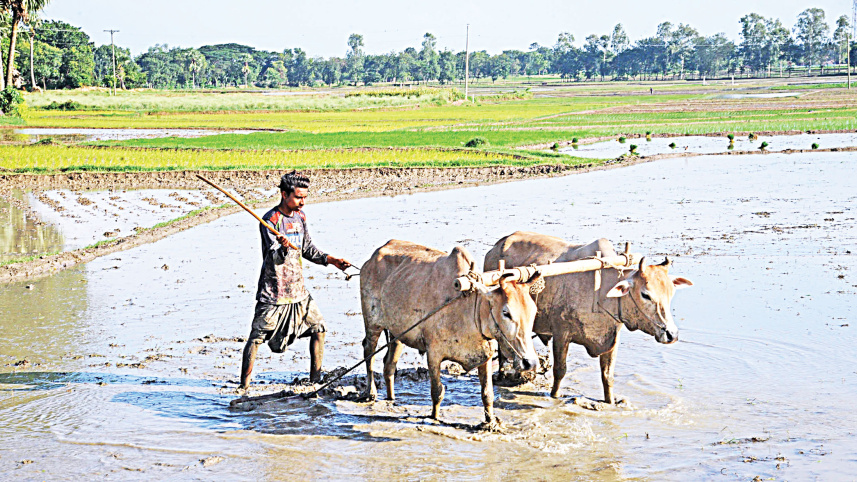
Bangladesh’s small-scale farmers, who make up more than half the country’s food producers, earn less than half the reported national average income, according to a new Bangladesh Bureau of Statistics survey published yesterday.
The Income and Productivity of Small-Scale Food Producers Survey 2025 found that small-scale producers make up 53.65 percent of all food producers, and large-scale producers make up 46.35 percent.

However, when it comes to income, small producers fall far behind the national average and further behind the large producers. As per the report, small producers earn an average of Tk 33,639 a year, against a national average of Tk 78,286, while large-scale producers bring home Tk 129,956.
The national average ends up much closer to what large-scale producers earn, masking how little most farmers actually take home.
The survey covered 12,879 households across all eight divisions and five agricultural sectors: temporary crops, permanent crops, forestry, livestock and aquaculture, BBS said in the report.
It defines small-scale producers as those in the bottom 40 percent nationally across three measures at once — land area, livestock holdings, and annual agricultural revenue. This category of producers operates an average of 33.5 decimals of land, compared to 123.5 decimals for large-scale producers.
Mohammad Yunus, research director of the Bangladesh Institute of Development Studies (BIDS), said the trend toward smaller landholdings cannot be stopped because people are gradually leaving the agricultural sector and moving into other professions.
“Economic development has helped reduce poverty because people have found alternative sources of income. However, for agriculture to remain sustainable, farmers must receive fair prices for their products,” he said.
The development expert stressed that introducing technology into agriculture is necessary to increase productivity.
“If farmers receive a fair return for their labour, similar to what they could earn in other sectors, they will remain engaged in agriculture,” he also said.
He warned that if farmers continue to leave the sector, the consequences will not be limited to them; urban populations will also be affected.
The BIDS research director identified three key requirements for ensuring food security.
He said, “First, farmers must receive fair prices so they remain committed to agricultural production.
“Second, the market system must be addressed, particularly by examining why prices increase significantly between the producer level and the consumer market, including issues related to syndicates and extortion.
“Third, agricultural productivity must be increased so that farmers can earn profits while ensuring food remains affordable for consumers.”
The survey also found that 84.5 percent, or Tk 28,421, of small-scale producers’ income comes from livestock, followed by aquaculture at Tk 12,670, forestry at Tk 10,892, temporary crops at Tk 4,591 and permanent crops at Tk 2,331.
MA Sattar Mandal, former vice-chancellor of Bangladesh Agricultural University, said this reflects high labour participation in livestock production among small-scale households.
He noted that since livestock includes both large animals and poultry, it generates employment and, as a household enterprise, has implications for family nutrition.
He added that as low income leaves households with no investable surplus, the productivity of small producers remains low too.
The survey separately measured productivity per labour day, revealing that small-scale producers generated Tk 1,494 in net value per labour day, compared to Tk 2,301 for large-scale producers.
 For all latest news, follow The Daily Star's Google News channel.
 By sector, small producers recorded higher productivity than large-scale producers in permanent crops (Tk 9,182 vs Tk 4,603) and forestry (Tk 6,518 vs Tk 4,656), while large-scale producers recorded higher productivity in aquaculture (Tk 13,074 vs Tk 7,429) and temporary crops (Tk 2,728 vs Tk 2,374).
By division, small-scale producers in Rajshahi recorded the highest average annual income of Tk 44,707, while those in Sylhet recorded the lowest, Tk 24,636. Sylhet was also the only division where large-scale producers formed the majority of food producers, at 60.01 percent. Chattogram and Rangpur had the highest shares of small-scale farmers, at 59.81 percent and 59.29 percent respectively.
The survey also found that female-headed households made up 10.7 percent of small-scale producers, compared to 4.7 percent of large-scale producers. Female-headed small-scale households earned an average of Tk 27,901 annually, compared to Tk 34,359 for male-headed small-scale households.
The survey was conducted to establish Bangladesh’s baseline for two UN Sustainable Development Goal indicators: SDG 2.3.1, which measures agricultural productivity per labour day, and SDG 2.3.2, which measures the average annual income of small-scale food producers.
Both indicators track progress toward SDG Target 2.3, which calls for doubling the productivity and incomes of small-scale producers by 2030. It is the second survey under BBS’s Sustainable Agriculture Statistics Project, carried out with technical support from the FAO.
Comments