


Phase out interest caps
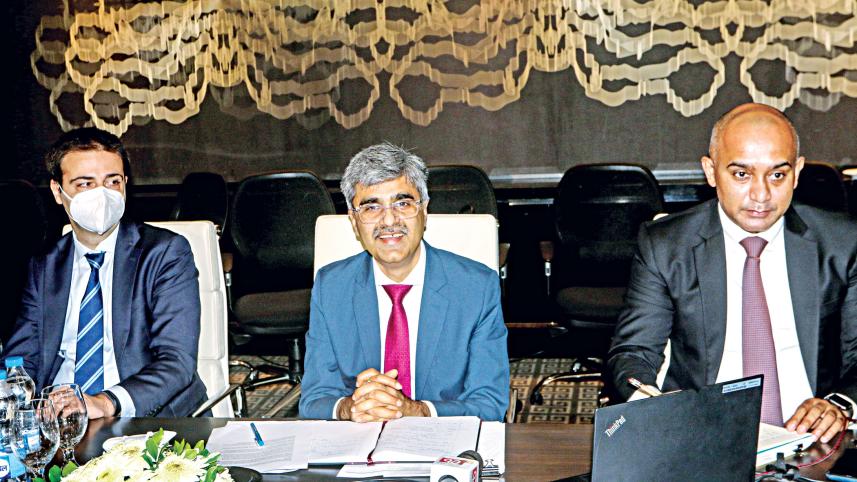
The International Monetary Fund (IMF) yesterday advised the government not to extend general forbearance to banks and corporations.
The Washington-based multilateral lender also called for phasing out the interest rate caps on lending and deposits.

It sounded the alarm about Bangladesh's ongoing economic recovery given the rapid spread of the latest variant of Covid-19, saying that it may have an adverse impact on the rebound.
The IMF also suggested the government widen its tax to GDP ratio, ensure exchange rate flexibility and strengthen the business-friendly environment to attract foreign direct investment (FDI).
An IMF team offered these recommendations during a press briefing at the InterContinental Dhaka after completing several meetings with different government entities and representatives of businesses, banks and labour unions.
Rahul Anand, division chief of the IMF's Asia and Pacific Department, led the team, which visited Bangladesh between December 5 and December 19 under the multilateral lender's Article IV consultation.
The IMF yesterday raised its projection on the country's economic growth for fiscal 2021-22 from 6.5 per cent to 6.6 per cent. However, the projection is still lower than the government's target of 7.2 per cent.
The GDP growth is expected to pick up further to hit 7.1 per cent in FY2022-23, the IMF said.
Explaining the slight rise in this year's growth forecast for Bangladesh, Anand said the country's export sector was doing well.
"We have seen lots of export orders being diverted from Vietnam, Myanmar, China and India to Bangladesh, and that is helping the country increase its export earnings," he said.
In addition, business activities, including that of the garments sector, have picked up, prompting the IMF to raise its projection.
"But, there are uncertainties around this because we still have half a year till the fiscal year ends.
The most important thing now is understanding how Covid-19 impacts the countries that are trading partners of Bangladesh," Anand said.
"Containment measures taken by those countries may have a big impact on the export earnings of Bangladesh and so, anything can go wrong," he added.
There will be domestic risks as well if Omicron causes a new round of infections. Besides, the price of oil and commodities has gone up in the global market, which may put pressure on the economy.
Reflecting non-food price inflation, which rose a 62-month high in October, and the recent hike in fuel prices, inflation is projected to be slightly higher than the central bank's target.
So, the central bank should keep a close watch on the inflationary pressure, said the IMF.
The IMF division chief went on to say that providing general forbearing during the peak of the pandemic was appropriate to support businesses as it helped spur economic recovery.
"Our advice is an orderly exit from all these relaxations that were given to the banks as well as corporations," he said.
In addition, proper identification of problem assets in the banking sector, which are mostly concentrated in the state-owned lenders, is highly important.
 For all latest news, follow The Daily Star's Google News channel.
 Bangladesh needs lots of investment but the high rate of non-performing loans has increased the cost of lending and hindered the smooth disbursal of funds.
In terms of corporate governance and other reforms, the authorities are now giving effort to amend five relevant laws, including the Banking Companies Act.
The IMF's advice aims to help align the best international practices while amending the five acts, according to Anand.
"This will strengthen the financial sector, which will play a major role in upgrading the country to middle-and-higher income status."
Meanwhile, interest rate caps on lending and deposit limit the policy space so they should be phased out to strengthen market-based pricing and improve credit allocation and monetary transmission.
Greater exchange rate flexibility together with safeguarding foreign exchange reserves will help buffer external shocks as well.
He also touched upon Bangladesh's tax to GDP ratio, which is one the lowest in the world.
"We have been discussing the issue with relevant authorities, who are very keen to fix the problem to raise revenue," Anand said.
As Bangladesh grows and becomes more integrated with the rest of the world, investors compare the country with other nations before making any investment.
So, Bangladesh should give emphasis attracting FDI as it is highly important in the context of gaining technology and integrating with the global value chain, said the IMF.
The country is now considered a success story as it made substantial progress in the last 50 years.
Bangladesh was once one of the poorest nations in the world but has since graduated from the situation, Anand said.
"This is a great achievement for the country, which is now fulfilling a good number of the Sustainable Development Goals."
However, a major portion of Bangladesh's export earnings still comes from garments and so, it is time to diversify the export basket, he added.
Comments