


Inflation edges up on food costs after fuel price hike
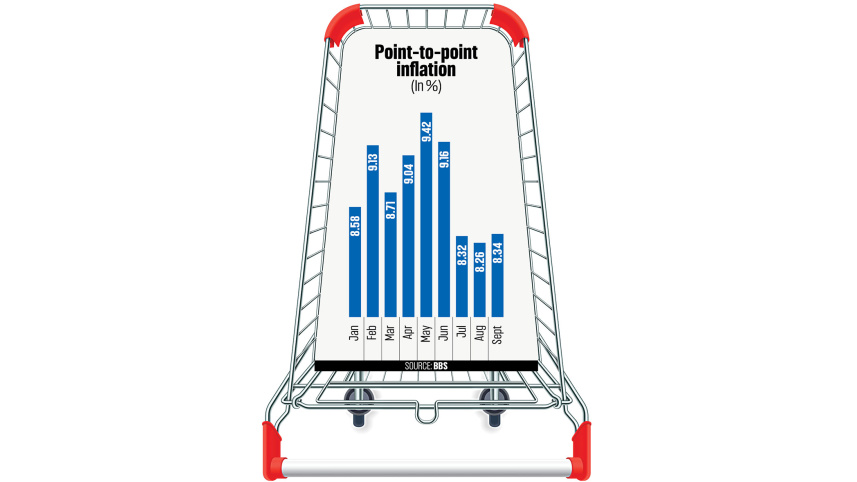
Inflation rose to 8.34 percent in September from 8.26 percent in August, ending two consecutive months of gradual easing as higher food costs pushed up overall consumer prices.
Food inflation increased to 7.22 percent last month from 7.02 percent in August, according to data released by the Bangladesh Bureau of Statistics (BBS) yesterday.

In contrast, non-food inflation eased slightly, falling from 9.32 percent in August to 9.30 percent in September.
Following the fuel price hike in the third week of September, price pressures mounted in both rural and urban areas. Rural households, however, faced higher price increases, with inflation rising to 8.38 percent last month, compared with 8.26 percent in cities.
Despite the monthly rise, September inflation was lower than the 8.36 percent recorded in the same month last year.
This means the disinflation process remains fragile, according to Deen Islam, a professor at the Department of Economics at Dhaka University.
Fahmida Khatun, a distinguished fellow at local think tank Centre for Policy Dialogue (CPD), said, “A small year-on-year decline in inflation is a good sign. But this does not mean prices have fallen.”
“People’s living standards will improve only when price hikes ease consistently for a longer period and wages begin to catch up,” she said.
Sectoral inflation data for September showed notable cost increases across key spending categories.
Restaurant and hotel prices recorded the steepest increase at 13.26 percent, up from 12.49 percent in August. Housing and utility expenses rose by 9.81 percent, while transport costs increased by 9.46 percent.
Over the 12-month period to September, the national moving average inflation rate stood at 8.65 percent.
For the current fiscal year, the Bangladesh Bank (BB) set an inflation target of 7.5 percent. The central bank in late September kept its main interest rate unchanged at 9.5 percent for the October-December quarter, saying inflation risks remained large and the economy was weak.
The BB said the risks included higher global energy prices, the ongoing conflict in the Middle East, the recent fuel price hike and implementation of the new pay scale for public employees.
The central bank said it would wait and watch before cutting rates again. On August 2 this year, the BB lowered the policy rate by half a percentage point to 9.5 percent after years of tightening.
According to the recently released World Bank’s South Asia Economic Update, inflation is projected to remain high at 8.6 percent in fiscal year 2026-27, staying above the BB’s target.
The Washington-based multilateral lender says surges in global energy prices, higher import costs and local currency depreciation are behind stubbornly high inflation in Bangladesh.
The World Bank said Bangladesh is South Asia’s most dependent economy on fertiliser imports, with such imports exceeding 0.4 percent of GDP, making its agricultural sector and food prices vulnerable to spikes in input costs.
The lender noted that Bangladesh used fuel subsidies to slow the direct pass-through of global oil price increases into domestic retail consumer prices as it sought to tackle inflation.
Prof Deen Islam said the government’s immediate priority should be to ensure that persistent high inflation does not impose a disproportionate burden on low-income households.
“Monetary and fiscal policies need to work together, while targeted social protection should shield the most vulnerable from the effects of elevated food and essential-service prices,” he added.
 For all latest news, follow The Daily Star's Google News channel.
 Similarly, Fahmida said the government should expand social safety net programmes during this difficult time.
“Programmes such as open market sales (OMS) should be available to poor and low-income households. Targeted energy subsidies should be given to vulnerable households,” said the economist.
Comments