


GPH Ispat seeks BB help to reschedule part of its Tk 12,000cr debt


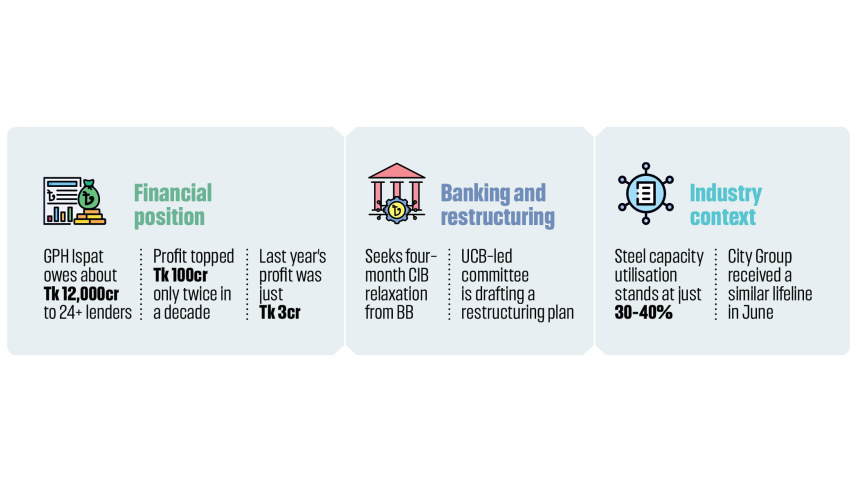
GPH Ispat, a listed steelmaker with liabilities of around Tk 12,000 crore, has asked the Bangladesh Bank to waive or relax Credit Information Bureau (CIB) requirements for four months as it seeks to restructure part of the debt owed to more than two dozen banks and finance companies.
In a letter to the central bank governor on September 24, the company said the bureau’s procedural and regulatory requirements were complicating its efforts to secure banking facilities and complete the proposed loan restructuring on time.

Earlier in June, City Group was given a three-month lifeline until September to restructure its outstanding loans following its request. City Group’s outstanding loans now stand at around Tk 25,000 crore, spread across 48 banks and non-bank financial institutions.
GPH Ispat said the CIB listing was affecting its working capital management and ability to keep operations running without interruption.
The CIB is the central bank’s database of borrowers’ credit histories. Banks consult it before approving new credit, meaning a borrower’s CIB status can directly affect access to fresh financing, including working capital.
The steelmaker has liabilities of around Tk 12,000 crore with more than two dozen banks and finance companies, including United Commercial Bank, Pubali Bank, Mutual Trust Bank, Trust Bank, City Bank, One Bank, Dutch-Bangla Bank, BRAC Bank, Eastern Bank, Modhumoti Bank, Sonali Bank, NRBC Bank, Meghna Bank, Southeast Bank, NCC Bank, Mercantile Bank and Uttara Bank.
The company said it was taking steps to strengthen its finances, improve liquidity management, regularise its dues and keep the business running.
A meeting on the issue was held at the central bank on September 13, led by the governor. It considered restructuring and rescheduling the company’s loans and credit facilities, as well as implementing a coordinated turnaround plan.
A committee headed by the managing director of United Commercial Bank has been formed to resolve the matter. At its meeting in September, the committee decided to prepare a realistic, coordinated plan to restructure the company’s overall liabilities.
Syed Mahbubur Rahman, managing director and CEO of Mutual Trust Bank, told The Daily Star, “We sat down with the BSEC chairman to discuss how the company can be supported.”
“In the country’s current situation, we must come forward to save companies like these,” he said, adding that work was under way. “We are considering giving them loan rescheduling or restructuring facilities, and looking at new working capital.”
GPH Ispat wants the relaxation to complete the ongoing restructuring and rescheduling, finalise documents and approvals with banks and financial institutions, arrange working capital to keep its normal business going, carry out its financial restructuring and deleveraging plan approved by regulators and lenders, and improve cash flow and its ability to repay and regularise its dues.
The company stressed that the request was aimed only at supporting its recovery and business continuity, not at evading or weakening any regulatory requirement. It said it remained committed to transparency with banks and compliance with all applicable laws, prudential rules and the BB directives.
The letter was signed by managing director Mohammad Jahangir Alam, who declined to comment when contacted.
An analysis of GPH Ispat’s financial statements shows that it made a profit of more than Tk 100 crore only twice in the decade since FY2014-15, while repeatedly expanding capacity with bank loans. Its profit margin remained mostly below 5 percent.
According to its audited report, GPH Ispat, which was incorporated in 2006, had long-term loans of Tk 4,718 crore and short-term loans of Tk 2,802 crore at the end of the last fiscal year.
Sales fell by around 30 percent year-on-year to Tk 3,940 crore. Despite the decline, the company posted a profit of Tk 3 crore, compared with a loss of Tk 24 crore in the previous year.
GPH Ispat’s annual production capacity includes 8.4 lakh tonnes of mild steel billets and 6.4 lakh tonnes of MS rods and medium sections.
In its FY25 annual report, the company said the country’s total annual steel production capacity was around 13-15 million tonnes, while effective demand had declined sharply, pushing capacity utilisation down to roughly 30-40 percent.
It described the mismatch between capacity and demand as a major short-term challenge for the sector. The situation did not improve in the last fiscal year.
 For all latest news, follow The Daily Star's Google News channel.
Comments