


Hike cigarette price at lower-tier to reduce health risks
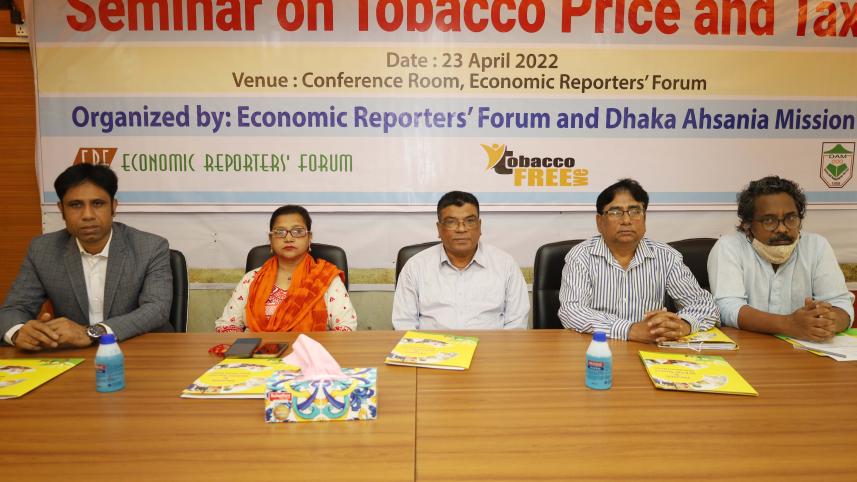
The price of cigarettes at the lower tier should be raised to boost revenue generation for the government as well as minimise health risks, speakers said at a seminar yesterday.
The Dhaka Ahsania Mission and Economic Reporters' Forum (ERF) organised the seminar titled "Tobacco Price and Tax" at the ERF auditorium in Dhaka. Speakers said that although the share of lower-tier cigarettes is almost 75 per cent of the whole industry, its price remained unchanged over the last two years.

As a result, the number of smokers at this level is not declining.
They also said the price of cigarettes should be increased considering the rise in per capita income and inflation.
There is no alternative to raise the price of tobacco products to turn Bangladesh into a tobacco-free country by 2041 as announced earlier by Prime Minister Sheikh Hasina, they added.
While presenting the keynote paper, Abdullah Nadvy, director (research) of Unnayan Shamannay, said the current duty structure for cigarettes is complex and it should be more simplified.
He proposed increasing the price of every cigarette packet of 10 sticks at the low-tier to Tk 50 from the existing Tk 39 while the price of the mid-tier cigarette packet should be TK 75 from Tk 63. Besides, Nadvy suggested raising the price of cigarettes at the high tier specifically.
"If this proposal is implemented, the government's revenue will be boosted while the number of smokers will be reduced by 13 lakh. Also, some 9 lakh youths will be discouraged to continue smoking," he added.
Mokhlesur Rahman, deputy director of the Dhaka Ahsania Mission, said the government has already announced its plans to turn Bangladesh into a smoking free country by 2041 and to materialise this, there is no alternative to raising the duty on cigarettes and tobacco products.
CTFK Grants Manager Abdus Salama Mia said that it is very much necessary to control the use of tobacco in turning Bangladesh into a developed country.
"This will not only help alleviate poverty but also reduce the cost of the government in addressing the tobacco-related diseases," he added.
ERF General Secretary SM Rashidul Islam said the government is in dilemma over tobacco as it wants to control tobacco on one hand while the government also depends on tobacco products for boosting revenue on the other.
"But in order to reduce the number of smokers, the price of cigarettes at the low-tier should be increased as around 75 per cent of smokers consume low-tier cigarettes," he added.
ERF President Sharmeen Rinvy presided over the programme.
Bangladesh is one of the largest tobacco consumers in the world, and nearly 8,400 crore cigarettes are sold annually. Some 35.3 per cent of adults in the country use tobacco products, according to the Global Adult Tobacco Survey (GATS) 2017.
Cigarettes are the biggest source of value added tax and supplementary duty for the government. It made up 30 per cent, or Tk 25,362 crore, of the total revenue in fiscal year 2019-20, down 8 per cent from Tk 27,618 crore the previous year, according to the NBR's annual report.
The average monthly expenditure for cigarettes was Tk 1077.7 and for bidis it was Tk 342, according to GATS.
A 2019 study by the Bangladesh Cancer Society showed that tobacco consumption caused 126,000 deaths in the country. The figure was 13.5 per cent of deaths from all causes in Bangladesh in 2018.
However, tobacco-induced deaths and diseases alone cost the economy around Tk 30,560 crore a year, which was equivalent to 1.4 per cent of the country's national GDP in 2017-18, the study finds.
 For all latest news, follow The Daily Star's Google News channel.
Comments