


Logistics woes stand in way of Ctg export hub

Bangladesh is betting on the Chattogram coast to power its next phase of export-led growth, with a wave of public and private investment reshaping the region into the country’s largest industrial corridor.
Once centred around Dhaka and Gazipur, industrialisation is now spreading across the two banks of the Karnaphuli and the coastal belt from Patenga and Anwara to Mirsharai and Matarbari.

While efforts are underway to attract more investment by expanding port operations, experts say the region continues to face broader infrastructure and logistics challenges, including poor road and rail connectivity, limited multimodal transport, inadequate logistics infrastructure and delays in completing supporting projects.
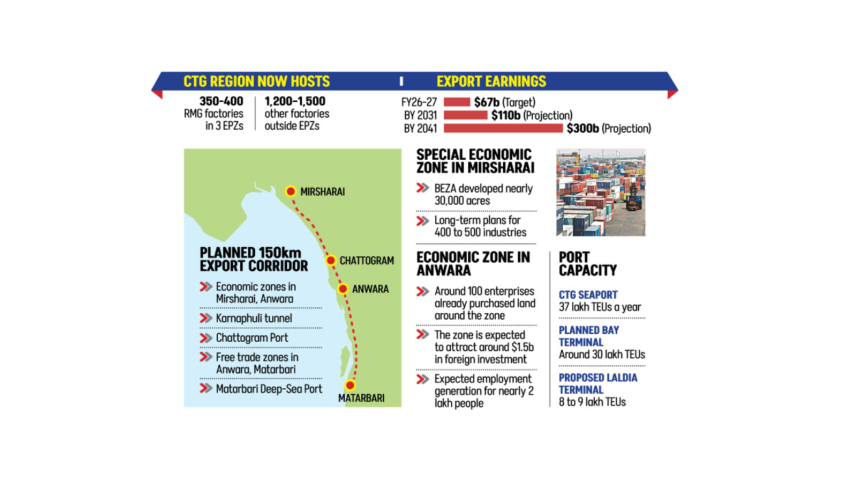
Government plans envision Chattogram as an integrated industrial-export corridor by 2031, supporting Bangladesh’s ambition to raise annual exports to more than $110 billion by then and over $300 billion by 2041.
That vision runs through the Perspective Plan of Bangladesh 2021-2041, the Export Policy 2024-27, and the development blueprints of the Bangladesh Economic Zones Authority (BEZA), Bangladesh Export Processing Zones Authority (BEPZA), and Chittagong Port Authority (CPA).
The Export Policy has set an interim export target of $67 billion for FY2026-27, but the longer-term strategy hinges on building a seamless production ecosystem where imported raw materials move quickly from port to factory and finished goods flow back to the port for export.
Economists and business leaders say the challenge now is no longer attracting factories alone, but ensuring the logistics system can keep pace.
“If industrial expansion continues to outpace logistics development, Bangladesh’s next major economic challenge will not be production capacity, it will be logistics bottlenecks,” said Dr Moinul Islam, former professor of economics at the University of Chittagong.
Once dominated by the Chattogram EPZ and Karnaphuli EPZ, the region has evolved into Bangladesh’s most diversified manufacturing base.
According to BEPZA, Chattogram EPZ has exported more than $47 billion worth of goods since its establishment in 1983, while Karnaphuli EPZ has contributed nearly $14 billion since 2006.
In FY2024-25, Bangladesh’s eight EPZs and the BEPZA Economic Zone exported $8.22 billion, with industries in the Chattogram region accounting for the largest share.
Outside the EPZs, Chattogram has also emerged as one of the country’s largest industrial clusters. Data from garment and knitwear exporters’ bodies and other associations suggest the region hosts around 350 to 400 export-oriented garment factories and more than 1,200 to 1,500 medium and large industrial establishments engaged in steel, cement, shipbuilding, textiles, cables, plastics, edible oil, pharmaceuticals, paper and food processing.
Combined, industries in the EPZs, the Korean EPZ and other export-oriented factories generate an estimated $15 billion to $18 billion in annual exports, roughly one-third of Bangladesh’s total export earnings, data from BEPZA and exporters’ associations showed.
150KM CORRIDOR IN THE MAKING
At the centre of the transformation is a nearly 150-kilometre industrial belt stretching from Mirsharai to Matarbari -- an unprecedented concentration of industry along the Chattogram coast.
The National Special Economic Zone (NSEZ), formerly the Mirsharai Economic Zone, is the country’s largest planned industrial hub. Spread across parts of Mirsharai and Sitakunda in Chattogram and Sonagazi in Feni, the zone is being developed by BEZA over nearly 30,000 acres, with long-term plans for 400 to 500 industries.
Further south, the China Economic and Industrial Zone (CEIZ) in Anwara is expected to attract around $1.5 billion in foreign investment and create employment for nearly 2,00,000 people.
The government has also approved Bangladesh’s first free trade zone in Anwara, designed not only for manufacturing but also for international warehousing, re-export, value addition and regional logistics services. Another free trade zone is planned around the upcoming Matarbari Deep Sea Port.
Industrial expansion in Anwara is already moving beyond the government-planned CEIZ and proposed free trade zone. Anticipating the area’s emergence as a major manufacturing and logistics hub, private investors have begun acquiring land for factories and industrial facilities.
The Karnaphuli Tunnel, together with the CEIZ project, has boosted investor confidence and accelerated private investment on the southern bank of the Karnaphuli.
 For all latest news, follow The Daily Star's Google News channel.
 “Around 100 small and large enterprises have already purchased land in Anwara outside the designated economic zone to develop manufacturing units and other industrial ventures,” Mohammad Mohsin Ul Alam Swapan, vice-president of the Chittagong Chamber of Commerce and Industry (CCCI), told The Daily Star.
“The growing private-sector response reflects strong business confidence in Anwara’s long-term potential as a major industrial, logistics and export hub.”
The government also plans to build a 150-kilometre coastal marine drive along the same shoreline, a project that could further strengthen connectivity across what is fast emerging as the country’s largest economic corridor.
PORT UNDER PRESSURE
Chattogram’s geographical advantage is central to the government’s export strategy. It combines the country’s largest seaport, international airport, industrial zones and manufacturing base within a single corridor.
“Geography has already given Chattogram a competitive edge,” said M Masrur Reaz, chairman and chief executive officer of Policy Exchange Bangladesh. “The challenge now is institutional efficiency. If transport, customs, ports and logistics are not modernised together, higher industrial investment alone will not translate into globally competitive exports.”
That challenge is already visible at Chattogram Port.
According to the port authority, the country’s busiest seaport handled a record 34 lakh TEUs (Twenty-foot Equivalent Unit containers), 13.8 lakh tonnes of cargo and 4,324 vessels in FY26. It now processes around 92 percent of Bangladesh’s seaborne trade and 98 percent of containerised cargo.
But its annual container handling capacity stands at only around 37 lakh TEUs, meaning utilisation has already reached about 95 percent, above the level at which ports often begin to face vessel delays, yard congestion and rising logistics costs.
To ease the pressure, the government is relying on several major projects.
The Bay Terminal is expected to add around 30 lakh TEUs of annual handling capacity and accommodate larger mother vessels carrying 8,000 to 12,000 TEUs, reducing Bangladesh’s dependence on transshipment through Singapore, Colombo and Port Klang.
The proposed Laldia Container Terminal would add another 8,00,000 to 9,00,000 TEUs, potentially lifting Chattogram Port’s capacity to around 75 lakh to 76 lakh TEUs.
Meanwhile, the Matarbari Deep Sea Port, under construction in Cox’s Bazar, will feature a 16-metre-deep navigation channel capable of handling large ocean-going vessels of up to 80,000 deadweight tonnes. Its first phase is expected to become operational around 2029-30.
BOTTLENECKS BEYOND PORT
Experts, however, say expanding port capacity alone will not be enough.
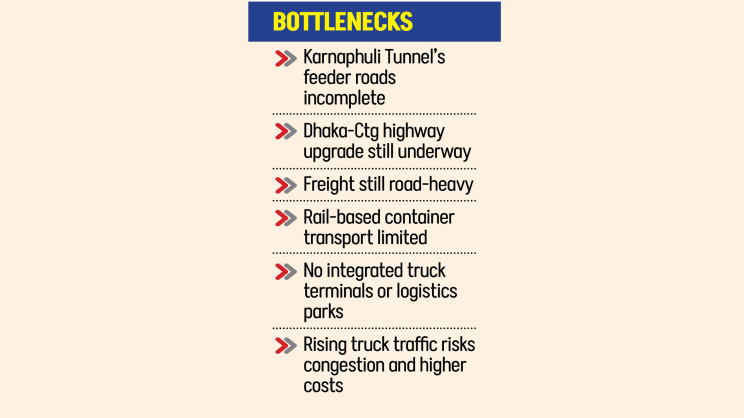
The Karnaphuli Tunnel has created direct road connectivity between Chattogram city and Anwara, the China Economic Zone, the Korean EPZ, the Bay Terminal and Matarbari, laying the foundation for industrial expansion south of the Karnaphuli. But many connecting roads and internal transport networks around the tunnel remain incomplete.
Likewise, although plans are underway to upgrade the Dhaka-Chattogram highway into a controlled six-lane expressway, freight transport still depends heavily on roads. Rail-based container transport remains limited, and Bangladesh still lacks integrated truck terminals, freight villages and large logistics parks around the port.
As industrial production expands, thousands more container trucks will enter and leave Chattogram every day. Without adequate truck holding yards and multimodal logistics facilities, congestion and transport costs could rise sharply even if port capacity increases.
“Bangladesh is entering a new phase of industrialisation, and logistics must be treated as a national competitiveness issue,” said Mohammed Amirul Haque, president of CCCI.
“Timely completion of the Bay Terminal, Matarbari Port, logistics parks, customs digitalisation and better road and rail connectivity will determine whether exporters can fully benefit from the country’s growing manufacturing base.”
Comments