


Four domestic airports see big drop in passenger traffic


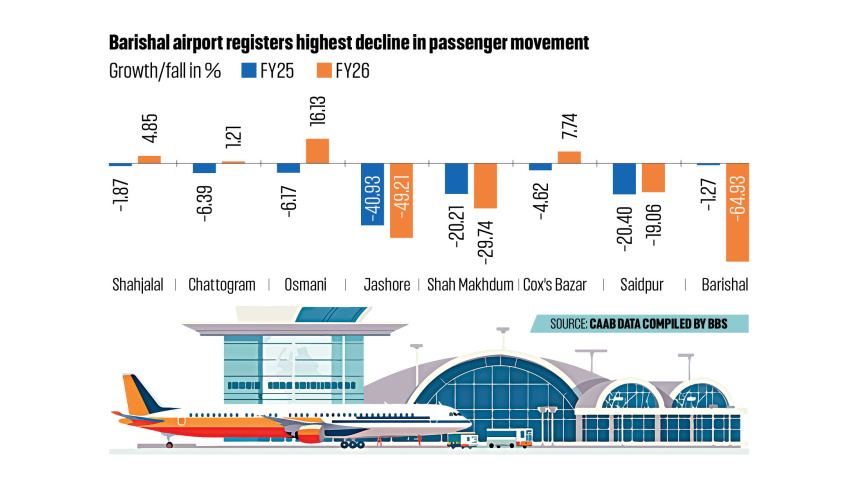
Four domestic airports have registered a gradual decline in passenger traffic as some travellers have shifted to road transport because of improved connectivity to several destinations and comparatively cheaper fares.
Passenger movement through Barishal, Jashore, Shah Makhdum in Rajshahi and Saidpur airports has been declining for at least the last two years. The other four airports -- Dhaka’s Shahjalal, Chattogram’s Shah Amanat, Sylhet’s Osmani International and Cox’s Bazar -- recorded a recovery in passenger movement in the last fiscal year following earlier declines.

Jashore, a border district in the southwest, saw the biggest slump in passenger traffic, followed by Barishal, as road travel times to the two destinations dropped significantly following the opening of the Padma Bridge in June 2022, which connected the south and southwest regions with Dhaka.
Jashore airport, which recorded 221,000 air travellers in fiscal year 2022-23, handled just over 92,200 two years later. During the July-May period of fiscal year 2025-26, the airport received around 44,000 passengers, down by half year-on-year, according to data from the Civil Aviation Authority of Bangladesh (CAAB).
Barishal airport handled 58,000 passengers in FY23. Two years later, the number had fallen to less than half. During the July-May period of FY26, passenger numbers slumped 65 percent year on year to 8,700.
The decline in passenger traffic through Shah Makhdum and Saidpur airports has been less severe than that at Barishal and Jashore. Rajshahi’s Shah Makhdum handled over 150,000 passengers annually two years ago. The number fell to 82,200 in the July-May period of the last fiscal year, a 30 percent drop year on year.
Saidpur airport in the northwest has also been registering a decline in passenger traffic. In the July-May period of the last fiscal year, it handled over 300,000 air travellers, a 19 percent fall from the same period a year earlier.
The decline in domestic air passengers was driven mainly by higher fares and improved road connectivity to several destinations, said Mes-Bah-Ul Islam, chief commercial officer (CCO) of Air Astra, the youngest private airline in Bangladesh.
“Another major reason is that some routes have become almost non-functional. The Barishal route has virtually closed as there are hardly any passengers, while Jashore, which used to be a major destination, now has only one or two flights,” he said, citing improved surface connectivity following the opening of the Padma Bridge.
“On the Jashore route, where utilisation was once 100 percent, it has now come down to around 10 percent. With Barishal almost closed and Jashore reduced to a minimum, the overall domestic passenger count has been affected,” he said.
Passenger numbers on the Saidpur route have also declined as road connectivity to the northern region has improved, he said.
CAAB data showed that Bangladesh’s airports handled over 1.58 crore passengers in the July-May period of FY26. Hazrat Shahjalal International Airport in Dhaka handled over three-fourths of the total. Shah Amanat International Airport in Chattogram accounted for 9 percent, followed by Cox’s Bazar airport.
Md Kamrul Islam, general manager (Public Relations) of US-Bangla Airlines, said passenger numbers on the Chattogram route have remained more or less unchanged, while US-Bangla is currently operating one more flight to Sylhet compared with the same period last year.
The largest private carrier, however, has reduced flights on the Saidpur route following a drop in passenger numbers.
“Passenger numbers on the Saidpur route have declined, and as a result, we had to reduce the number of flights and seat capacity,” Kamrul said.
On the Rajshahi route, US-Bangla had suspended flights for around one and a half months but has since resumed operations, currently operating six flights a week, he said.
Kamrul said the situation varies from route to route and there has not been a decline across all domestic sectors.
“For example, we have increased the number of flights to Cox’s Bazar because passenger demand is higher. It is not only US-Bangla; Air Astra has also increased flights on the route,” he said.
As part of its future expansion plans, the airline is also considering adding smaller aircraft suited to domestic operations to increase the number of flights, he added.
Air Astra’s Mes-Bah-Ul said airlines were trying to keep fares low despite the high price of jet fuel.
 For all latest news, follow The Daily Star's Google News channel.
 “Jet fuel prices are now at $165 or $166. Even then, we are not increasing fares. The highest fare to Cox’s Bazar was Tk 6,300, and it has now come down to Tk 4,300. We are keeping fares low, even at a loss, in an effort to retain passengers and increase passenger numbers,” he said.
Comments