


Foreign aid falls as debt repayments cut net inflows

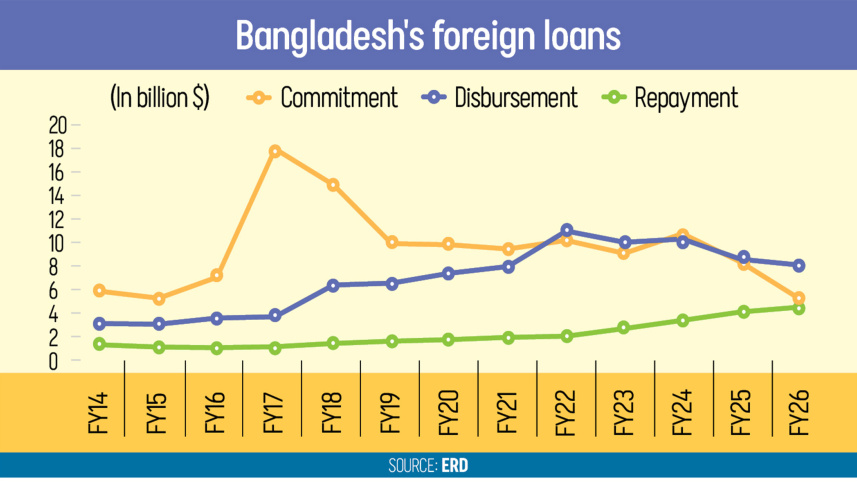
Foreign aid disbursements to Bangladesh fell in the last fiscal year while repayments on external debt continued to rise, reducing the country’s net inflow of foreign funds, shows government data.
Total foreign aid disbursements fell 5.8 percent year-on-year to $8.07 billion in fiscal year 2025-26 from $8.57 billion a year earlier, according to provisional data released by the Economic Relations Division (ERD) yesterday.

During the same period, external debt servicing rose 10 percent to $4.49 billion from $4.09 billion.
Economists say the trend could add to pressure on foreign exchange reserves at a time when high energy import bills, weaker export earnings and slower remittance growth are weighing on external finances.
In FY26, the net inflow of foreign funds fell to about $3.58 billion from $4.48 billion in the previous fiscal year, a decline of around 20 percent, according to ERD data.
The fall in disbursements was driven mainly by lower project assistance, which dropped to $8.02 billion from $8.52 billion, despite an increase in grants.
Of the total amount, about $3.5 billion was disbursed in June alone, with most of it coming as budget support. It points to a slowdown in regular project loan disbursements.
At the same time, debt repayments continued to increase as the country entered a period of higher repayments on external loans taken out in previous years.
Economists said Bangladesh needs to improve project implementation and speed up the use of committed foreign loans to support development spending while easing pressure on foreign exchange reserves.
The issue has become more pressing as the country continues to spend billions of dollars each year on fuel and other essential imports, making steady foreign currency inflows vital for maintaining external sector stability.
Despite a strong finish in June, export earnings for FY26 stood at $48 billion, down 0.58 percent from the previous fiscal year.
ERD data also show that foreign aid commitments fell sharply during the year. Total commitments dropped to $5.24 billion from $8.32 billion a year earlier, largely because of lower loan commitments for development projects.
Meanwhile, Bangladesh’s pipeline of committed but undisbursed foreign loans shrank to $39.26 billion, reflecting weaker fresh loan commitments.
Mustafizur Rahman, distinguished fellow at local think tank Centre for Policy Dialogue (CPD), said the figures reflect growing pressure on Bangladesh’s external sector as foreign aid disbursements slow while debt servicing obligations continue to rise.
“One of the main reasons for lower disbursements is weak implementation of ADP [Annual Development Programme],” he said. “Although nearly $3.5 billion was disbursed in June, much of it was budget support. Without that, total disbursements would have been even lower.”
Mustafizur said Bangladesh still has around $42 billion in committed but undisbursed foreign loans, highlighting the need to improve project implementation and speed up the use of the existing pipeline.
“Debt servicing will continue to increase as many large infrastructure projects undertaken around 2015 and 2016 have moved beyond their grace periods. We are now repaying both principal and interest, which is pushing up external debt servicing,” he said.
He said net external borrowing will continue to shrink unless loan utilisation improves.
“This will have negative implications for the balance of payments, foreign exchange reserves and exchange rate stability, especially if import demand picks up,” he said.
Mustafizur also stressed the need to negotiate future external borrowing on favourable terms, saying Bangladesh’s recent sovereign credit rating downgrade could raise borrowing costs.
 For all latest news, follow The Daily Star's Google News channel.
 “The government must improve ADP implementation, ensure projects are completed on time and deliver good value for money, while securing better borrowing terms from development partners,” he added.
The World Bank remained the country’s largest source of foreign aid in FY26, disbursing $2.07 billion, according to ERD data. The Asian Development Bank (ADB) followed with $1.91 billion, while the Asia, JEC and F&F wing provided $1.55 billion.
Europe accounted for another $1.31 billion in disbursements, while development partners under the America and Japan wing released $795.32 million.
Comments