


Election stirs stock revival hopes, but history says otherwise

Elections rarely spark dramatic rallies in Bangladesh’s stock market. The trend has been consistent at least in the last six parliamentary elections. Yet, stakeholders hope this time will be different.
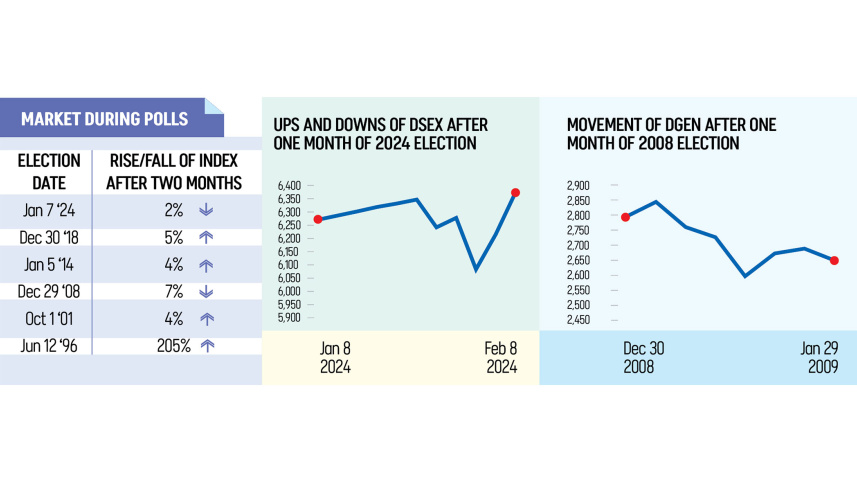
Analysing capital market trends for the last six parliamentary elections, The Daily Star found that only once, in 1996, did the Dhaka Stock Exchange (DSE) surge dramatically post-election, rocketing 200 percent within two months before crashing spectacularly.
 For all latest news, follow The Daily Star's Google News channel.
 Every other election delivered tepid results or outright declines. The 2008 and 2024 elections actually pushed the index downward.
The elections of 2001, 2014, and 2018 managed meagre 4-7 percent gains over two months, hardly the stuff of investor euphoria.
Most tellingly, the market’s greatest rally came in 2010, utterly disconnected from any electoral momentum.
Yet, DSEX, the benchmark index of DSE, has already climbed 460 points, or 9 percent, over the past month in anticipation of the 13th National Parliament Election slated for February 12.
Market analysts say many foreign investors are waiting for the election. They think investors will start to pour money into the market as some of the listed firms are now trading at low prices, and foreign exchange-related tension has also eased.
Saiful Islam, president of the DSE Brokers Association, believes this time genuinely differs.
“This time, foreign investors and institutional investors are waiting for investment. So, after a political government comes into power, the stock market will behave positively,” he said.
Fundamentally sound companies are trading at bargain prices, he argues, and once a government takes office, the market will respond positively.
But the current rally tells a less optimistic story. Junk stocks are dominating turnover and gainers’ lists.
One merchant banker put it bluntly, saying, “Although the stock market started to rebound, the elected government will have to bring good companies and ensure good governance in the market to keep the rising trend going.”
“Otherwise, the market will rise on the basis of some low-performing companies which will not be sustainable in the future,” he added, noting that junk stocks are taking place in the top turnover, and the gainers’ list currently.
Islam himself acknowledges the structural rot. “Sustainability of the market will depend on how many good companies the next government can enlist in the stock market, and whether they let institutions run independently.”
Proper reforms will also be necessary in the stock market framework.
On reform issues, he questioned the necessity of the swollen ranks of merchant banks and asset management companies in the country.
“A large number of firms are creating market distortion. So, a reform is necessary here,” he noted.
Comments