


DSE posts worst single-day fall in six years
The Dhaka Stock Exchange (DSE), one of the country’s two premier bourses, suffered its steepest single-day fall in six years yesterday, as investor panic deepened over conflict in the Middle East following Iran’s warning of attacks on ships passing through the Strait of Hormuz, one of the world’s most critical maritime trade routes.
The DSEX, the benchmark index of the DSE, plummeted 209 points, or 3.77 percent, to 5,325 on the day. The last time the index fell harder in a single session was on March 9, 2020, when it plunged 279 points.
 For all latest news, follow The Daily Star's Google News channel.
 The DS30, the blue-chip index, dropped 85 points, or 4 percent, to 2,050. Turnover rose 13 percent to Tk 885 crore. Among traded issues, 31 advanced, 349 declined, and 11 remained unchanged.
The declining trend extended to the Chittagong Stock Exchange (CSE), where the CASPI, the port city bourse’s main index, dropped 414 points, or 2.6 percent, to 15,085. At the CSE, 45 stocks rose, 153 fell, and 16 remained unchanged.
“The market tumbled mainly due to panic centring on the Iran conflict,” said Kazi Monirul Islam, CEO of Shanta Asset Management.
He noted that investors had initially expected the war to be short-lived following the killing of Iran’s supreme leader, which helped the DSEX recover 72 points on Monday after shedding 139 points on the first trading day after the conflict began. Yesterday’s sharp reversal suggests that sentiment has shifted.
“Investors now realise the war will have a lasting impact on the economy. Oil and gas prices are already rising, and fears intensified further with the threat of closing the Hormuz Strait,” Islam said.
“This creates deep uncertainty among investors about the profitability of listed firms. The impact was clear on the stock market index,” he added.
The selloff was exacerbated by a sharp fall in British American Tobacco Bangladesh (BATBC), which announced its lowest dividend in nearly a decade for 2025 after its profits fell 67 percent during the year.
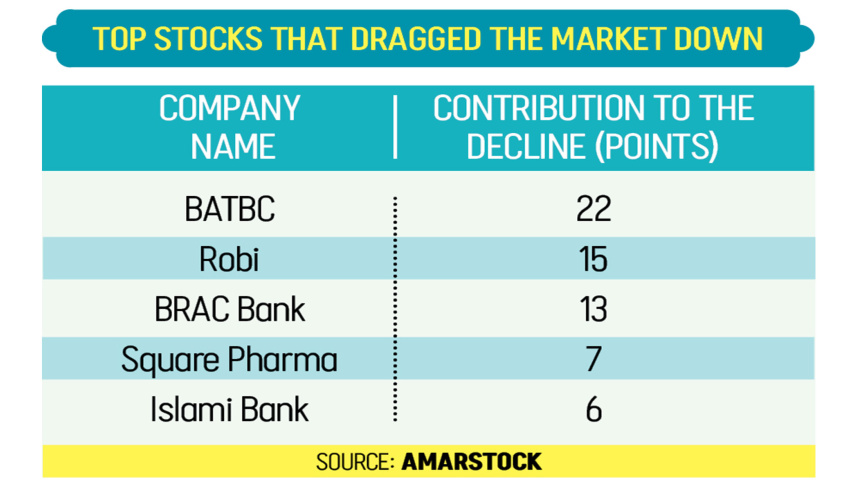
Islam noted that as one of the market’s largest-cap stocks, BATBC’s decline alone dragged the DSEX down by 22 points. The multinational tobacco company’s profit fell 67 percent in 2025, which contributed to a drop in its stock.
Robi Axiata, Brac Bank, Square Pharmaceuticals, Islami Bank, Beximco Pharmaceuticals, and Walton Hi-Tech Industries together contributed a further 51-point decline.
Islam also pointed to profit-booking as an additional pressure on the DSEX.
“Many investors had seen gains of 10 to 15 percent in their portfolios even though stocks remain undervalued. They are booking a profit even if they know the stocks are undervalued. This is common psychology, investors want to book profits,” he said.
Market analysts said the country’s economy is in a fragile state, making it especially vulnerable to the fallout from a prolonged conflict in the Middle East.
Bangladesh sourced over 50 percent of its LNG imports, approximately 3.6 million tonnes, from Qatar and the UAE in 2025, making its energy security acutely exposed to Middle Eastern geopolitics.
Comments