


Disease outbreak wipes out shrimp at 250 Batiaghata farms

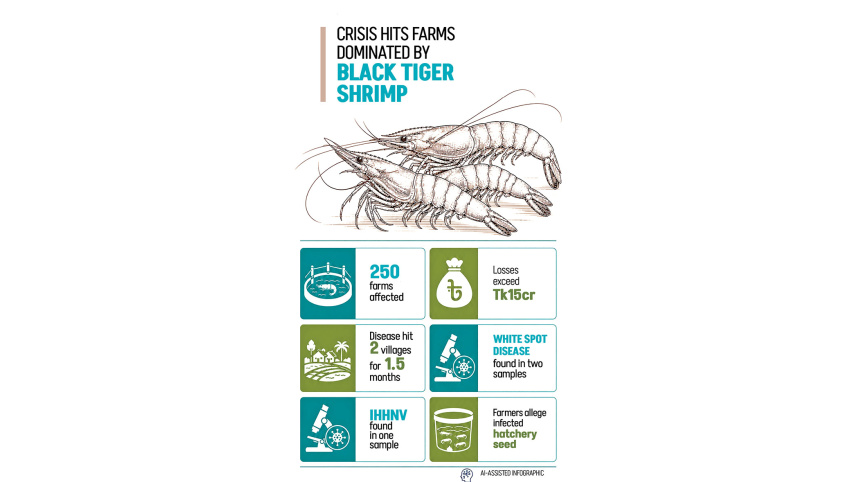
Disease outbreaks have destroyed shrimp across hundreds of farms in Batiaghata of Khulna, with farmers reporting estimated losses of more than Tk 15 crore over the past one to one-and-a-half months.
Some 250 of the 324 enclosures, or farms, in Dakkhin Soilmari and Khalishibunia villages have been affected, according to Molla Shamsur Rahman Shahin, president of the Fish Farm Owners Association Bangladesh (FOAB).

The losses come after a profitable year for farmers in the area, which is known for semi-intensive shrimp farming. Encouraged by last year’s profits, many farmers increased their investment this year.
Semi-intensive farming involves stocking shrimp at higher densities than traditional systems and requires greater investment in hatchery-bought seed, commercial feed, water-quality management and aeration. Black tiger shrimp, locally called bagda, is the dominant species farmed in such systems.
Bipradas Boiragi, a farmer in Chak Soilmari village, said he made around Tk 12 lakh in profit from shrimp farming last year. This year, he stocked 51,000 post-larvae, or young shrimp, from Fishtech Hatchery in his 48-decimal pond in late June. By August 14, the shrimp had started dying.
He eventually sold the survivors for Tk 42,000 after spending about Tk 1.5 lakh on seed, feed and pond preparation.
“I worked day and night, hoping the shrimp would survive and fetch a good price. But everything was ruined in the end. I feel completely broken,” Bipradas told The Daily Star.
Other farmers have reported similar losses. Lipton Mondal of Rakhi Fisheries said around 90,000 shrimp died, while Shubhankar Mondal and Kripa Gain each reported losing more than 100,000. Other farmers said they lost between 20,000 and 400,000 shrimp.
Farmers said they bought seed from two hatcheries, Fishtech and Desh Bangla, at around Tk 1,500 per 1,000 pieces.
They alleged that the seed was infected or of poor quality and that the shrimp died from white spot disease (WSD) and early mortality syndrome (EMS).
The owners of the supplier hatcheries rejected the allegations.
MA Hasan Panna, owner of Desh Bangla Hatchery, said seed-related problems can occur but argued that his hatchery should not be held responsible for shrimp dying two to three months after stocking. Disease-free seed, he said, still requires a biosecure farming environment to survive.
Fishtech Hatchery owner Tarek Sarker likewise denied that his hatchery’s seed was responsible, citing environmental factors and farm biosecurity. He said the company was investigating the matter and considering incentives for affected farmers.
Officials at the Department of Fisheries (DoF), meanwhile, suspect gaps in farm-level biosecurity and say it is unlikely that the seed was infected at the hatchery.
Md Badruzzaman, Khulna district fisheries officer, said the DoF sent three samples to a laboratory. Two tested positive for white spot syndrome virus (WSSV), which causes WSD, while one tested positive for infectious hypodermal and haematopoietic necrosis virus (IHHNV).
“The shrimp that died ranged from 42 to 84 days old,” he said. “If the fry were infected in the hatchery, then they would not have survived for so long.”
He said inadequate biosecurity at the farm level may have allowed infections to spread through humans, other animals, crabs or bird droppings.
The department also believes long-term farming practices may have contributed to the outbreak.
“Moreover, we saw that all these shrimp houses have been cultivated in the same way for a decade. Shrimps here needed crop rotation. Then it is possible to break the chain of disease,” Badruzzaman said.
Badruzzaman’s assessment is broadly consistent with shrimp pathology. A 2021 study in the Journal of Invertebrate Pathology found that WSSV can cause 90-100 percent mortality within roughly three to 10 days after an outbreak begins, a timeline also cited in a 2020 review in Reviews in Aquaculture.
 For all latest news, follow The Daily Star's Google News channel.
 The study also noted that WSD was first reported in Bangladesh in 1994 at a semi-intensive farm in Cox’s Bazar before spreading to Khulna in 1996.
IHHNV, meanwhile, affects shrimp differently depending on the species. Research published in Virus Research found that in black tiger shrimp, it is generally associated with chronic growth deformities known as runt-deformity syndrome rather than rapid mass mortality.
The DoF said it was advising affected farmers and recommending mineral supplements but had not announced hatchery inspections or a compensation mechanism.
A PROMISING MODEL UNDER STRESS
According to Shahin, Bangladesh has around 2.7 lakh hectares under shrimp cultivation, but planned semi-intensive farming is concentrated in only a handful of locations.
Shubhankar Haldar, a farmer from Khalishibunia, said converting agricultural land into a shrimp pond costs at least Tk 1.5 lakh per bigha before regular production expenses are added.
“We have to monitor the ponds around the clock. After spending so much money and working so hard, if the shrimp die, how can we recover the loss?” he asked.
Bangladesh produced around 3.15 lakh tonnes of farmed shrimp and prawn in FY24, rising to 3.26 lakh tonnes in FY25.
The country’s 46 black tiger shrimp hatcheries produced 882.68 crore seeds in FY25, while Bangladesh exported 23,237 tonnes of frozen shrimp worth Tk 3,041 crore during the year.
Comments