


Exports grew 13% in Aug on RMG rebound

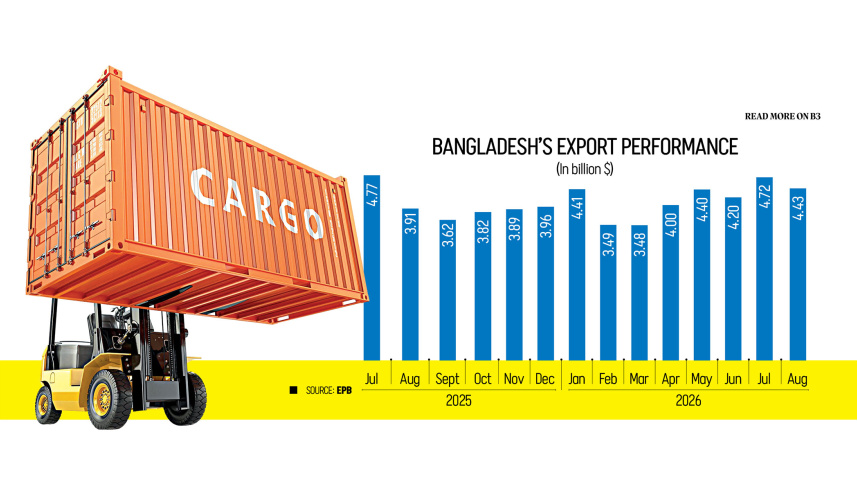
Bangladesh merchandise exports grew 13.14 percent year-on-year to $4.43 billion in August, driven by a rebound in garment shipments, according to official data.
With this, exports in the first two months of fiscal year 2026-27 rose 5.43 percent to $9.16 billion, from $8.69 billion in the July-August period a year earlier, according to the latest data published by the Export Promotion Bureau (EPB) yesterday.

The readymade garment (RMG) sector remained the main driver of growth, with exports rising 13.92 percent year-on-year to $3.89 billion last month. Both knitwear and woven garment shipments in August increased from the same month a year earlier.
The growth was supported by stronger demand in major markets, greater buyer confidence in Bangladesh as a reliable sourcing destination and expanded production capacity, the EPB said.
The bureau also said rising exports of higher-value products and efforts to diversify products and markets helped increase export earnings.
However, EPB data showed that exports fell 6.30 percent in August from the previous month. Export earnings stood at $4.72 billion in July.
In August, several non-RMG products also performed strongly, supporting the country’s export diversification efforts, according to EPB.
Among the major gainers were jute and jute goods, up 37.09 percent; pharmaceuticals, 28.52 percent; leather and leather goods, 24.85 percent; printed materials, 24.83 percent; engineering products, 23.88 percent; and other footwear, 15.29 percent.
Cumulative growth in July-August was particularly strong for printed materials, at 41.89 percent; pharmaceuticals, 38.94 percent; other footwear, 27.32 percent; and jute and jute goods, 22.26 percent.
The United States, Bangladesh’s largest single-country export market, recorded 26.09 percent growth in August, while exports to the country rose 11.90 percent in July-August.
The United Kingdom regained its position as the second-largest export market, followed by Germany, Spain and the Netherlands. Among emerging markets, exports to Türkiye rose 141.03 percent, while those to the Republic of Korea and Saudi Arabia increased 42.37 percent and 42.09 percent, respectively.
In July-August, exports of frozen and live fish fell 10.25 percent to $73.19 million. Agricultural product exports declined 9.10 percent to $158.78 million, plastic products fell 4.27 percent to $42.82 million, cotton and cotton products dropped 13.02 percent to $82.24 million, and man-made filament exports fell 10.56 percent to $63.29 million, according to EPB data.
Mohammad Hatem, president of the Bangladesh Knitwear Manufacturers and Exporters Association (BKMEA), said the export data is confusing because production has been hit by gas and power crises at industrial belts across the country.
He said he would scrutinise the data further to determine whether it is accurate, as production did not match the export figures.
Mahmud Hasan Khan, president of the Bangladesh Garment Manufacturers and Exporters Association (BGMEA), said export performance has not improved significantly in August.
He said garment exports stood at only $3.17 billion in August last year, following a decline in shipments to the US due to reciprocal tariffs and lower exports to the European Union.
“Against this relatively low base, the August 2026 export figure of $3.61 billion shows a higher growth rate, but export performance has not improved significantly,” said the BGMEA president.
Hasan said overall export growth in the first two months of FY27 stands at 5.12 percent, below the industry’s target.
“Given the ongoing gas crisis, high interest rates, and adverse global trade conditions, all combined in a period of severe challenge, this growth undoubtedly reflects the industry’s capability and resilience,” he added.
 For all latest news, follow The Daily Star's Google News channel.
Comments