


Clarify bank control return to former owners
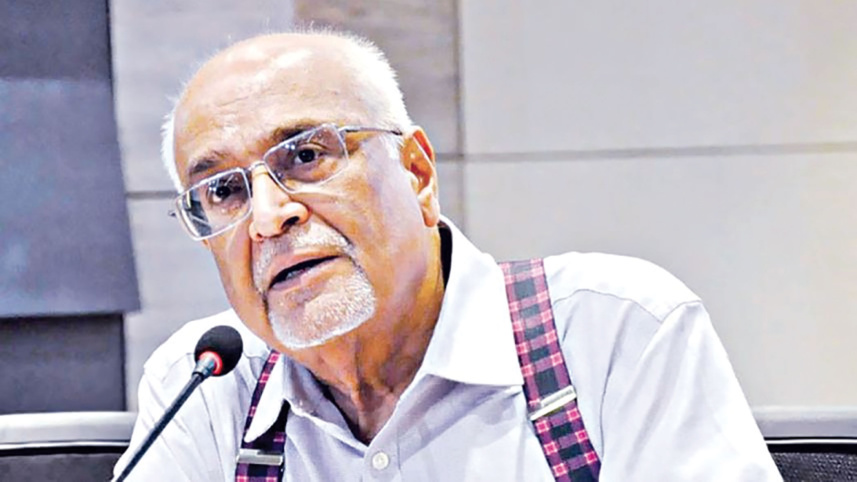
Economist Debapriya Bhattacharya yesterday urged the government to explain the intention behind recent revisions to the Bank Resolution Act, which now allow former owners to regain control of five Islamic banks being merged amid a severe liquidity crisis due to past irregularities.
At a session of the annual economists’ conference at BRAC Centre Inn in Dhaka, he said political authorities must set out their position in parliament and issue a clear statement explaining their intent.

Earlier this month, the House passed the revised Bank Resolution Act 2026, paving the way for former owners of the merging banks to reclaim control under relatively easy terms. The move has been widely viewed as a reversal of the interim government’s banking reform drive.
Under the law, former directors or owners can reclaim control by paying 7.5 percent of the funds injected by the government or the Bangladesh Bank upfront. The remaining 92.5 percent is to be paid within two years at 10 percent simple interest.
“I have no problem with the policy itself, but I want clarity,” Debapriya said at the conference organised by the South Asian Network on Economic Modeling (Sanem).
He said, “Even the central bank governor has not given a statement on this. So, instead of relying on our own interpretations, the authorities must speak.”
Debapriya, convenor of the Citizen’s Platform for SDGs, Bangladesh, said, “I am worried. I have already said over the past couple of days that we need a political statement on this issue. We need a discussion in parliament.”
“What we are doing now, what you, I, and others are saying, is based on our goodwill, but it is still just interpretation,” he said.
“I believe in political interpretation backed by commitment. That commitment should ensure that past problems or actors do not return. And this issue is not limited to today; it will affect the media tomorrow, and then oil and LNG imports the day after. It extends beyond banking; it affects the entire economy,” he further said.
“We have seen such patterns before. That is why I am looking for a clear political explanation, and wondering why the political leadership is silent,” added Debapriya, also a distinguished fellow at the Centre for Policy Dialogue (CPD).
He said the situation highlights a broader failure to pursue meaningful reform. If reforms are delayed further and pushed into a Five-Year Plan, the approach would be misplaced.
“Unfortunately, although I am also a member of that planning committee, I must say that now is the time for consolidation and reform in order to move forward,” he said.
Without reforms, including stronger revenue generation, better public spending and balanced deficit financing, he asked where the economy would go.
He also referred to findings in a white paper on the economy published by the interim government, which highlighted how deals were struck between politicians and businesspeople, especially around the Prime Minister’s Office.
Businesspeople observed such arrangements and thought, “Why shouldn’t I have a share in this?” he said, adding that some then tried to cut transaction costs by becoming directly involved, including awarding contracts to family members. Eventually, some even entered parliament themselves.
On the capital market, he suggested including not only multinational companies but also state-owned enterprises.
This, the economist said, could achieve two goals at once: raising funds in the short term, even if it feels like selling family silver, and strengthening the quality of listed shares to make the market more vibrant.
Researchers, businesspeople, economists, trade analysts and students from home and abroad took part in the discussion, which was moderated by Selim Raihan, executive director of Sanem.
‘BANK DEFAULT NOW EMBEDDED IN FINANCIAL SYSTEM’
At the session, Professor Rehman Sobhan, chairman of CPD, said banking reforms have been discussed since the time of President Ziaur Rahman, yet major defaults began then and have continued through successive governments.
 For all latest news, follow The Daily Star's Google News channel.
 Although it was once suggested that defaulters should not contest elections, laws were later introduced allowing them to do so if they made a 5 percent down payment and rescheduled loans.
This has resulted in a large group of defaulters in parliament who, he said, help block meaningful reform.
The CPD chairman added that bank default has now become embedded in the structure of the financial system and cannot be addressed simply by targeting a few crony capitalists.
He said legislation alone is not enough. Reforms must be translated into operational measures implemented by the bureaucracy, with outcomes monitored on the ground.
Prof Rehman Sobhan added that an active opposition should work with civil society to act as a watchdog over reform implementation. Ultimately, he said, the government must show genuine intent and build accountability from the Prime Minister’s Office down to the field level.
He said the ultimate test of accountability lies in the government’s willingness to subject its performance to a free, fair and inclusive election.
Mohammad Muslim Chowdhury, former Comptroller and Auditor General of Bangladesh, said that although banks such as Sonali, Janata, Agrani and Rupali were converted into public limited companies two decades ago, they continue to function largely as extensions of the government.
He suggested that these banks should be brought under a genuine corporate structure, merged if necessary, and eventually listed on the stock exchange after a thorough review of their asset quality and balance sheets.
He also called for bringing the Financial Institutions Division (FID) under the regulatory oversight of the Bangladesh Bank to prevent misuse of authority and strengthen supervision.
He further said the total number of banks should be reduced, with particular attention to those with weak balance sheets and negative net worth, through liquidation or other corrective measures.
Comments