


Budget boost targets entrepreneurs, tech innovators

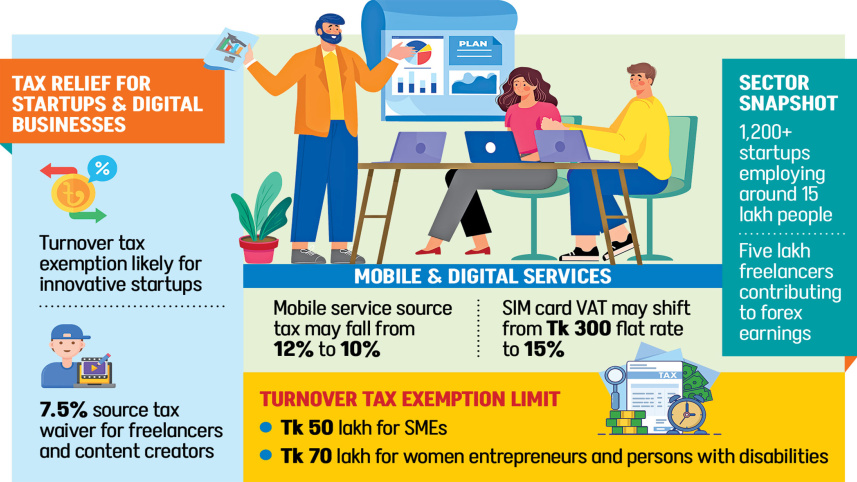
Startups and IT-based businesses may no longer have to pay turnover tax from the next fiscal year, as the government looks to encourage entrepreneurship and innovation.
Around 5 lakh freelancers and individual content creators are also likely to be exempt from the existing 7.5 percent source tax in the 2026-27 national budget.
 For all latest news, follow The Daily Star's Google News channel.
 In addition, the government is considering reducing source tax on mobile network services, such as phone calls, text messages and data packages, from 12 percent to 10 percent.
“A zero turnover tax provision is likely to be applicable for innovative startups, marking one of the most notable fiscal relaxations for the sector in recent years,” said a finance ministry official, seeking anonymity.
A startup is a newly established business, usually small, built around an innovative idea, product or service. Under tax law, annual turnover must be below Tk 100 crore to qualify in this category. Some well-known local startups include Pathao, Shohoz.com and Chaldal.com.
According to industry estimates, Bangladesh now has more than 1,200 active startups, directly and indirectly employing around 15 lakh people. These small businesses currently pay a 0.1 percent turnover tax -- a tax levied on the gross sales of a business regardless of expenses or profitability.
On the other hand, an IT-based business is any company that mainly uses information technology to deliver products or services, ranging from Facebook pages selling goods to mobile financial services such as bKash.
Regarding the budget boost for the telecom sector, finance ministry officials said the government plans to impose 15 percent VAT on SIM cards instead of the existing flat fee of Tk 300.
They said these measures are designed to support the country’s rapidly expanding digital economy at a time of intensifying global competition in the tech sector.
Finance Minister Amir Khosru Mahmud Chowdhury is expected to formally propose the measures while presenting the national budget in parliament on June 11. Officials said the proposals have already received in-principle approval from Prime Minister Tarique Rahman at a high-level meeting last month.
Industry people said removing the turnover tax could help new startups survive the critical early years, when many businesses struggle with cash flow and operational sustainability.
Former BASIS president AKM Fahim Mashroor said the decision would particularly benefit early-stage firms, allowing them to reinvest initial revenues into growth rather than tax payments, and that easing fiscal pressure could improve survival rates among early-stage companies.
Raisul Kabir, founder and chief executive officer of Brain Station 23, one of Bangladesh’s largest software firms, also welcomed the move, saying tax burdens often weigh heavily on businesses in their early stages.
Kabir said simplifying the tax structure would allow entrepreneurs to focus more on building products and scaling operations.
While welcoming the zero turnover tax proposal for startups, Pathao chief executive officer Fahim Ahmed said the eligibility criteria must be designed in a non-restrictive way so that companies generating meaningful revenues can also benefit.
He said previous proposals placed undue restrictions on operational duration and maximum turnover when determining eligibility.
Ahmed also called for a reduction in withholding tax and VAT withholding at source for startups and tech-enabled firms, saying most operate in informal sectors where vendors often do not have a tax or VAT footprint.
“The requirement to withhold taxes and VAT from such vendors results in a cost increase for such startups and ultimately limits scalability or risks passing such cost burden to the customers,” he said.
In the next budget, the government is also considering exempting income from annual turnover of up to Tk 50 lakh for SME entrepreneurs, and up to Tk 70 lakh for women entrepreneurs and entrepreneurs with disabilities.
To promote industrial decentralisation, it may introduce accelerated depreciation benefits for investment in plant, machinery and equipment for manufacturing, tourism and sports facilities outside the Dhaka and Chattogram city corporation areas.
The proposed incentive would allow businesses to claim depreciation at 60 percent in the first year and 40 percent in the second year.
Officials said the measures are aimed at boosting private investment, supporting small businesses and creating jobs across the country.
Comments