


Japanese buyers seek more apparel sourcing under EPA

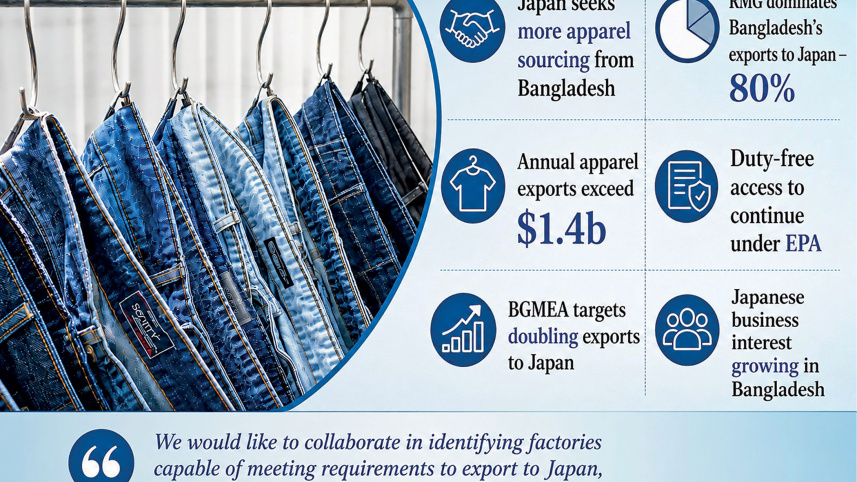
Japan is looking to increase imports of garment products from Bangladesh, with Japanese companies seeking local business partners to strengthen sourcing under the Economic Partnership Agreement (EPA) signed between the two countries.
The interest was expressed at a meeting held yesterday between leaders of the Bangladesh Garment Manufacturers and Exporters Association (BGMEA) and representatives of Japanese businesses, including officials from the Japanese Commerce and Industry Association in Dhaka (JCIAD), the Japan External Trade Organization (Jetro) Dhaka office, and the Japan-Bangladesh Chamber of Commerce and Industry (JBCCI).
 For all latest news, follow The Daily Star's Google News channel.
 The chairman and chairman-elect of the Apparels and Textiles Committee of JCIAD also attended the meeting to discuss potential sourcing opportunities from Bangladesh.
Both BGMEA and Japanese entrepreneurs are keen to deepen engagement between businesses in the two countries and strengthen partnerships to source more apparel products from Bangladesh, said Kazuiki Kataoka, country representative of Jetro Dhaka, over the phone after the meeting.
This was the first meeting between Japanese apparel entrepreneurs and BGMEA leaders. It is expected to pave the way for expanded business ties between Bangladesh and Japan, particularly through the proposed committee, Kataoka said.
“We would like to collaborate in identifying factories capable of meeting requirements to export to Japan,” the Jetro country representative said.
Suitable manufacturing facilities are needed to supply the right products and expand Bangladesh’s apparel exports to Japan, he said, adding that the country currently exports more than $1.4 billion worth of garment products to Japan annually.
Of Bangladesh’s total exports to Japan, around 80 percent comprise garment products, while the remaining 20 percent consists of other goods, he said.
Entrepreneurs from both countries are eager to see the EPA, signed on February 6 this year, implemented to elevate bilateral trade and investment, Kataoka added.
The membership of JCIAD has been growing steadily, reaching 163, reflecting Japanese businesses’ confidence in expanding operations in Bangladesh, he said.
Meanwhile, the Special Economic Zone (SEZ), dedicated to Japanese entrepreneurs in Araihazar, Narayanganj, has already become operational and is expected to accommodate more Japanese companies in the future. Japanese investors are seeking to expand or relocate operations to Bangladesh under Japan’s China Plus One strategy, adopted in 2008.
JBCCI President Tareq Rafi Bhuiyan Jun said a committee named Market Strategy for Development of Japan Markets has been formed to help expand trade and business relations between the two countries.
Japan could serve as an important market for Bangladesh as the country seeks to offset the slowdown in garment exports in recent months. Bangladesh is also looking to expand exports to Asian markets amid volatility in global supply chains. The newly formed committee and BGMEA discussed preparing a model list of BGMEA-affiliated supplier companies, he said.
Under the EPA, Bangladeshi garment products will continue to enjoy duty-free access to the Japanese market from the date of implementation. At present, Bangladeshi apparel exports benefit from preferential market access under the least developed country (LDC) category, and Japan has already extended these facilities until 2029 following Bangladesh’s graduation from LDC status.
BGMEA President Mahmud Hasan Khan said the association aims to increase garment exports to Japan to $3.0 billion from the current $1.4 billion within the next one to two years, with Asian markets such as Japan, South Korea and Turkey now receiving greater focus as part of export market diversification efforts.
Comments