


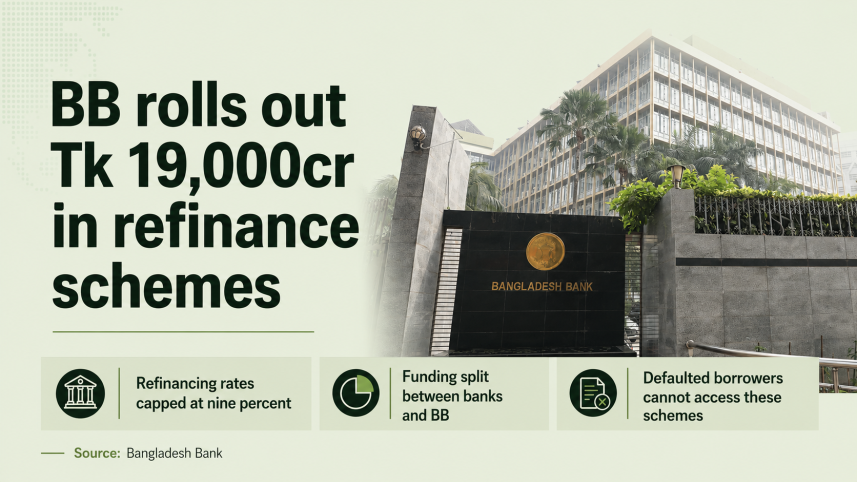
BB rolls out Tk 19,000cr in refinance schemes
Highlights
- BB rolls out Tk 19,000cr refinance schemes
- Four funds cover agri, CMSMEs and exports
- Initiative aims to diversify earnings, boost jobs
The Bangladesh Bank has launched four refinance schemes worth a combined Tk 19,000 crore to ease financing constraints on small businesses and farmers, stimulate green investment, generate employment and reduce the country’s heavy dependence on the readymade garment sector for export earnings.
The central bank announced the funds through separate circulars issued on June 7 and June 8, covering a Tk 5,000 crore working capital fund for cottage, micro, small and medium enterprises (CMSMEs); a Tk 3,000 crore export diversification scheme; a Tk 10,000 crore agricultural refinance scheme; and a Tk 1,000 crore green industries and factories fund.

Under all four schemes, participating banks may obtain refinancing from Bangladesh Bank at rates ranging from 2 to 4 percent and lend to customers at maximum rates between 5 and 9 percent, depending on the scheme.
Funds for the CMSME and the export diversification schemes will be drawn from the surplus liquidity of scheduled banks, while the agriculture and green factory schemes will be funded from Bangladesh Bank’s own resources.
The announcements come as businesses continue to struggle with high borrowing costs, liquidity shortages and weak demand, while policymakers seek to broaden the country’s export base and strengthen food security amid growing global competition.
Tk 5,000cr FOR CMSMEs
CMSMEs remain a key driver of Bangladesh’s economy through job creation, support for local industries and production of import-substituting goods. Yet many such enterprises struggle to secure adequate working capital, preventing them from operating at full capacity.
The revolving fund will stay operational for three years. It will cover working capital loans and investments extended to CMSMEs that cannot run at full capacity due to working capital shortages.
Renewed working-capital facilities will also qualify. Borrowers classified as defaulters in the Credit Information Bureau (CIB) database will not be eligible.
The central bank said the objective of the fund is to help businesses increase production capacity, strengthen economic activity and create both direct and indirect employment opportunities across the country.
Tk 3,000cr FOR EXPORTS
The export refinance scheme targets non-garment sectors, with the BB citing the economy’s heavy concentration in RMG as a vulnerability to sector-specific shocks and shifts in global demand.
Refinancing support will be available for industries listed under the highest-priority and special development sectors in the Export Policy 2024-27. Priority will go to producers and exporters using domestically sourced raw materials, particularly in jute and leather.
Financing will be in the form of term loans or investments in local currency. The scheme will run for three years and may include a grace period of up to six months, BB stated in the circular.
Borrowers must maintain a satisfactory credit record. Defaulters will not qualify, and applications will be rejected if export proceeds are not repatriated through the formal banking channel.
Participating banks will also be required to collect updated CIB reports before applying for refinancing support.
According to the BB, many export-oriented industries possess strong growth potential but have failed to expand because of inadequate access to financing. The refinance facility is expected to address this gap and encourage fresh investment in emerging export sectors.
Tk 10,000cr FOR AGRI AND LIVESTOCK
The scheme, the largest of the four, is aimed at boosting agricultural production, strengthening national food security and generating employment in rural areas.
Scheduled banks participating in BB’s agricultural and rural credit programme will receive refinancing at 4 percent and may lend to farmers and entrepreneurs at a maximum of 8 percent.
 For all latest news, follow The Daily Star's Google News channel.
 The five-year fund, financed from the central bank’s own resources, will be managed by its Agricultural Credit Department-1.
The scheme covers crop cultivation, fisheries, livestock, agricultural machinery, irrigation equipment and other income-generating agricultural activities.
Small and marginal farmers may obtain loans of up to Tk 5 lakh for crop production without collateral, against crop hypothecation.
Loan ceilings have been set at Tk 30 lakh for crop production; Tk 15 lakh for livestock and other agricultural activities; Tk 20 lakh for agricultural machinery; and Tk 1 crore for fisheries and livestock projects.
Banks will be required to maintain separate accounts, submit regular reports and ensure proper monitoring of loan utilisation and recovery under the scheme.
Tk 1,000cr FOR GREEN INDUSTRIES AND FACTORIES
The fund is designed to accelerate investment in green industries and environmentally sustainable factory buildings, in support of Bangladesh’s climate and sustainable development goals.
Under the scheme, banks and financial institutions will be able to access refinance support at a 2 percent interest rate -- the lowest rate among the four schemes -- and lend to eligible borrowers at a maximum of 5 percent.
The scheme’s tenure will range from three to 10 years, with a grace period of up to one year. The fund, sourced from Bangladesh Bank’s own resources, will take immediate effect.
The facility will finance the establishment of green industries and factory buildings certified or pre-certified under internationally recognised standards, including LEED, EDGE, BEEER and GreenARCH.
A single borrower may receive up to Tk 100 crore, with projects required to maintain a minimum debt-equity ratio of 70:30. Defaulted borrowers will not be eligible.
Participating banks and financial institutions must comply with the BB’s sustainable finance, environmental and social risk management, and climate risk management and disclosure guidelines.
MONITORING
To access any of the four facilities, scheduled banks must sign participation agreements with the BB and meet all relevant risk management and regulatory requirements.
The central bank will monitor fund utilisation through reporting requirements and on-site inspections. Misuse of funds, submission of inaccurate information or non-compliance with scheme conditions could result in cancellation of refinancing facilities and financial penalties.
Comments