


Amir Khosru vows not to print money to fight inflation
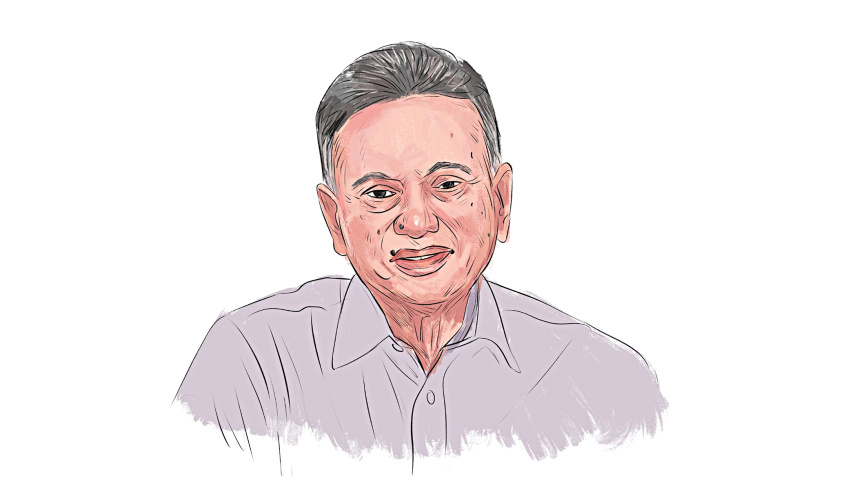
Finance Minister Amir Khosru Mahmud Chowdhury has pledged to avoid printing money to fund the government’s deficit and warned that creating “high-powered money” would trigger an inflationary spiral as the administration attempts to steer an economy battered by political cronyism and global shocks.
Speaking at a pre-budget discussion with representatives of the Economic Reporters’ Forum (ERF) at the finance ministry yesterday, he said the government was “doing its utmost to maintain its course despite navigating incredibly difficult times.”

“We are actively trying to prevent the ‘crowding out’ of the private sector. We must avoid creating an inflationary spiral by printing money,” Chowdhury said, describing this fiscal restraint as one of the foundational principles of the government’s economic policy.
The government strongly pushed back against recent media reports claiming that the central bank had printed Tk 20,000 crore.
During the discussion, Bangladesh Bank Governor Md Mostaqur Rahman dismissed the claims as “completely untrue,” warning that such misleading news harms the country’s sovereign rating and increases borrowing costs.
He clarified that fluctuations in the government’s “Ways and Means” advance account are normal working transactions.
Chowdhury echoed the governor, saying he felt “deeply saddened” by the rumours.
“During our political movement, we repeatedly protested against printing money and the government borrowing heavily from banks, which crowded out the private sector,” Chowdhury said at a separate pre-budget discussion with editors and senior journalists. “We cannot deviate from our manifesto promises.”
At the ERF meeting, Chowdhury blamed the country’s deep economic distress on a legacy of “political patronage” that had allowed the state to fall “into the hands of oligarchs.” This crony capitalism, he argued, allowed a select few to evade taxes with no barriers, causing the nation’s tax-to-GDP ratio to plummet from 11 percent to below 7 percent at present.
“The financial sector became so heavily politicised that banks have essentially been emptied, and the stock market was looted,” the minister said.
Outlining the scale of the crisis, Chowdhury warned that the private sector was now “severely undercapitalised.” Combined with sharp currency depreciation and high inflation, he said, business owners have been seeing their working capital erode, leading to widespread job losses.
Addressing pressure from multilateral lenders to quickly increase revenues, he offered a stark reality check. “Raising taxes right now is an extremely difficult task,” he said. “When institutions like the IMF and the World Bank push for a higher tax-to-GDP ratio, you must understand the situation before demanding reforms.”
“We cannot act like dictators and forcefully extract money from those who simply cannot afford to pay,” he said.
Instead, the government is focusing on restructuring the tax framework, which Chowdhury described as historically “half-baked -- much like an undercooked cake that is unfit for consumption.” A new committee has been formed to separate tax policy from execution, ensuring future policies “genuinely reflect the will of the people.”
To revive economic growth without fuelling inflation, the minister promised a sweeping deregulation drive to slash the “cost of doing business,” which he said is artificially inflated by port delays, customs bureaucracy, and road extortion. Deploying police to inspect consumer markets “will not solve the issue,” he said; instead, the government must “fix the supply chain.”
Chowdhury also outlined a strategy to “democratise the economy” by shifting focus toward small and medium-sized enterprises (SMEs) and the grassroots workforce. “We need mega-industries, yes, but the SME sector is the true engine of employment,” he said.
The administration is rolling out a “Family Card” scheme -- a direct cash transfer designed to empower female heads of households and alleviate poverty -- alongside a push for universal primary healthcare, which Chowdhury likened to an “indirect cash transfer” that protects households’ standards of living.
The minister pledged to restore the integrity of state data, referencing allegations that the Bangladesh Bureau of Statistics (BBS) had historically understated population figures
to artificially inflate per capita GDP.
“Institutions like the BBS must be kept entirely free from political interference,” he said. “I cannot simply summon BBS officials and dictate what numbers they should publish; their independence must be maintained.”
 For all latest news, follow The Daily Star's Google News channel.
 ERF President Doulot Akter Mala and General Secretary Abul Kashem also spoke at the discussion.
Comments