


AI trails traditional method in poverty targeting
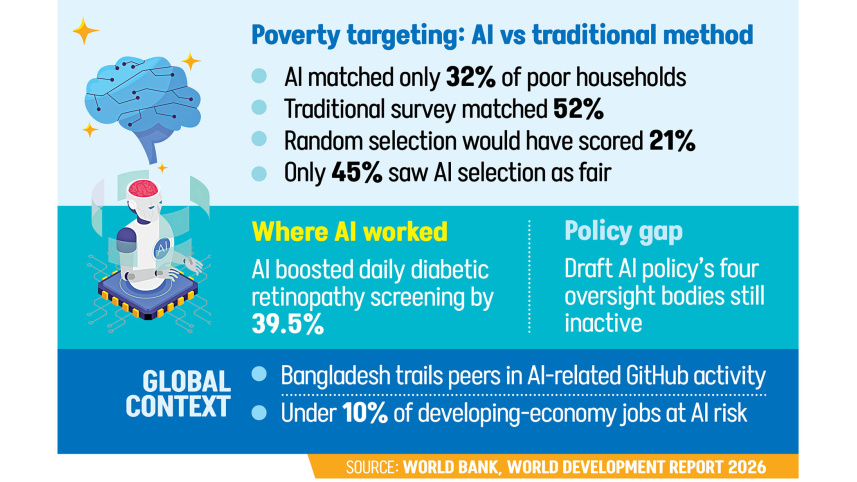
An artificial intelligence model, built using mobile phone data, matched only 32 percent of genuinely poor households in a large-scale trial in Bangladesh, compared with 52 percent for a traditional door-to-door survey method.
Even random selection would have scored 21 percent, according to the World Bank’s World Development Report 2026, titled The Promise of Artificial Intelligence.

The report is a global assessment of AI’s impact on developing economies, including Bangladesh.
THE TRIAL
The trial was run by the government, in collaboration with non-profit organisation GiveDirectly, as part of an effort to identify the poorest 21 percent of households for a cash-transfer programme.
Researchers first surveyed 5,000 households in person to determine the actual poverty rate. They then built two models to rank 106,000 potential beneficiaries.
One used the traditional method, called proxy means testing, which relies on asset ownership. The other, called phone-based targeting, used more than 1,500 data points drawn from mobile phone records.
According to the WB report, the traditional method performed better. Six percent of households could not be matched to phone records at all. Only 45 percent of recipients thought the phone-based approach was fair.
The WB said AI tools must be tested against local data before being used to make real decisions about people’s lives, as they can perform well in one setting and can fail badly in another.
DIABETES SCREENING: WHERE AI WORKED
The report was more positive about AI elsewhere in Bangladesh. AI-assisted screening for diabetic retinopathy, a leading cause of preventable blindness, raised the number of patients screened per day at Bangladeshi clinics by 39.5 percent.
The WB report highlighted this as one of only two examples worldwide of AI already improving public services in real time. The other was AI weather forecasts saving Indian farmers money in Telangana state.
BANGLADESH’S AI POLICY IS STILL BEING BUILT
The report also examines Bangladesh’s approach to AI governance, noting that Bangladesh built digital public services years before it had a national AI policy, through the ICT Division and the Aspire to Innovate programme.
A draft National AI Policy for 2026-2030 proposes four bodies -- a National Data Governance Authority, an Independent Oversight Committee, an AI Project Implementation Cell, and an AI Innovation Fund.
None of them had started operating by the time the report was published, it states.
OTHER FINDINGS ON BANGLADESH
As per the WB report, Bangladesh lags behind Pakistan, Nigeria and Vietnam in AI-related activity on GitHub, relative to its income level.
It notes that along with Cambodia and Vietnam, Bangladesh’s garment factories rarely use automated cutting and sewing equipment, as manual labour remains cheaper.
Regulatory compliance costs are a major obstacle for larger Bangladeshi firms adopting new technology, the report adds. “In Bangladesh, for instance, firms cite regulatory compliance costs as one of the top obstacles to adopting new hardware or software, especially among large firms.”
 For all latest news, follow The Daily Star's Google News channel.
 The WB also states that Bangladesh has opened its market to satellite internet providers such as Starlink, along with Brazil, Nigeria and Rwanda, to expand coverage.
Citing authorities, it states that Bangladesh has said it intends to ratify the Council of Europe’s AI treaty -- the first binding international agreement on AI.
Bangladesh is also among a small number of countries that have set up an outside advisory council to bring public feedback into AI policy, along with Canada and France, it adds.
The report’s broader outlook was positive for countries like Bangladesh. It estimates that fewer than one in ten jobs in developing economies are at risk from AI automation. In wealthy countries, the figure is more than a third.
About one in six jobs could be improved by AI rather than replaced, according to the report.
It notes that poorer countries do not need to build their own data centres or AI models. Small, offline-friendly AI tools are enough for most countries to start with.
Comments