


New budget faces revenue execution risks: Fitch
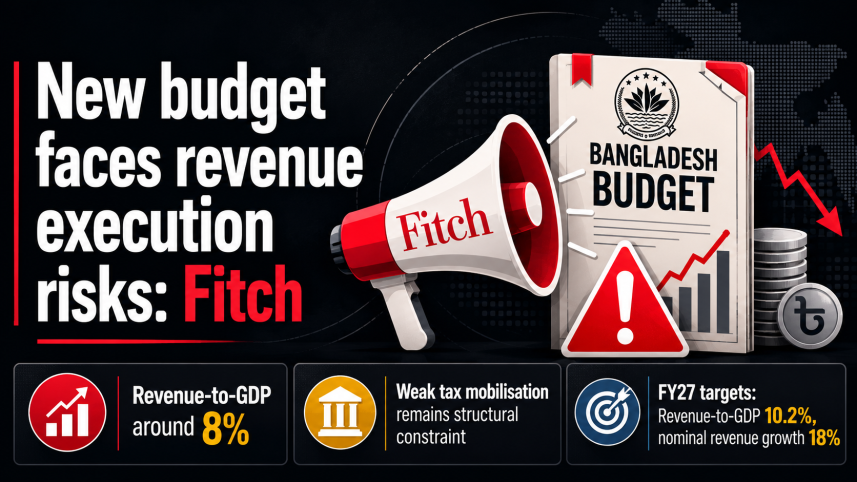
The first budget under the newly elected BNP government sets ambitious revenue targets that may prove difficult to achieve, given the country’s persistent constraints in tax collection and uneven progress in implementing reforms, according to Fitch Ratings.
In a report yesterday, the ratings agency said the budget for financial year 2026-27 aims to raise the revenue-to-GDP ratio to 10.2 percent from around 8 percent in FY26. If achieved, it would mark Bangladesh’s highest ratio since 1993.

Fitch said revenue collection would be the main test of the budget’s credibility. The government is targeting 18 percent nominal revenue growth year-on-year while planning to increase spending by 19 percent.
Measures proposed to boost collections include simplifying tax procedures, reducing tax exemptions, easing value-added tax compliance for small and medium-sized enterprises, and increasing non-tax revenue from government investments in state-owned enterprises, corporations and banks.
While these initiatives could broaden the tax base over time, Fitch said weak implementation has limited the effectiveness of previous reform efforts.
The pressure to meet revenue targets is heightened by the government’s spending commitments. Social protection and related programmes account for 29.7 percent of total expenditure, while physical infrastructure makes up 18.7 percent, reflecting the government’s election pledges.
However, Bangladesh’s history of underspending could help contain the fiscal deficit if implementation again falls short of budget plans, said Fitch.
The rating agency said measures aimed at the energy sector could support medium-term growth if carried out effectively.
More than 40 percent of the country’s electricity generation capacity is gas-based, and the budget prioritises domestic gas exploration, efficiency improvements across generation and distribution, and stronger infrastructure to support liquefied natural gas supplies.
In the face of global energy volatility triggered by the war in the Gulf, Bangladesh has requested a new programme from the International Monetary Fund (IMF).
Fitch noted that completing the final review of the current arrangement, which expires in January 2027, appeared unlikely.
It added that reaching agreement on a reform agenda could take time, meaning the credit implications of the FY27 budget would depend largely on whether the government could improve revenue mobilisation and investment execution.
The agency also questioned the government’s growth assumptions.
The authorities expect the economy to expand by 6.5 percent in FY27. Fitch, however, forecasts growth of 3.5 percent, citing continued fragility in the banking sector, weak private-sector credit growth, shortcomings in the policy framework and an uncertain external environment that continues to weigh on investment.
Fitch kept its FY27 fiscal deficit forecast unchanged at 3.6 percent of GDP, matching the government’s target. However, the agency said this reflects expectations of both lower revenue and lower expenditure than projected in the budget.
Fiscal performance in FY26 illustrated that pattern.
The revised deficit estimate for FY26 is reduced to 3.3 percent of GDP from the original 3.6 percent, supported by lower-than-expected spending disbursements. Revised revenue estimates are slightly above the budget target.
Fitch said this reduces the risk of near-term slippage on the headline deficit, but also underlines how difficult it may be to implement the FY27 budget in full.
Over the medium term, the agency said improvements in revenue collection and economic growth would depend on whether the government could deliver reforms more effectively than in the past.
The authorities aim to raise the revenue-to-GDP ratio to 11 percent by FY30-FY31, increase total investment to 40 percent of GDP and lift foreign direct investment to 2.7 percent of GDP. These measures are intended to boost real GDP growth to 8.5 percent while bringing inflation down to 5 percent.
 For all latest news, follow The Daily Star's Google News channel.
 The budget includes several initiatives intended to support investment and export growth.
The government has reduced withholding tax on machinery rental payments to non-residents to 7.5 percent from 15 percent, highlighted bridge and expressway projects, and continued to promote public-private partnership initiatives.
It has also retained the 2.5 percent cash incentive for remittances sent through formal channels and extended duty-free import facilities and bank guarantees for raw materials and intermediate goods to encourage export diversification beyond the ready-made garment sector.
Comments