


Corporate tax freeze may ease policy uncertainty: Selim Raihan
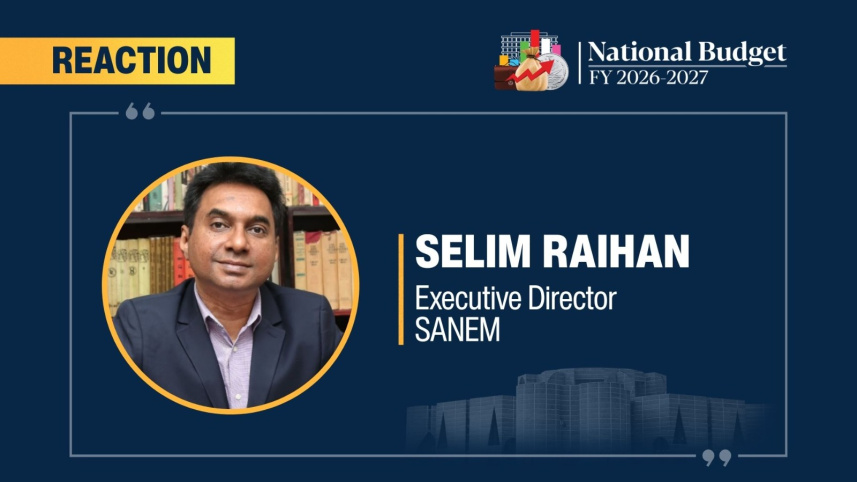
The investment incentive package proposed in the fiscal year 2026-27 budget sends a generally positive signal to both local and foreign investors, Selim Raihan, executive director of South Asian Network on Economic Modeling (Sanem), said today.
“Keeping corporate tax rates unchanged may help reduce policy uncertainty at a time when private investment remains weak, financing costs are high, external sector pressures persist and business confidence is fragile,” he said.

According to the economist, the proposed reduction in withholding taxes on interest payments for foreign loans and machinery leases is also a sensible move, as it could lower the cost of capital for industrial firms and make foreign-funded investment more attractive.
He said the proposals for Free Trade Zones, greater foreign ownership in off-docks and inland container depots (ICDs), and new frameworks for private investment in ports, terminals and air cargo facilities reflect a growing recognition of the importance of trade logistics.
“For an economy seeking export diversification and deeper integration into global value chains after graduating from the least developed country (LDC) category, efficient customs services, warehousing, ports and logistics are critical to competitiveness,” he added.
Raihan described the sector-specific incentives as ambitious. The incentives for renewable energy, electric vehicles, batteries, semiconductors, electronics, digital devices, startups, freelancing and content creation indicate the government's intention to steer Bangladesh towards a greener and more technology-driven growth model.
However, he cautioned that tax incentives alone are unlikely to create globally competitive industries.
Developing sectors such as solar energy, electric vehicles, semiconductors and advanced electronics requires reliable power supplies, skilled workers, testing facilities, intellectual property protection, predictable regulations, access to finance and strong supplier networks, he said.
The economist noted that Bangladesh has often offered fiscal incentives without putting in place the institutional and technological foundations needed for long-term competitiveness, raising the risk that some incentives may encourage import-dependent assembly activities rather than genuine industrial upgrading.
The incentive package for the semiconductor sector, in particular, should be approached with caution, he said, adding that without a realistic strategy focusing on areas such as chip design, testing, packaging and electronics-related components, the initiative may remain largely aspirational.
He also raised concerns about the fiscal implications of a broad range of tax breaks and exemptions at a time when Bangladesh continues to struggle with a low tax-to-GDP ratio.
According to Raihan, incentives should be time-bound, transparent, performance-based and subject to regular review. Companies receiving benefits should be required to meet measurable targets in areas such as investment, employment generation, exports, technology transfer and energy efficiency.
The Sanem executive director described the proposed accelerated depreciation facility for investments outside Dhaka and Chattogram as a promising initiative.
However, he said its success will depend on improvements in logistics, utility services, land access, skills development and local administrative support in other regions.
Overall, he said, the budget's investment strategy is moving in the right direction.
“It seeks to lower investment costs, attract foreign direct investment, support green and technology-based industries and address logistics bottlenecks,” Raihan said.
Its success, however, will depend largely on effective implementation, regulatory consistency and the government's ability to align incentives with a broader industrial development strategy, he added.
 For all latest news, follow The Daily Star's Google News channel.
Comments