


49pc women married off without their consent
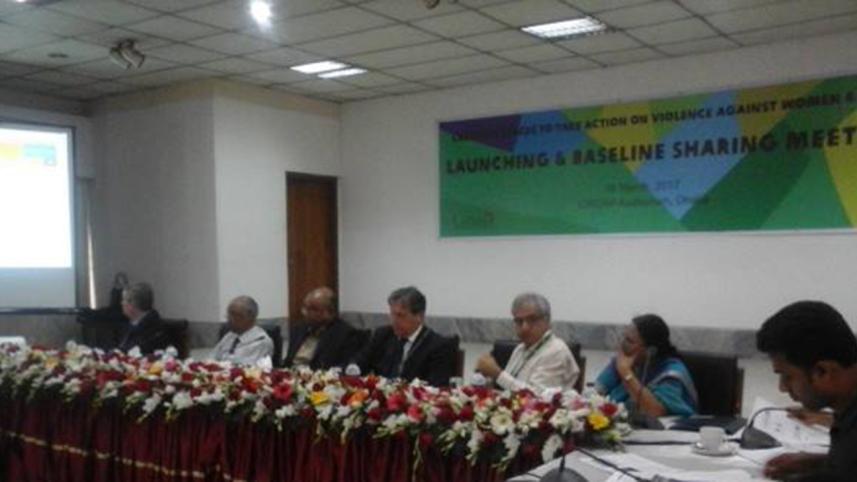
Forty-nine percent of women had not given consent to their parents to go ahead with their marriages, according to the recent findings of a baseline household survey conducted by Oxfam in Bangladesh.
However, only four percent of men surveyed had the same experience. Both male and female respondents in the survey claimed that the marriages were mostly arranged by their parents.

The survey findings were revealed at a programme organised by Oxfam at the capital's Cirdap auditorium yesterday. The survey was conducted among 330 households in four districts -- Dinajpur, Tangail, Netrakona and Tangail -- between October and December last year.
It was part of a project titled “Creating Spaces to Take Action on Violence Against Women and Girls” funded by Global Affairs Canada. Oxfam will implement the project between June 2016 and May 2021. The project will also be implemented in India, Indonesia, Nepal, Pakistan and the Philippines.
The findings said, “Average age at first marriage for men was 24 years and for women it was 16 years.”
About the right age for girls to be married, 25 percent female respondents said girls should be married after the age of 20, while only four percent of the male respondents opined so, it mentioned.
“Overall, only 50 percent of the respondents thought that girls should have the right to choose when to marry.”
The majority of the respondents (66 percent female and 42 percent male) had education up to primary level.
Nearly half the respondents mentioned that the husbands have right to force his wife to have sex even if she did not consent, the survey claimed.
“When asked what a woman could do if she was facing marital rape, 92 percent of the male respondents stated that a woman could do nothing,” it said.
The survey found that male respondents, irrespective of their level of education, strongly believed that it was common in their community for a husband to physically assault his wife such as slapping or beating if she went out without telling him, used family planning or questioned him about spending money.
When asked about household decision-making, at least 59 percent females stated that their husband made the decisions about household expenditure and children's education, while 61 percent male said they made these decisions themselves.
While all the male respondents stated that they were involved in economic activities, only 40 percent of the female respondent said they were, it said.
Moreover, when respondents were asked if women should be allowed to work to earn a living, nearly all the respondents said they should. But only 69 percent believed that women should have the right to spend their income.
Speaking at the programme, Canadian High Commissioner in Bangladesh, Benoît-Pierre Laramée said they had observed that there were concerns in the Child Marriage Restraint Act-2017 which had been passed in parliament.
There must be monitoring of the implementation of the law, he added.
Law and Justice Division Secretary Abu Saleh Sheikh Mohammad Zahirul Haque said there was no scope for enjoying exceptions in the new law and that only court would decide the “exceptional” cases of marrying off girls below 18 years of age.
He asked all to report if there is any child marriage and that they would take stern actions against the offenders.
Oxfam Bangladesh Country Director Snehal V Soneji moderated the programme. Chief Executive Officer and Chief Editor of Ekushey Television Monjurul Ahsan Bulbul and Project Director of the Multi-Sectoral Programme on Violence Against Women Abul Hossain, among others, also spoke.
 For all latest news, follow The Daily Star's Google News channel.
Comments